Indian Summer

The fall sings in full chorus, but it speaks in a whispered word. A scarlet leaf of a sourwood tree whirls in the front yard, then smacks against the porch screen. It holds there, flattened and pinned by the warden wind like a captive pleading with me. Then, after a few seconds, it is yanked away.

It was like the Monarch butterfly I saw on the gravel road, displaying and folding the only bright color of that moldy November morning. The leaf, the butterfly. What were they trying to tell me?

The trees in chorus are something else. They fill the air in harmony, but like a church chorale, the words are hard to discern, English or Latin. In the meadow framing the woods, in this Indian summer sunshine, millions of particles are swirling with the warm breezes. I wonder if they are an offshoot of the uncut grasses, the rusty stalks as tall as fawns. I investigate.

They are insects, countless hoards. An infestation, but harmless. Ladybugs. Herman says no, they are kudzu bugs, swarming because the highway department killed off too much kudzu. I know they’re ladybugs, harmless but with hardshell wings. Their bright yellow or orange bodies, freckled in black (the Monarch’s black borders were freckled in white dots), hit me in the face and hands, so drunk on sunshine they were. Maybe they aren’t so harmless in this infestation. How can so many be around on just this last day or two of warmth in early November? Nature explodes, showing her potential for incredible abundance, or plague. And in contrast, a lone prophet tries to tell us, Prepare for one or the other.

Speak up. I don’t understand.

I lifted the Monarch off the road and set it on a crooked tree. The next day, it was still there, still barely alive. At least the slow wing motions seemed to show signs of art and life.

We like to imagine that the natives who were here before Europe invaded and settled were more attuned to Nature’s words and music. But they had their plagues, wars and hungers. David J. Silverman’s “This Land Is Their Land: The Wampanaug Indians, Plymouth Colony, and the Troubled History of the First Thanksgiving,” depicts an epoch of abundance for the red tribe of Cape Cod. Their God, Kiehtan, had been good. They mastered the maize horticulture that had spread across Indian culture from Mexico for a thousand years, but balanced that with summer fishing, and winter hunting. The women were in charge of edible plantings, which held female spirit and allowed for child raising, while the males were into fishing, hunting, tobacco, and war. They learned of the spirit world from dreams that one of their two souls could visit while the other kept the body alive. And in a special way, for males, from a rite of passage that involved fasting, sleep deprivation and ingesting of emetics and hallucinogens (Bradford’s history, p. 190).

But they were devastated by an epidemic around 1618. So when the Mayflower arrived in Plymouth in 1620, the Wampapaug sachem was ready for trading – which held promise of mutual benefit as well as symbolic meaning for a good relationship. Theirs was a gift economy. Our economy today has some of this understanding, mutual benefit in regulated commerce. But we tend to squash it with fear, distrust and not getting the symbolic, human part.

Phinizy Spalding’s “Oglethorpe in America” also tells a story, from 110 years later and down here in Georgia, of a benevolent and fairly equitable relationship between the colony’s founder and the Creek Indians. The Indians welcomed the treaty Oglethorpe negotiated on friendly terms, and they granted lands that they didn’t use for hunting and living.

The settlers were given to mistrust and fear, but an initial impulse for openness and mutual respect among leaders of both groups laid a good foundation. At least among leaders like the Wampanaug sachem Ousamaquin, the Creek leader Tomochichi, the “Pilgrims” Edward Winslow and Stephen Hopkins, and the last English knight errant James Edward Oglethorpe. (See Michael L. Thurmond’s “James Oglethorpe, Father of Georgia: A Founder’s Journey from Slave Trader to Abolitionist.”)

Posted in Uncategorized | Tagged , , | Leave a comment

For Better or Verse

Living for a couple of seasons in forested hills, our miniature “lake country” of North Georgia, is more than poetic. It is where we turn around on a trail when we hear the low growl of a mama bear, or marvel at the insane chorus of coyotes before dawn. It is where poetry happens, as it did for Wordsworth in his Lake Country.

I once asked a good published poet why she wasn’t writing poetry anymore. It takes too much time, she said. For her, it took about six months between even short poems, and she was too busy being a college dean.

I know what that means. But I have learned that other things are needed besides time to make poems: A little solitude and an interior life; a lot of reading and hearing of poems, and living close to nature and the seasons, away from town. Robert Graves said this about Robert Frost living for 10 years as a (not very successful) New England farmer: “The four natural objects proper to poems are, by common consent, the moon, water, hills and trees; with sun, beasts and flowers as useful subsidiaries.” He didn’t mean only as pretty objects in the poems, but also as the lived-in ecology of the writer.

One other thing is a frameable experience. This can be a burst of consciousness. Or it can be something as dramatic as Hurricane Helene’s devastation in parts of the Southeast last year.  Poems that writers made out of that are collected in a new anthology, Had I a Dove: Appalachian Poets on the Helene Flood, edited by Hilda Downer, who is holding a series of readings around Appalachia. Last night, one was at Blacksburg Books. Tonight, from 6-7 p.m., there’s one at Black Mountain Library. I am glad to see the names of so many poets who will be there (and sorry I won’t join them, though I have a poem in the book): Ginger Graziano, Clint Bowman, Andrew Mack, Gene Hyde, Paige Ghilchrist, Michael Conner, Nancy Martin-Young, Pat Riviere-Seel, Rob Masterson, Whitney Waters, Lee Stockdale, Patricia Crittendon, Laurie Wilcox-Meyer, Paul Kanowski, Jennie Boyd Bull, Amy Tilley, Barbara Conrad, Hilda Downer.

It feels like I’m not doing much here in the mountains. But I do see that I’m writing a poem now and then, more than I used to. Here’s one, from a canoe trip my brother Walter took me on, on the Chestatee River out of Dahlonega.

On the River

A six-legged creature dents a surface that holds,
Making six giant craters in the smooth river shoals.
Then sensing a shadow with globular eyes,
It leaps, to be killed by a dragon that flies.

A million years later, or was it just now,
Two brothers are paddling, one stern and one bow.
The stern one is younger but like his canoe
Knows currents of rivers unknown to his crew.

Connecticut’s head in Vermont, just last week,
Was still in his blood on this slow Georgia creek.
No traffic, small eddies, mud turtles, all sorts,
Guitar for a bow sprit, his dog between thwarts.

Rivers all join, but family trees split.
So a branch from New England became Uncle Whitt,
And great-uncle Roger, on the Chattahoochee,
With a place you could swim from a river-skewed tree.

These brothers, from babyhood dunkings, were keyed
To slack water swimming, a lacustrine breed.
The first time they swam from that man’s riverbank
Was as if from some mystical liquor they drank.

What’s this? Moving water! The soul set aflame!
Like St. Stephen, the young one was never the same.
Rapids that plunge and rocks backward churning,
Waves for their origin endlessly yearning.

The spirit was restless that took him to go
Eternally seaward, whether tandem, solo,
Westward or eastward – the call was the sea.
The push was for Selfhood, for Being to be.

“With a lover’s pain to attain the plain”
So sang from fourth grade in the older one’s brain.
A stronger current under surface of prose—
The memorized song of Lanier still flows.

Posted in Uncategorized | Tagged , , , , | Leave a comment

Pickens Progress

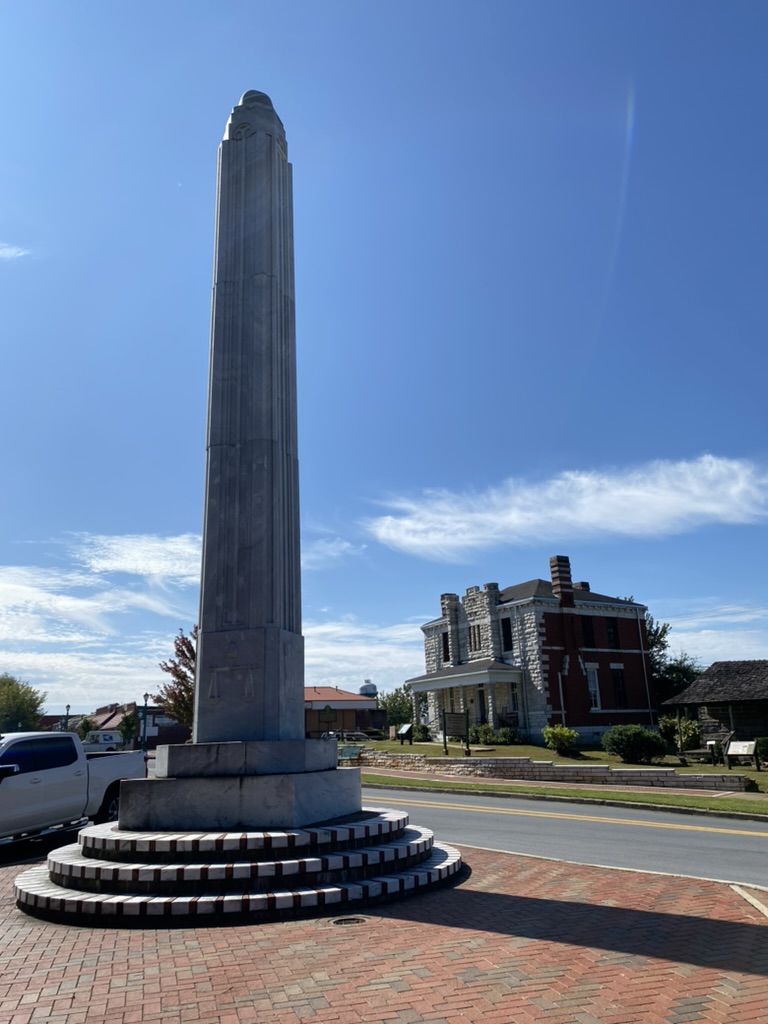
My wife and I are living for a time in an Appalachian corner of Pickens County, Ga., watching sunsets over a 2,800-foot-high lake. They talk about “two Georgias.” This is the “other” one — rural, heavily for Trump in the last election, relying too much on state and federal dollars but with that old Scots-Irish individualist pride and clan loyalty. Pickens is one of 94 of Georgia’s 159 counties with more deaths than births each year, according to the the blog by my friend Charlie Hayslett, “Trouble in God’s Country.”https://troubleingodscountry.com/

The Oglethorpe Monument in Jasper, Ga., with the historic Pickens County jail in the background.

The turnout in the last election was huge — very democratic, small “d.” As The Pickens County Progress reported it: “Pickens County voters turned out in big numbers in the November 5 election, with 80 percent of registered voters casting ballots. In the presidential race, Donald Trump (R) took 82.7 percent, or 17,263, of the Pickens vote, beating Kamala Harris (D) who took 16.76 percent, or 3,499, votes.”

You may wonder why this locally-run weekly newspaper is called the “Progress.” It has something to do with being started in 1888, honoring the agrarian Southern rebellion against the Gilded Age Republican Party, a “Progressive” movement that was not too happy with the Democratic machine either. The need for real progress here is still obvious. I look for it in the newspaper, and when I saw it recently, I wrote this letter to the editor, which ran a few weeks ago.

Editor:

Reading the news takes effort, but it’s worth it when you find nuggets of good news. I don’t mean “soft news,” like gardening tips or high school sports, as nice as those are in The Pickens County Progress. I mean gold nuggets like Sheriff Donnie Craig telling the Chamber of Commerce’s monthly breakfast that crime in Pickens County has been falling for the past five years. Burglary, thefts and assaults are all much lower in the county today than they were in 2019.

But I always want to know the “why” behind the statistics – not just good news but good journalism. (I was a journalist, then a journalism professor.) One reason for the drop in crime, Sheriff Craig said, is that deputies for the past year have responded to domestic calls accompanied by a mental health provider. He called this having a “co-response” team. Such teams had responded to 169 calls since Craig, elected sheriff for the fourth time in November, adopted this change last year, he said.

Anyone involved in crime fighting (or reporting on it) knows that a lot of the job comes from problems in homes troubled by domestic violence, addictions and untreated mental conditions. A weapon in the home can make it worse, but having a mental health worker to de-escalate the problem is an idea that doesn’t have to wait on our endless gun-control debate.

Craig, a Republican, admitted he was skeptical at first of having “counselors” at crime scenes. But seeing how it worked in practice, he called it “one of the best things” he has been part of. The counselors are empowered to follow up after the initial call, helping provide mental health services as needed.

As I read the news these days, local and national, I see how President Trump has succeeded in targeting real problems (crime, immigration, inflation, government inefficiency, you name it) that had evaded solutions – but he comes blustering in with exactly the wrong solutions. Good TV, as he calls it, but not real solutions. Sheriff Craig shows how real solutions take time, an open mind, an honest set of statistics, and a willingness to try something that comes from a different perspective.

Doug Cumming

Posted in Uncategorized | Tagged , , , , , , , | Leave a comment

1690: Two obscure beginnings of public trust

How do you know . . . that South Korea had an authoritarian president named Yoon, and that Yoon declared martial law last December to shut down critics, an independent media and the National Assembly? Or that he was ousted by a snap election, and now faces criminal charges for leading an insurrection?

How do you know South Korea even exists?

How do I know that a South Korean family of three will be sending their first month’s rent for our furnished condo while my wife and I begin 12 months away? And that they will arrive soon, on a certain date?

The answer to the question “How do you know?” is always this: Trust.

I trusted the New York Times, AP, NPR, and in time, Wikipedia, to tell me the news about Yoon. I know the difference between trust-worthy news and trust-worthy opinion – such as the opinion of anti-Trump writers that South Korea’s ousting of Yoon is a good sign that democracy can win over authoritarian strongmen. That’s just an opinion, but at least it’s based on trust-worthy facts about what happened, and what’s happening.

I trust that South Korea exists, though I’ve never been to any Asian country. I was a questioning student, what they call a “critical thinker.” But the existence of South Korea cropped up in my schooling hundreds of times, from maybe 3rd grade and from my parent’s talking about the Korean War all the way to today. And there was never a suggestion – a conspiracy theory – that South Korea didn’t exist.

How do I know that our real estate agent found good tenants for our condo? It’s because of trust. I trust our real estate agent. I trust the confidential salary report from the man’s South Korean university, and the online conversion table from South Korean “Won” to U.S. dollars. And a hundred other tiny signs and signals. I see the peer-reviewed papers he’s written about de-carbonizing transportation through public policy. And it makes sense to me that Georgia Tech would be bringing him to Atlanta for a year-long research fellowship. My world makes sense to me, and I can act in that world, because of trust. I know that millions of people live in that world. Or used to.

Something has gone wrong. People have lost their trust in things they should trust (and correspondingly, they seem to trust things they shouldn’t, like the Truth Social posts of a TV-savvy president who says things like, “All planes will turn around and head home, while doing a friendly ‘Plane Wave’ to Iran”).

I don’t know what is happening to trust.

But I was wondering how it began in American history, and I happened upon an interesting beginning. It happened in 1690, with two events that occurred within four months of each other. Both involved a printing press – a key element of the trust that grew in the West out of Gutenberg’s machine – and both occurred in Boston.

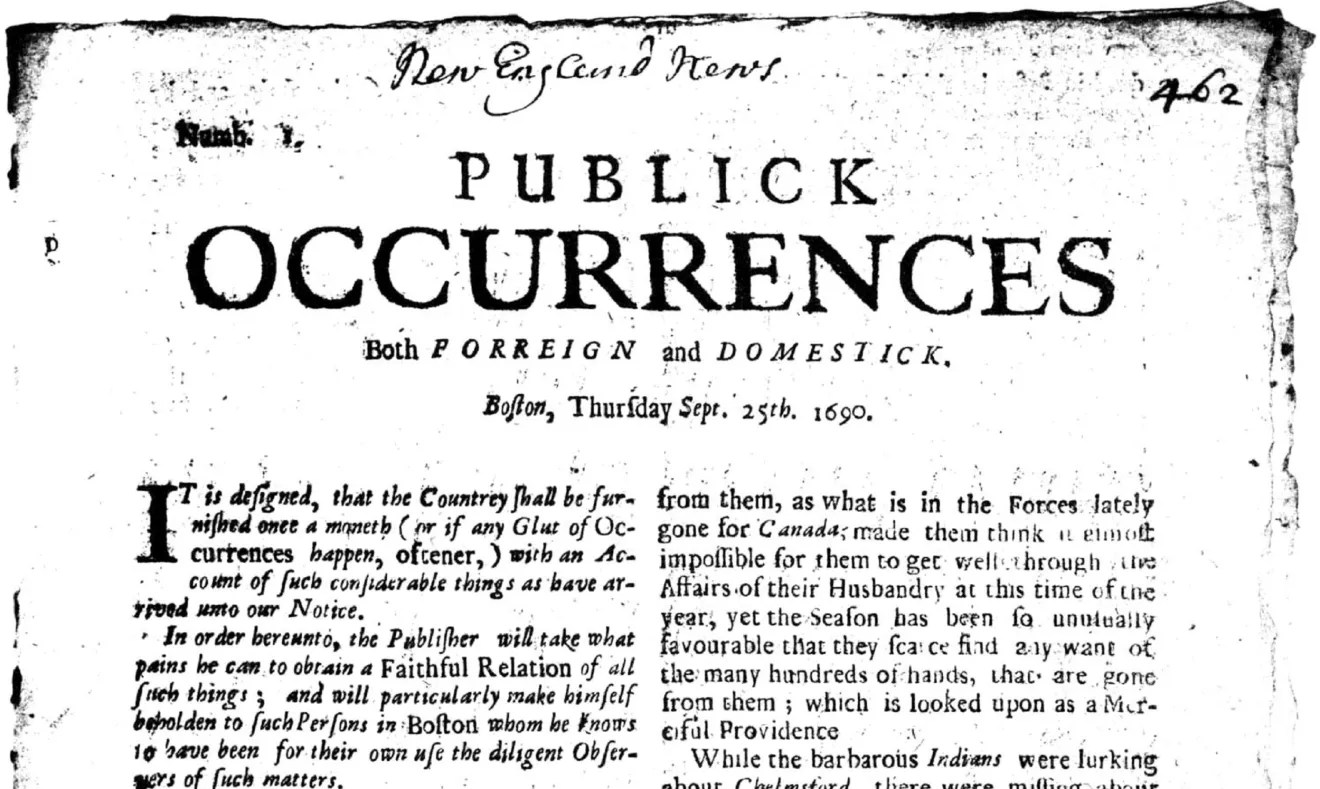
One was the printing of “Publick Occurrences, both Foreign and Domestic,” on September 25, 1690, America’s first newspaper. Benjamin Harris, a British scofflaw who had immigrated to the Puritan colony of Massachusetts, printed this newspaper without the government’s permission. The first issue, containing various interesting news reports, declared the newspaper had several goals. One was to see that people paid attention to “memorable Occurrences of Divine Providence,” the idea that God was blessing America not just through one’s own interpretation of the Bible but through its news and history, as difficult as those seemed – death, corruption, wars and all that. Also, to “cure or at least charm” the spirit of Lying that prevailed among people without a newspaper.

The king’s governor shut down Harris’s newspaper after that one issue. But others would come soon enough, like the New England Courant that James Franklin (Ben Franklin’s older brother who taught Ben printing) established in 1721, also in Boston.

The other “origin” of trust came on December 10, 1690, when the Massachusetts colony decided to print paper currency for the first time on America’s shores. The government created 7,000 pounds of “bills of credit” to pay militia who had attacked French soldier in Quebec City. The battle was a humiliating defeat for the attackers from Massachusetts, who were further humiliated by their colony having run out of money to pay them. As any economist can tell you, printing currency for the first time, with no gold or silver in the treasury to back it, was a doomed experiment. Wildly inflationary.

But in time, slowly, the idea of paper currency and credit grew. It grew on trust, “faith and credit,” a value agreed-on in common by people who enjoyed the benefits of such common trust. It took a long time, and it took a sense of honor, and self, and the common good.

Today, I can trust that the exchange rate between the South Korean Won and the U.S. dollar will hold steady. So will planning to rent an apartment in Italy with Euros. These are democracies with checks and balances, mixed economies, and a measure of trust in news, in the meaning of words, and in a pragmatic sense of how things are, really.

But there are curious signs and signals that this trust is breaking down.

Posted in Uncategorized | Tagged , , , , , , , | Leave a comment

Outage

Our April morning peace was ripped—   
A boom and then the dark. What now?
Outside the squirrels began to mourn.
We know how lightning strikes have clipped   
These trees, blazed black trails to burn
Down mountain houses. Anyhow
This was no bolt, but just a tripped

Transformer. Our whole world shook. 
Out back, years of briar and vine
Have overtaken junked rolled fence   
And coiled barb wire that overtook
The last pole planted here since   
Georgia Power stamped the sign
Listing its history. Let’s have a look.

Lengths, years, and tree type: “Ches’n’t.
Cypress. Cedar. Pine,” painted
With creosote ninety-five
Years ago, this pole shouldn’t
Have been here that long, a live
Wire going where? Unacquainted
With our house, which was not

Here for another forty years?
The creosote has oozed like grief
To blacken the pinewood pole’s base.
This wasn’t lightning strike, but tears
For trees skinned, for nights, days,
Waiting to shed light. So this brief
Darkness, like a comma, appears

To remind us of how we fail
To honor roots and wild grape vines
That grow so slow on trees they seem
Like dropped cables, and steel barbs pale
Copies of cat briar. The man from the team
Stays on the ground, looks up and finds—
The pole has grown a stilled gray tail.

Posted in Uncategorized | Leave a comment

Walker Percy: my favorite philosopher-novelist

I’m offering another course at OLLI-Emory, the adult education program that has created a lively community of Baby Boomers who love teaching and learning, mostly in retirement. I don’t know if anyone will be as interested in this as they might be in other more practical courses for June, such as understanding kidney stones, garden slugs and defensive driving. In any case, here is the OLLI-Emory link and my Course Description.

Walker Percy: His Life, Novels and Ideas (Doug Cumming)

Instructor: Doug Cumming

Is there a writer you value as your favorite and a lifelong guide? Walker Percy is that writer for me. Percy, from Old-South families, was trained as a doctor and scientist, but recovering from TB immersed him in Russian novels, existential philosophy, Catholic conversion, and a riddling career as a novelist. His first novel, The Moviegoer, won the National Book Award in 1962. Five other novels followed until his death in 1990, along with collections of his fascinating works on language as the sole human mystery. I would like to present this writer’s worldview, humor and character in hopes that you will share some of how these have grown on me. One class: bio. Another: philosophical writings on language. Another: Love in the Ruins: The Adventures of a Bad Catholic at a Time Near the End of the World. Finally: The Second Coming. Books needed: “Love in the Ruins” and “The Second Coming”

 Bio: I taught journalism for 19 years as a professor at Washington & Lee University. This academic stretch came after 26 years of reporting, writing and editing for metro papers (including the AJC in the 90s) and magazines.

Thu 11:30AM – 1:00PM
Jun 05, 2025 to Jul 03, 2025

Available

$40.00

Posted in Southern literature | Leave a comment

Waves

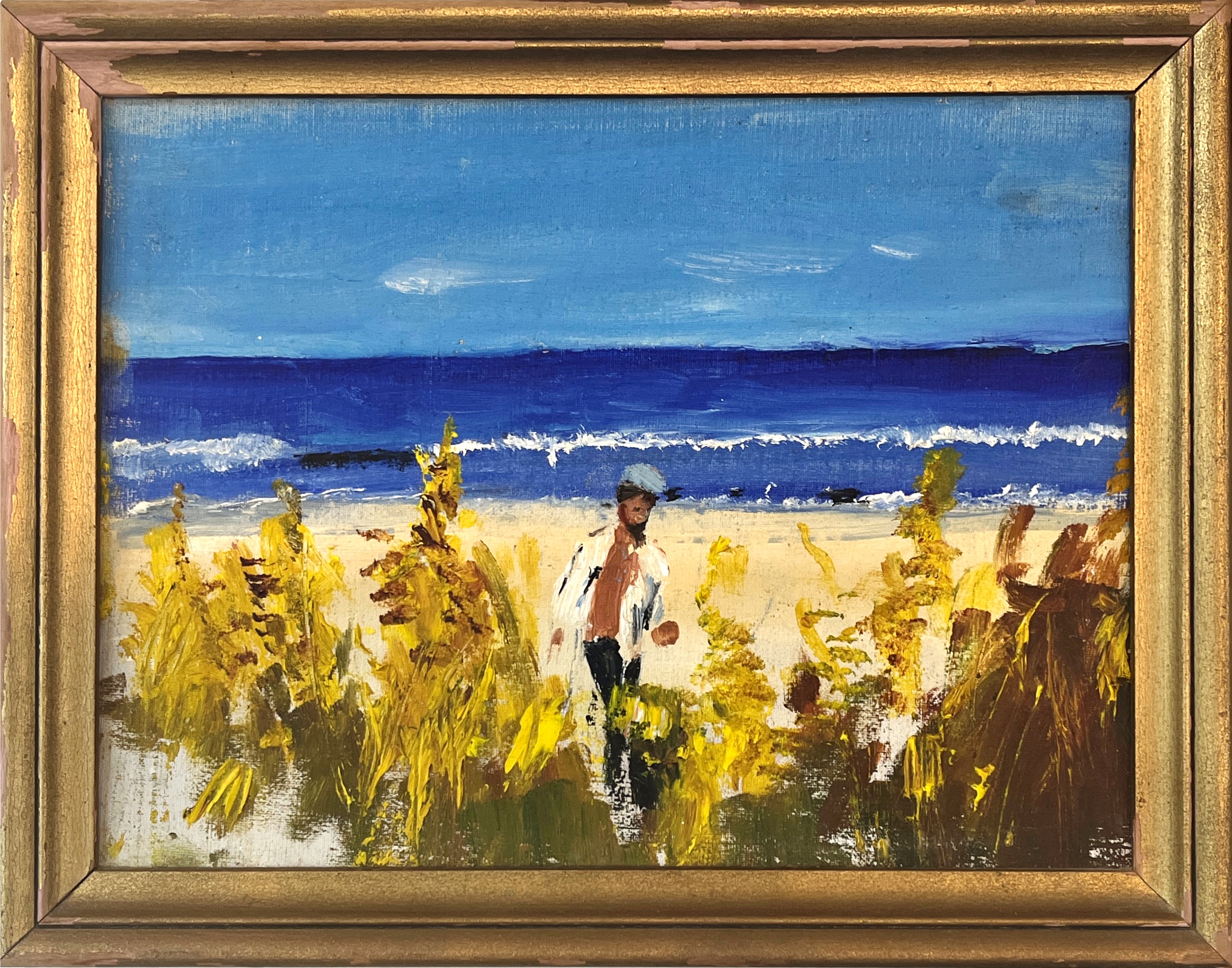
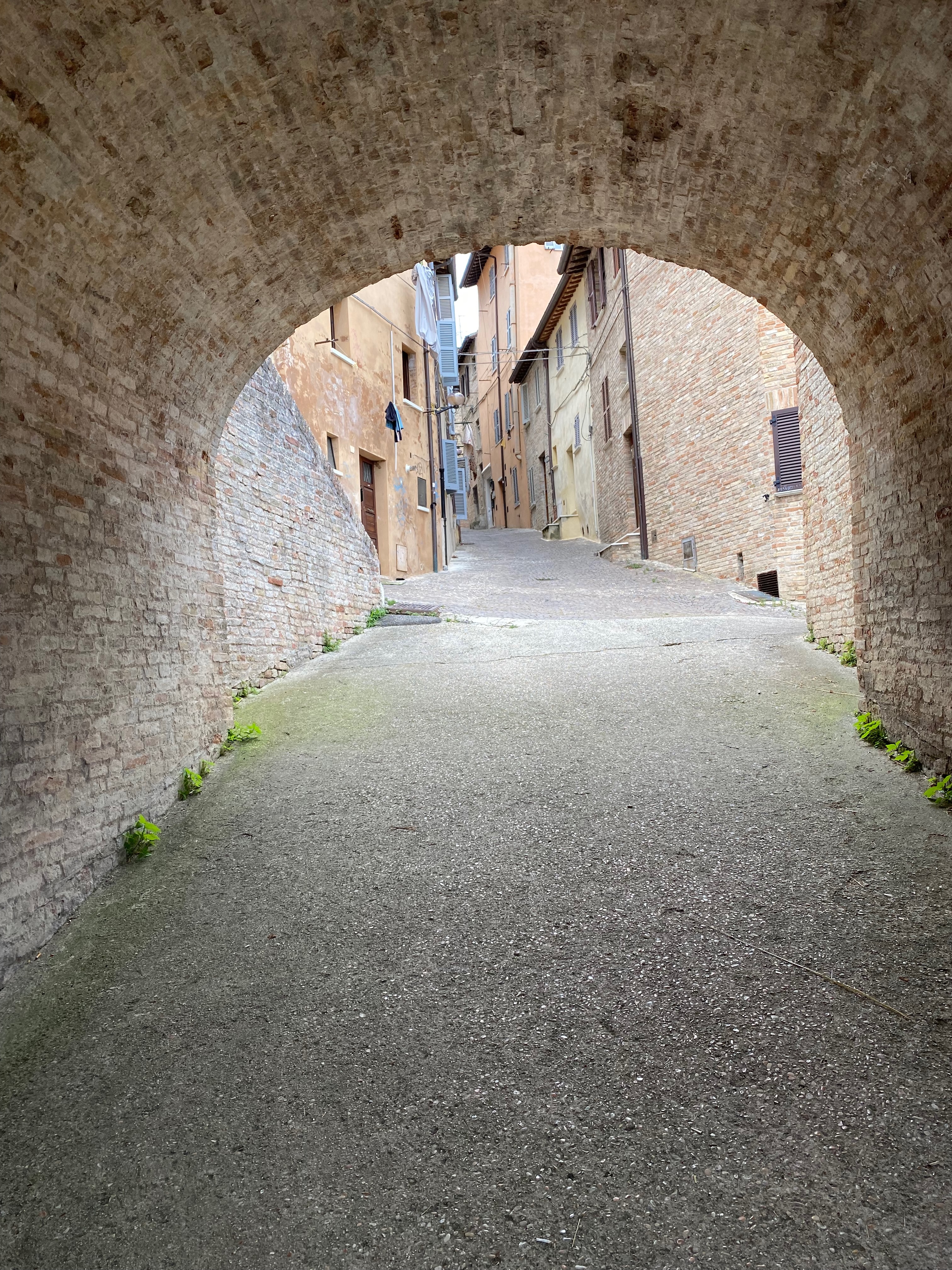
I miss waves. When my love and I transplant to Italy, it will be on the Adriatic. Waves there are small, but they have a lot of history. I look forward to walking the beaches of the Marche where Romans landed and 16th century galleons fought in a clash of civilizations. In the summer, the beaches are covered with rented umbrellas in bright colors and the waves are like a steady snore.

On the Outer Banks, long ago. Painting by Walter Cumming

Waves are endlessly fascinating. As a general principle, they are how energy is transmitted, whether that is in the slosh of the world’s oceans, or as sound waves or the mysterious “wave” of electromagnetic energy we call light. My love is a physicist, so she tries to explain this to me, and it only deepens my wonder.

The Brazilian composer Antonio Carlos Jobin wrote a wonderful bossa nova he titled “Wave.” Right now, I am studying the chords, which curl and slide like I imagine the waves that inspired him in Rio.

Poets have been inspired too, drawn by the infinite meanings and rhythm of being shore to ocean, as one poet wrote. “Holding the curve of one position/Counting an endless repetition.”

But has anyone, from science or art, observed waves as beautifully as Gerard Manley Hopkins did in this passage I found from his journals? We’ve all stared at waves for a long time, so we can all nod yes, yes, exactly. But I wish I were patient enough to observe nature this steadily, and to get it down in writing. It’s a good example of journal writing and maintaining attention. I’m transcribing the whole thing here.

Aug. 10 [1870]. I was looking at high waves. The breakers always are parallel to the coast and shape themselves to it except where the curve is sharp however the wind blows. They are rolled out by the shallowing shore just as a piece of putty between the palms whatever its shape runs into a long roll. The slant ruck of crease one sees in them shows the way of the wind. The regularity of the barrels surprised and charmed the eye; the edge behind the comb or crest was as smooth and bright as glass. It may be noticed to be green behind and silver white in front: the silver marks where the air begins, the pure white is foam, the green/ solid water. Then looked at to the right or left they are scrolled over like mouldboards or feathers or jibsails seen by the edge. It is pretty to see the hollow of the barrel disappearing as the white comb on each side runs along the wave gaining ground till the two meet at a pitch and crush and overlap each other.

About all the turns of the scaping from the break and flooding of the wave to its run out again I have not yet satisfied myself. The shores are swimming and the eyes have before them a region of milky surf it is hard for them to unpack the huddling and gnarls of the water and law out the shapes and the sequence of the running: I catch however the looped or forked wisp made by everybig pebble the backwater runs over – if it were clear and smooth there would be a network from their overlapping, such as can in fact be seen on smooth sand after the tide is out –; then I saw it run browner, the foam dwindling and twitched into long chains of suds, while the strength of the backdraught shrugged the stones together and clocked them one against another.

Looking from the cliff I saw well that work of dimpled foaming – strings of short loops of halfmoons – which I had studied at Freshwater years ago.

It is pretty to see the dance and swagging of the light green tongues or ripples of waves in a place locked between rocks.

Posted in Uncategorized | Tagged , , , , , | Leave a comment

Sparks from Ignatius

I have had brief brushings with a 484-year-old club called the Society of Jesus. My first university job at age 51 was at Loyola in New Orleans, which was run by this club of Catholic priests called “Jesuits.” Ignatius de Loyola was the founder of their society in 1541. At Loyola U. on the streetcar line of St. Charles, I learned a little bit about the Jesuits, those black-clad bachelors with “S.J.” after their names. I spent half a day in one of their “Spiritual Exercises,” and learned about how they instructed the conversion of Walker Percy there at Loyola U.

Years later, in 2018, I took my magazine class to the New York offices of “America,” the Jesuit periodical. I asked an editor about another Catholic tradition, the Benedictine practice of withdrawing in community from secular/consumerist culture. Fr. Sam Sawyer said the Jesuits were the opposite. They have always gone out into the world to see how it is, with a well-trained and highly educated confidence that Jesus Christ and His (Roman) Church have a truth to tell at the highest level of relevance and intelligence. Pope Francis is the first Jesuit pope. Today, you can listen to a cool podcast of young lay America magazine staffers, “Jesuitical.”

It’s interesting how relevant the Jesuits can seem today, as the world faces a new form of an older battle between liberal democracy and illiberal authoritarianism. The Jesuits seem to be firmly on the side of liberal democracy, for all their loyalty to the illiberal authority of the Roman Catholic Church. The Jesuits, as much as our own Jeffersonians and Progressive lefties, can claim heroes of the 17th and 18th century European Enlightenment. I have recently run across two examples.

Marin Mersenne (1588-1648), a mathematician and musicologist known as the “father of acoustics,” was a French Jesuit educated at the Sorbonne in the Franciscan Marims order. He brought the New Science of the times, as it was called, to his monastery outside Paris, and his circle became a salon of intellectual ferment, frequented by Blaise Pascal and both Descartes, father and son.

Ippolito Desideri (1684-1733) was an Italian Jesuit missionary who spent some 12 years in India and Tibet. He was the first Westerner to study Buddhism in depth, a project he took on to better evangelize for Christianity. The book he wrote on Buddhism was remarkably objective, so lacking in a Christian “slant” that the Catholic Church prevented its publication. He also lost his plea with the Pope for the Jesuits to retain control of the Tibet mission, which yielded to the Capuchin order instead.

Desideri’s works on Buddhism and Christianity is described this way in a footnoted passage in Wikipedia:

“Between 1718 and 1721 he composed five works in the Classical Tibetan literary language, in which he sought to refute the philosophical concepts of rebirth (which he referred to as “metempsychosis“) and Nihilism or ‘Emptiness’ (Wylie: stong pa nyid; Sanskrit: Śūnyatā), which he felt most prevented conversions from Tibetan Buddhism to the Catholic Church in Tibet. In his books Fr. Desideri also adopted and utilized multiple philosophical techniques from Tibetan literature for scholastic argumentation. Fr. Desideri also used multiple quotations from the dharma and vinaya, and even brought the Scholasticism of St. Thomas Aquinas into a debate with the nihilistic Madhyamaka philosophy of Nagarjuna to argue his case for “the superiority of Christian theology.”[4]

Imagine, if you can, the followers of Christ, today, spending 12 years seeking to understand, respectfully, the beliefs or non-beliefs of other people before trying to convince them of the better truth of Jesus. What the world needs now, beside “love, sweet love,” is the intellectual energy of the best of the Jesuits.

Posted in Uncategorized | Tagged , , , , , | 1 Comment

Not the End of Civilization (only a re-start)

The Middle Ages weren’t all bad.

There was a beauty in what C.S. Lewis called “The Discarded Image,” the orderly cosmology that connected the heavenly bodies with our own bodies and with Heaven itself (until science displaced these connections with facts, as Lewis acknowledged). And there was virtue in the bravery, devotion, and knightly character that Tolkein drew on for his Lord of the Rings books. But the Middle Ages also gave us bad things – gargantuan inequality, rat-borne diseases, arbitrary power. The bad things died out or were corrected by the Reformation, Renaissance, and Enlightenment. Religion could flourish again, but only as a “sanctuary,” divided and restrained under a system of secular democracy, with the consent of the governed.

It would be a very useful project for some seminarian or theologian to point out all the ways that the Bible, from Genesis to Revelations, supports today’s secular democracy by way of human dignity, freedom, and an earth-loving kingdom-come.

These days, the President and his henchmen – like the four knights who broke into Canterbury Cathedral to murder Archbishop Becket in 1170 – want to bring back all the bad things about the Middle Ages, including a supposed unity of Faith. They are busy tearing down the long, hard work of the Reformation, Renaissance, and Enlightenment.

It is easier to tear down, apparently, than to build up.

Posted in Uncategorized | Tagged , , | Leave a comment

Editors needed

President Biden, in his farewell address warning of a new American oligarchy that owns a “tech-industrial complex,” talked about the threats to a free press. He mentioned that “editors are disappearing.” I have often told people who worry about evils of the “media,” meaning social media, entertainment and maybe cable TV news, the key is the disappearing figure of the editor. Editors are what distinguishes journalism from everything else. This idea made me dig up my article in the 2006 Encyclopedia of Journalism on “Editors.” If you have time to read this little history, be my guest.

Editors

The title of editor is conferred on a wide variety of individuals who determine what appears in newspapers and magazines. The term editor today can refer to a newspaper’s top executive or a lowly copy editor. Every news department, such as those responsible for a newspaper’s sports, features, or business sections, usually has its own editor to assign or approve stories and manage reporters.

By the early nineteenth century, the editor was the most important (and often the best known) figure at a publication. He (most were men) often combined several roles that were “editorial” in quite different senses of the word. A traditional editor was the paper’s opinion-leader, executive, spokesman, literary stylist, and on occasion the publisher or owner. Such were the eclectic pioneers of the mid-nineteenth-century penny press, notably James Gordon Bennett Sr. at the New York Herald and Horace Greeley at the New York Tribune. Starting around the time of the Civil War, editorial functions began to be divided up; a publisher would hire an editor-in-chief, while the daily management of a newsroom would fall to a managing editor. A century later, the various jobs of the old-fashioned full-service editor had been further split and downgraded into specialties within a corporate structure.

Still, a publication’s top editor was its public face. As late as the 1980s, executive editors such as Ben Bradlee at The Washington Post and Abe Rosenthal at The New York Times could attain a certain nationwide fame, even though they did not determine the editorial position or business side of their publications. But the next generation of executive editors, in an era of falling circulation and media-industry consolidation, had little fame and that only among journalism insiders. Top newspaper editors of the early twenty-first century were typically corporate functionaries or, at best, fighters of a losing cause for professional autonomy and higher newsroom budgets. Many lost their jobs to that cause. In the heyday of mass-circulation magazines, meanwhile, the personality of a single editor often stamped the character of such periodicals as The New Yorker (under Harold Ross, then William Shawn), the original Vanity Fair of the 1920s and 1930s (under Frank Crowninshield), Time (under Henry Luce, then T. S. Matthews), and The Saturday Evening Post (under George H. Lorimer). Since then, the age of the titan magazine editor has passed.

Origins

The earliest definition of “editor,” a word derived from the Latin verb edo (to bring forth into the world), applied to the publisher of a literary work. An editor as “one who conducts a newspaper or periodical publication” began to appear in 1803, according to the Oxford English Dictionary. This was when the older archetype of printer-proprietor was being replaced by a new type of newspaper chief. In colonial America, the men and women who published the first newspapers and magazines were called printers. With the proliferation of printing presses, heads of newspapers took on more literary status and the new title of “editor.”

John Fenno, a Bostonian, became the first editor of the Gazette of the United States, the mouthpiece of the new Federalist government and, in particular, of Treasury Secretary Alexander Hamilton. To advance an opposition party, James Madison, a key author of the Constitution, along with then–Secretary of State Thomas Jefferson, sought an editor to create an anti-Federalist newspaper, the National Gazette. They installed Philip Freneau, a patriot-poet who had been Madison’s college roommate. Fenno and Freneau were editors of the new style rather than printers who happened to own the mechanical means of communication.

The 1790s and the next three decades, which have been called “the dark ages of the partisan press,” continued to produce editors under the sway of political interests and patronage. But political spoils and control by factions did not dampen the individuality of editors from this era, most notably Aurora editors Benjamin Franklin Bache and William Duane, English gadfly William Cobbett, Wasp editor Harry Croswell, American Mercury editor Noah Webster, and Columbian Centinel editor Benjamin Russell. Each of these editors tended to be colorful, vitriolic, and abusive in a tradition of personal and partisan journalism that would continue throughout the nineteenth century.

In the 1830s, editors of several big city newspapers embraced innovations that greatly increased circulation and revenue. They severed ties with political parties, added amusing human interest stories of crime and sports aimed at working-class readers, dropped their daily price from six cents to a penny, and charged advertisers more as circulation grew. The leaders of this “penny press” revolution were founders, owners, and publishers of their own newspapers, but also proudly bore the title of editor. They did not renounce traditions of violence or partisan politics. Bennett deliberately provoked rival editor James Watson Webb to assault him twice in the streets of New York, which Bennett, as victim, gleefully reported in his paper. Greeley, founding editor of the New York Tribune, embraced some political agendas with a childlike fervor. But these editors largely relied on advertisers, not political machines, as their chief patrons. They were careful to appear neutral in covering politics, at least in their paper’s news reports, and sought entertaining news for the masses as well as timely information for the elite. The modern editor was henceforth to be a guardian of journalistic independence and an authority on developing content with mass appeal.

As with newspapers, American magazines have often mirrored the personalities of their editors. In Victorian America, editors such as poet James Russell Lowell and novelist William Dean Howells at the Atlantic Monthly helped set the intellectual agenda of the cultural elite, while female editors such as Sarah Josepha Hale (who got Thanksgiving to be a national holiday and wrote “Mary Had a Little Lamb”) at Godey’s Lady’s Book and Miriam Folline Squier at Frank Leslie’s Lady’s Magazine (who took the name of her husband, Frank Leslie, after he died) constructed America’s culture of the “domestic sphere.” The editors of successful magazines in the first half of the twentieth century, especially editors who launched new titles or built huge circulations, tended to be unusually competitive and innovative in their market strategies and graphic design, but also culturally conservative and attuned to the values of the American heartland.

The modernization of newspapers after 1900 saw editors-in-chief diminished in number and in importance. Publishers consolidated newspapers into chains; reformers emphasized schooling and professional standards, thus reducing the importance of editors as on-the-job trainers. After World War II, newsrooms of metropolitan newspapers achieved their greatest energy, size, and professional standards. Editors of various ranks now ran the show. Late City Edition, a 1947 book by editors at the New York Herald Tribune, describes the three main news desks controlled by editors: local or city desk, national or “telegraph,” and foreign or “cable.” It was an all-male club until well into the 1970s. “The best editor is the man with an insatiable desire to know the facts of a matter, and an instinctive tendency to be interested in the matters his readers care about,” the Herald Tribune‘s city editor wrote in the book. Most major newspapers by this time had separated the function of editorial page editor from that of news editor, generally called managing editor or “M.E.” Under the managing editor came department editors responsible for particular topics—arts, women, sports and business, for example. These editors were usually anonymous to the reader, yet influenced the paper by hiring staff and shaping the news, from story assignment to copy editing and headline-writing.

The skills of a good editor are distinct from those of a reporter or writer, yet successful newspaper editors invariably emerge from the ranks of news reporters with little or no formal training to be an editor. Even heirs of newspaper-owning families who are being groomed for editorships take a turn as cub reporters. Jonathan Daniels, for example, was a Washington correspondent for the Raleigh, North Carolina, newspaper his father owned, The News & Observer, before the younger Daniels became editor in 1933. Daniels served as editor in two stints for a total of 29 years, writing editorials and overseeing news while his two brothers managed the business side. Management skills, increasingly important for any newspaper editor, sometimes pushed a good editor into the job of publisher or company president. Lee Hills, for instance, markedly modernized the Miami Herald as its managing editor, then executive editor, from 1942 to 1966, systematizing recruitment, bringing colorful design to the paper, and sharpening its news writing. For the next 16 years, he was a publisher or president within the paper’s chain, Knight Ridder. His ideas gradually permeated the chain through the many editors who followed in his footsteps.

In contrast to the inventive and eccentric editors of the nineteenth century, however, successful newspaper editors of the twentieth century fit comfortably into the conventions of newspaper production and management. Few editors tried to invent anything as new as the penny press. Ralph Ingersoll, who had been an editor at The New Yorker and Fortune, attempted a radical experiment in newspapering with PM, an afternoon tabloid that relied on wealthy patrons instead of advertisers. Ingersoll’s PM, which accepted but did not solicit advertisements, was greatly admired for its coverage of modern cultural topics, its quality art and photography, and its literary writers. But it never gained the circulation or influence Ingersoll had sought, and folded after eight years, in 1948.

Some Notable Newspaper Editors

James Gordon Bennett Sr. (1795–1872)

Bennett launched the New York Morning Herald as a penny paper in 1835, and during the next 37 years as its star reporter, top editor, and irrepressible salesman, helped to invent the modern concept of “news.” With an entertainer’s flair for writing and a cynic’s understanding of public appetites, Bennett changed American journalism by his example, showing how newspapers could be far more democratic, sensationalistic, and profitable. Rivals waged a “moral war” against him, and the diarist George Templeton Strong summed up the elite view of Bennett when he wrote that no one had more debased American journalism. Yet Bennett was hailed as a genius of the profession he helped create. A gangly, cross-eyed Scottish immigrant, Bennett learned editing at the Charleston (South Carolina) Courier, the New York Enquirer, and the New York Courier. After many business failures of his own, he threw everything into his vision of a paper that cost a penny, like Benjamin Day’s New York Sun, but outdid all its competition with a frenzy of news for every class of citizen. Bennett turned over management to James Bennett Jr. in 1866.

Benjamin C. Bradlee (1921–)

Bradlee was a high-profile editor who ran The Washington Post during the heady years when the paper exposed the Watergate scandals of the Nixon Administration from 1972 to 1974. A prep-school and Harvard graduate from Boston, Bradlee began reporting for the Post in 1948. Later, as Newsweek magazine’s Washington bureau chief, he and the magazine’s business editor, Osborn Elliott (soon to be the magazine’s editor for more than a decade), convinced Post publisher Philip Graham to buy Newsweek in 1961. Bradlee, a friend and neighbor of Senator John F. Kennedy, enjoyed being at the center of Washington’s social life from the time Kennedy became President. Named managing editor of the Post in 1965, then executive editor in 1968, Bradlee flourished with the support of Katharine Meyer Graham, the publisher after her husband’s death. Bradlee led the paper’s aggressive coverage during the Pentagon Papers case of 1971 and the Watergate years. His reputation was damaged by the fabricated “Jimmy’s World” feature story about an eight-year-old heroin addict by staff reporter Janet Cooke, for which a 1981 Pulitzer Prize was retracted when Cooke confessed that she had concocted the story’s main character. Bradlee was the last of the flamboyant big-city newspaper editors. When he retired in 1991, editorial writer Meg Greenfield complimented him as one who had “made the Post dangerous to people in government.”

Arthur Brisbane (1864–1936)

Brisbane was the highest-paid and most widely read editor under yellow-journalism publisher William Randolph Hearst. The European-educated son of a wealthy Buffalo, New York, family, Brisbane became the chief advisor and front man for Hearst. He had proved himself a facile writer for Charles Dana at the New York Sun and then for Joseph Pulitzer at the New York World before becoming editor of Hearst’s Journal in 1897. There, he was the first newspaper editor to reach a circulation of 1 million. He also wrote articles for Hearst’s Cosmopolitan magazine and penned a popular editorial column, syndicated as “Today” in Hearst’s papers and hundreds of others, giving him an estimated readership of 30 million. Critics derided his columns for their banal wisdom, but his concise style made a rising new middle class “think they think,” as he once described the goal of an editorial.

Turner Catledge (1901–83)

Catledge was a Mississippi-raised journalist who worked at The New York Times for nearly forty years, half of that as managing editor, executive editor, or vice president. He retired in 1970, moved to New Orleans, and wrote a memoir, My Life and The Times. Catledge expanded the Times‘ cultural and national coverage, giving attention to the South and the issue of civil rights before any other national news publication did so. He was the most influential of a series of top editors at the Times from the South, such as Edwin James, Clifton Daniel, and Howell Raines, reflecting the Southern origins of the patriarch of the Times‘ dynasty since 1896, Adolph Ochs.

Charles A. Dana (1819–97)

Dana enjoyed a long and influential career as a gifted newspaper editor, first at Horace Greeley’s New York Tribune from 1847 to 1862, and later as editor of the New York Sun from 1868 until his death in 1897. His interest in radical politics led him to join the New England Transcendentalists at Brook Farm, where he edited The Harbinger, and to cover the revolutions of 1848 in Europe, where he recruited Karl Marx as the London correspondent for Greeley. Dana also played a key role in the Lincoln administration during the Civil War, as assistant secretary of war. But his great talent was not his political vision, which was spotty and often vindictive. Rather, Dana raised the quality of newspaper writing, making the Sun one of the best of the major papers of the period. He virtually invented the “human interest story.” Dana, who was the first managing editor ever, believed that “the invariable law of the newspaper was to be interesting.”

Horace Greeley (1811–72)

Greeley was the founding editor of the New York Tribune, his national “pulpit” from which he crusaded for various reforms and rebuked the other penny papers for their money-grubbing sensationalism. The Tribune, he announced when it started in 1841, would advance the interests of “the People” and avoid the “immoral and degrading Police Reports, Advertisements and other matter which have been allowed to disgrace the columns of our leading Penny Papers” (Stoddard, 61). He crusaded for temperance, workers’ rights, an early form of socialism, and an end to slavery. Raised poor in New England, Greeley failed to make a profit from The New Yorker, a weekly literary magazine he ran for seven years in the 1830s, or from the Log Cabin, a propaganda sheet he edited for his Whig Party mentors Thurlow Weed and William H. Seward. He ran the Tribune with an energy, eccentricity, and idealism all his own, “no man’s man,” and it flourished in that spirit. He was the first editor to allow by lines, and his published interview with Mormon leader Brigham Young is considered a breakthrough in reporting. Other editors of renown began their careers under Greeley at the Tribune, such as Charles N. Dana (later editor of the Sun) and Henry J. Raymond (who launched The New York Times in 1851). Other notable correspondents for Greeley’s Tribune were Karl Marx, in London, and feminist Margaret Fuller.

Ralph McGill (1898–1969)

McGill was called the “conscience of the South” as editor, columnist, and publisher at the Atlanta Constitution from 1938 through the years of the civil rights movement. A former college football tackle and Marine from Tennessee, McGill was sports editor at the Constitution in the 1930s. Doing feature stories on his own time for the newspaper, he witnessed the sad waste of rural poverty and racial hatred in the South during the Depression. He traveled to Europe on a Rosenwald fellowship in 1937, seeing firsthand the relationship between an un-free press and the rise of Nazism. His page-one columns in the Constitution—more than 10,000 were published by the time he died at age 70—drew on his love of rural culture but also applied an almost religious morality to race questions that few others would write about. In the old style of Southern editors, he was at once the paper’s public face, political captain, and literary voice. His criticism of white bigotry and his eventual support of the civil rights movement brought local hate mail, but national fame. He won a Pulitzer Prize in 1959 for editorial writing and published a historical memoir in 1963, The South and the Southerner.

Carr van Anda (1864–1945)

Van Anda was managing editor of The New York Times during the formative period of 1904–32, when his mathematical and scientific intellect helped make it the most respected newspaper in the world. Van Anda, a child prodigy, had dropped out of Ohio University and abandoned his plans to become a professor of physics or Greek to work on the mechanical side of several Ohio newspapers. He then switched to reporting, in which he excelled by his detective-minded diligence. But it was as night editor at the Baltimore Sun and the New York Sun where his energy and news sense achieved the most. Later, as managing editor of The New York Times, he kept a night-editor’s hours, scooping other papers and catching last-minute errors. Adolph Ochs, who had bought the Times in 1896 with the goal of rejecting sensationalism for “all the news that’s fit to print,” found in van Anda his ideal of an independent, intellectual news chief. Ochs gave van Anda a good salary and a free hand. Van Anda is credited with making the Times the admired newspaper of record it became.

Henry Watterson (1840–1921)

Watterson was editor of the Louisville Courier Journal for a half century after the Civil War. He was a “Kentucky colonel”–style orator with a message of reconciliation he called the “New Departure.” His message was like Henry Grady’s editorial campaign for a New South, but more partisan, less visionary, and drawn out over a much longer career. As the son of a Tennessee congressman, Watterson learned to love politics and the Democratic Party as a child who literally played in the halls of the U.S. Capitol. His service in the Confederate army was desultory but placed him in the company of legendary generals Leonidas Polk, Nathan Bedford Forrest, and Albert Sidney Johnston. He developed an extravagant writing style as editor of a Confederate propaganda organ called the Rebel, followed by stints as editor of a Cincinnati newspaper and an editorial-opinion writer at the Nashville Banner. In partnership with Walter N. Halderman, he helped merge Louisville’s Courier and Journal and made the combined paper one of the best and largest in the South. He viewed the editorial page as the heart of any newspaper, and had as many as ten editorial writers on staff. He and his partners sold their stock in the Courier-Journal to Robert Worth Bingham in 1919.

William Allen White (1868–1944)

White became nationally known as a prototype of the kind of editor most likely to remain unknown beyond the county line—the proprietor-editor of a small-town newspaper in the American heartland. For nearly 50 years he ran and wrote for the Emporia (Kansas) Daily and Weekly Gazette, with a circulation of less than 8,000, but achieved fame by having his editorials reprinted throughout the country. White’s columns appealed to a wide audience because of their earthy, clear style and his wholesome-seeming political values. After an apprenticeship under William Rockhill Nelson at the Kansas City Star, White made a name for himself in 1896 with a widely reprinted editorial called “What’s the Matter with Kansas?” It was a sarcastic attack on the Populist revolt against industrialism in farm states like Kansas. Under the later influence of reform-minded President Theodore Roosevelt, White turned more progressive in his politics. But he remained a loyal, active Republican most of his life.

Some Notable Magazine Editors

Edward W. Bok (1863–1930)

Bok edited the Ladies Home Journal from 1889 until 1919, during which time it became the best-selling magazine in history. He filled it with functional advice in home management and cheery fiction by celebrated writers. Born in Holland and raised in New York, Bok left school at age 12 to hustle his way, Horatio Alger style, from stenographer to writer to editor at various enterprises. In the Journal, as in such books as his Pulitzer Prize–winning memoir, The Americanization of Edward Bok (1920), he preached a sunny philosophy that treated poverty as a spur to character building and embraced mild reforms, such as an anti-billboard campaign, that rarely challenged the status quo.

Helen Gurley Brown (1922–)

Gurley Brown was the editor of Cosmopolitan for 32 years, turning a failed old general-interest magazine in 1965 into an ad-thick, self-help monthly for sexually liberated young females. Her Cosmo, which she called “feminist” and not a woman’s answer to Playboy, was focused mainly on how to win male attention in any way that felt good. Without nudity, it developed a sex-manual style that a Tom Wolfe novel later satirized as “some sort of pornographic parody of Cosmopolitan.” The daughter of a poor Ozark couple, Helen Gurley succeeded by her wits and charm as an unmarried secretary and advertising copywriter in Los Angeles. She argued for such feminine self-reliance in her 1962 best-selling book, Sex and the Single Girl. By then, she was happily married to Hollywood producer David Brown, who helped her seek ways to repeat the book’s success. The Hearst Corporation rejected their proposal for a new magazine, but let her revamp and edit Cosmopolitan. The female consumer she targeted and influenced was the type she described in Sex and the Single Girl as economically “a dream,” because this individual was not a “parasite” in a family but living alone and supporting herself. “You need an apartment alone even if it’s over a garage,” she advised in her 1962 book.

Norman Cousins (1915–90)

Cousins was editor-in-chief of the Saturday Review, a national weekly literary review that grew from a circulation of 20,000 when he began there in 1940 to 650,000 when he fell out with new owners in 1971. Cousins, an irrepressible optimist, returned in 1973 as owner and editor to revive the bankrupt magazine as a biweekly focusing on science and education. It suspended publication in 1982, except for a brief revival in 1986. The Saturday Review had started in 1924 as a continuation of the New York Evening Post‘s literary supplement after the newspaper shut down the supplement. But it flourished only under the sway of Cousins’s boyish faith in well-educated magazine readers who were not of any intellectual clique but simply loved discussing ideas. Cousins later applied his intellectual optimism to the idea that a sick patient’s attitude could contribute to self-healing. He experienced this personally in overcoming a potentially deadly form of arthritis, and promoted the idea in several popular books and as an adjunct professor of biobehavioral science at the University of California, Los Angeles.

Clay Felker (1925–2008)

Felker was a magazine editor credited with inspiring national and city magazines with his 1960s-style creativity in graphic design, New Journalism, sophisticated satire, and service coverage of where to eat, shop, and live. With designer Milton Glaser, Felker exerted this influence mostly as editor of New York, a slick weekly he launched in 1968 as a stand-alone version of the New York Herald-Tribune‘s earlier Sunday supplement. He lost the magazine to media mogul Rupert Murdoch in 1977, but went on to edit other magazines. Felker, the son of two newspaper editors from St. Louis, Missouri, had been a reporter for Life, worked on the 1954 creation of Sports Illustrated, and edited features at Esquire before becoming editor of the Herald-Tribune supplement in 1963. His brash style, on paper and in person, both inspired and intimidated. One former employee said Felker grew bored faster than anyone she ever met, forcing staffers to make their ideas seem interesting within ten seconds. Projecting an in-your-face elitism in print was his great insight into how magazines could survive in the age of television. Print, he said, had become a niche product for well-educated, affluent people with elitist attitudes.

Henry R. Luce (1898–1967)

Luce, the founding editor-in-chief of Time, Inc., created three or four of the most influential magazines of “the American century,” a phrase he coined that expressed his somewhat imperialistic view of the twentieth century. Born and raised in the isolated American culture of a Presbyterian mission in China, Luce started Time magazine in 1923 with his friend from prep school and the Yale Daily News staff, Briton Hadden. The success of this news weekly, the first of its kind, made both men millionaires before they were 30. After Hadden’s untimely death from a strep infection in 1929, Luce launched Fortune magazine and established “experimental” departments to investigate other innovations in magazine forms. Fortune, a pro-business magazine paradoxically flourishing in the Depression, published high quality profiles of businesses with artful photography. Luce launched Life in 1936, buying the name from a former humor magazine, and Sports Illustrated in 1954, proving that excellent writing and photography could appeal to sports fans even if it covered many sports those readers didn’t care about. Luce also created “The March of Time,” a radio and newsreel dramatization of the news that ran from 1931 until 1951, and subsidized a commission chaired by Robert Hutchins to study threats to freedom of the press. Luce retired as editor-in-chief at Time, Inc. in 1965, after it had become the largest magazine publishing company in the United States.

S. S. McClure (1857–1949)

McClure created and edited McClure’s Magazine, a ten-cent monthly that introduced the reform-minded journalism of the early twentieth century known as “muckraking.” He claimed that the alignment of powerful exposés of political corruption and industrial exploitation by Ida Tarbell, Ray Stannard Baker, Lincoln Steffens, and others in McClure’s, starting around 1903, was an unplanned “coincidence.” But it was really the result of his long preparation. McClure’s energy, gut instinct for new markets, and good relations with literary journalists put him at the center of this progressive movement of the press. Although McClure struggled financially, his talent for publishing good writers in new forms changed magazine journalism. Samuel Sidney McClure emigrated from Ireland at age nine after the death of his father. He graduated from Knox College, where he met friends and lifelong business partners. In 1882, he launched what was probably the first quality niche magazine, a periodical for the new outdoor activity of bicycling called the Wheelman. He created a syndicate to sell short fiction and nonfiction by big-name writers to American newspapers. He launched McClure’s in 1893, and edited it until forced out by a reorganization in 1911, though he remained active in journalism for another 20 years.

Conclusion

Changes brought by the Internet and digital communications reshaped the various roles of editor. Magazine editors were able to take advantage of the web as a free advertisement, or tease, to draw new subscribers to their print product, which had more sensual appeal in its images and text than either newspapers or the Internet. But for the three major types of newspaper editor—corporate executive, news editor, and opinion writer—the first decade of the twenty-first century presented difficult challenges.

As an executive of a large news operation, a newspaper’s top editor was deeply involved in seeking a new business model for sustainable revenue. Executive editors had to invent—and often upgrade— newspaper websites to serve both readers and advertisers. Working out the relationship between the printed and electronic versions of the paper became a central function of senior editors. Web revenue for newspaper companies seemed to be quite limited— about 10 percent of the industry’s advertising income in 2006, with the rapid early growth showing signs of slowing. By 2008, a weakening overall economy forced many executive editors into the bleak role of overseeing major staff cuts.

News editors face an equally difficult task of finding a balance between the traditional daily news cycle of their newspaper and the instant-update pace of their webpages. Webpages can be updated with an immediacy and ease that newspapers and TV news can’t match. But filing and editing stories for the web takes time away from in-depth reporting for the newspaper. Furthermore, with staff cuts, the additional work has to be done with fewer workers. One editorial response is to equip reporters with video and audio recording equipment to make them more flexible in their work, with less editorial intervention. Another response has been to separate “content”—journalistic coverage of the news—from its delivery or “platform.” This further divided news editors into “news and information” managers on the one hand and digital, audio-visual, or print editors, on the other.

In complex ways, the digital age has loosened the grip that editors traditionally had on their readers, their advertisers, and their reporters. But the flexibility and speed of evolving digital technology also gave new importance to news managers—editors— who could navigate the changes and meet the needs of consumers for information and storytelling.

Doug Cumming

Posted in Uncategorized | Tagged , , , , | Leave a comment