
There’s a new kind of balance now between the local and the not-local. Global news is of dread interest to all, reliable and scary – “cases near 2 million” – but we are just as interested in what’s happening on our own block or in our town.
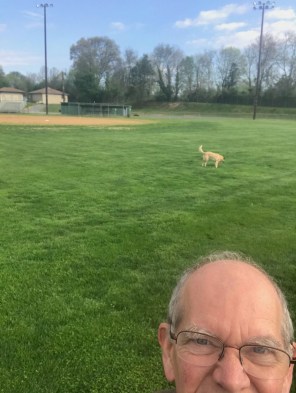
Junie and me, on spring-green Brewbaker Field, behind our sequestering house in Lexington.
We all have stories to tell. No one’s story is average or insignificant. (On National Public Radio, random ordinary people’s voices carry dignity and weight alongside the president’s news conferences and reporters reporting from Paris or Rome.) Collectively these individual stories make up the numbers, the statistics. (At least 580,878 people in the U.S. have tested positive, according to the NYTimes database. More than 23,000, about 4%, have died.) But each one wants to be told, in Zoom meetings between siblings or among college classes scattered across the land. Those stories are our lessons for the day, and for the time to come.
Things are turned on their head. Positive is bad, and a false negative is the last thing we want in our test results. Being stuck at home is a journey, an adventure with an uncertain destination that will bring us home when we can set out into the world again.
The common good, that elusive abstraction of academics like Michael Sandel, is temporarily visible to the non-elite, like dust motes you can see in a stroke of sunlight. Everybody must play nice. Everybody has public obligations, and everybody carries an inner truth of privacy rights, behind their mask or within their prison homes or literal prisons.
Whether for the rich or the poor, the un-evolving spiky little virus is the same. All are vulnerable, even if our protections vary. Humanity is the same. The variance that we created is visible now, the guilty gulf between the richly housed and the homeless, the Hamptons and the refugee camps.


 Docs and musings