
Re: Zoning Board of Appeals variance decision for Commerce Drive curve, June 10, 2024
Dear City of Decatur Leaders:
Our city is trying hard to accommodate growth with intelligent urban planning. We see this with the projects for pedestrian and bicycle safety and connectivity found in last year’s Decatur Town Center Plan 2.0. We applaud the Commissioners’ recent updating of the Unified Development Ordinance (UDO) to diversify housing through the “missing middle” of duplexes, triplexes and quadraplexes in R-60 single-family zones. With diligent enforcement of the tree ordinance, the City recognizes the need to protect old-growth forest clusters, especially in an era of hotter summers. The city’s pilot projects for affordable and denser housing along busy Commerce Drive has invited public engagement with hearings, charrettes, and education. Historic districts like Ponce de Leon Court and landmarks like the Decatur Cemetery are respected as sites of civic place-making and collective memory.
A private developer in January bought the four adjacent lots at the northeast Commerce Drive curve, next to the cemetery and backing up to Ponce de Leon Court. If the City had known that it was for sale for $178,000, no doubt it would’ve snatched it up. The City paid two-thirds more than that for half as much property at the other end of the block of Commerce, at E. Ponce de Leon Avenue. A nonprofit institute is now working with the city to make that corner a demonstration site for all of the key urban principles Decatur is embracing: pedestrian safety; protecting old-growth trees by keeping living space dense and unified; designing a proper transition to less dense housing, and giving neighbors a voice and space to engage.
Of course a private developer has different interests and can enjoy his property rights. The developer who bought the four lots adjacent to the Decatur Cemetery has gone out of his way to work with the city’s Planning Department and meet with neighbors from the historic street abutting the rear of his property, Ponce de Leon Court. He is dealing with a very challenging piece of property, with complicated problems that prevented the previous owner from finding a buyer for many years (though at a higher price, and before last year’s UDO updates).
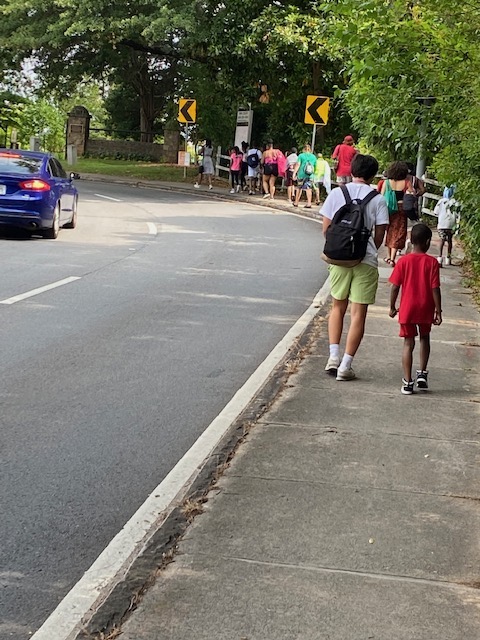
The state DOT created the problem in the late 1960s when it built Commerce Drive as a four-lane arterial, squeezing the property on its east side. Three of the lots became too narrow to conform to R-60 zoning and the sidewalk became a frightening walk. For pedestrians, to this day, the sidewalk is a mere stumble away from speeding traffic. Cars around the 90-degree turn have crashed a dozen times in the last five years.
Neighbors are concerned about the danger of this sidewalk. The City has plans to widen and buffer it. The neighbors circulated a petition in favor of making the sidewalk safer. The petition embraced the City’s plans to widen the sidewalk and opposed giving the developer the variance he was requesting for a five-foot setback. The zoning code requires a 30-foot setback. The owner/developer plans to build two quadraplexes, one of them five feet from the sidewalk on Commerce Drive. Building that close to the sidewalk, he claims, will calm traffic. Perhaps so. But it would put those rental units and their residents in harm’s way. It would also make it impossible for the City to widen the sidewalk, unless the state DOT gives up a lane of that busy thoroughfare.
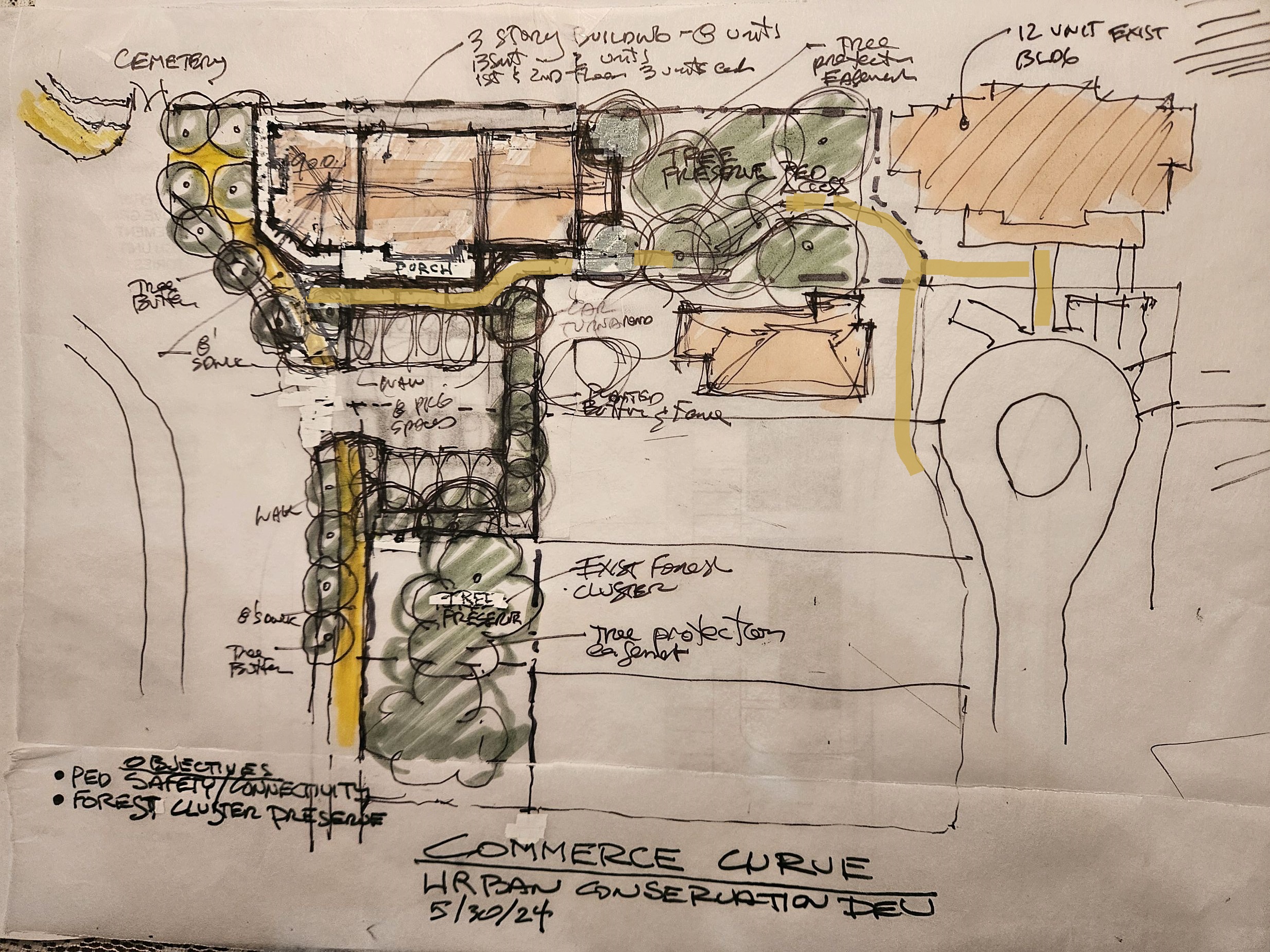
This variance request brought forth community involvement at a very high level. The petition was signed by 72 neighbors and other Decatur residents, including officers of Friends of the Decatur Cemetery and of Downtown Decatur Neighbors. Neighbors testified in an orderly and respectful manner at both hearings before the Zoning Board of Appeals, April 8 and June 10. We have encouraged the developer to seek a zoning change needed to build a single building with more units next to the cemetery, saving a forest cluster, leaving room for a safe sidewalk, and giving him a solid return on his investment. (He said he was interested, but wanted assurance that he could get such a zoning change.) We hired a traffic engineer, who also testified. We have not opposed the developer’s rights, but focused on the one legal criterion that would most oblige the Zoning Board to deny the five-foot variance: it “imperils public safety.”
The Zoning Board of Appeals hearing on June 10 dismayed us. We felt our entire argument for public safety was undermined when Chairman KC Boyce said before any could speak that the Board would not consider issues of “trees or traffic.” The Board’s discussion at the end seemed a slapdash attempt to solve the developer’s setback problems and then, capitulation. Board members gave no rebuttal on the city’s vision of widening the sidewalk; it was merely ignored. Dismissed almost as cavalierly was the Planning Department’s recommendation for a safer front variance of 10-feet. Board members asked the developer and his architect if they could live with a 10-foot setback. Both said no because it would mean the loss of more trees.
So the Board voted to approve the five-foot setback 3-1. Chairman Boyce voted no, but didn’t explain why. The video on the website is entirely silent, due to “audio issues.”
How did this process get off course?
The Zoning Board made its decision based on narrow legal criteria. Was the shallowness of the lots the developer’s fault? No, it was the state DOT’s fault. (Did he buy the property at a bargain-basement price because of the shallowness, and was he aware that he couldn’t built without a favorable variance? Yes, and yes, but the law protects all of that.) In most requests for a variance, such a narrow question is proper. But for this iconic gateway to downtown Decatur, deeply wooded, squeezed between a historic district and historic cemetery, and suffering an unusually dangerous sidewalk configuration, approval needed to be far more contextual. Yes, the developer has rights, but there’s a larger public good that those rights exist within. Why did the Board not table the process to allow further inquiry? Why didn’t more experienced planning and policy representatives (if not the good citizenship of so many residents) play a weightier role?
The answer cannot be that there are more permitting processes the developer has to go through that will ensure a quality project. Tree protection, storm water ordinances, and other permitting reviews do not provide for the larger context.
What is needed for this unique property is a zoning change, not a narrowly considered variance. Such a zoning change should be part of a broadly cooperative (and creative) public process that solves the developer’s problems on this property with the urbanist thinking of Decatur today and gives the new owner his rights and return on investment.
See below for one proposed alternative – a conservation development supported by many residents and neighbors of the Ponce de Leon Court Historic District that would preserve the owner’s investment, preserve the pocket forests, upgrade the dangerous sidewalk to be a safe non-car pathway, allow minimal parking, and create an appropriate transition between the existing single-family homes and higher density development. Even after getting approval of his variance, the owner/developer said he was willing to continue working with neighbors. We appreciate how open he has been in working with us, and we welcome a cooperative process going forward.
Respectfully,
Douglas Cumming
co-owner, 164 Ponce de Leon Court, Decatur, Ga., 30030


 Docs and musings