
On this morning of Election Day, 2024, I am waving the flag of a poem by Richard Wilbur called “On Freedom’s Ground: A Cantata.” Read it aloud, slowly with a touch of drama. Record yourself doing so, as I did a sleepless night ago. Play it back to yourself.
I write this without having listened to readings of the poem, or musical versions (it seems to be the libretto of a chorale). I have not read any of the commentaries you can read online. I stumbled on the poem this week in Wilbur’s New and Collected Poems. It gives me the stirring poetry that – I have to admit – I have wished to hear from Kamala Harris’s closing arguments for American unity, to “turn the page” on Trump (as much as I am confident and grateful that her disciplined message will win the day).
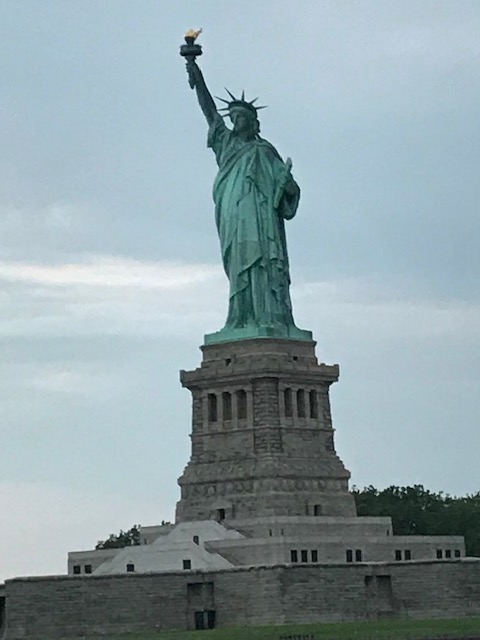
The poem has five sections. The first, “Back Then,” is a loose-metered sonnet with a beautiful description of the Statue of Liberty’s island, previously Bedloe’s Island, during primordial Time. The words he uses suggest a provocative idea, that Nature, without Man, operated in a state of utter slavery – “subject of the tide,” “vassals of the harnessed wind,” “slaves to hunger.” Before the mind of man “came ashore,” Where was the thought of freedom then?
What follows can be debated, that it was an English thought/ That there is no just government/ Unless by free consent,/ And in that English cause we fought. This was written for the Centennial of the Statue of Liberty, circa 1986. Today, I hear the criticism of saying “freedom” and “democracy” (popular sovereignty) are English ideas. How Euro-concentric! How chauvinistic!
After that lovely description of Nature in the first part, Part Two, “Our Risen States,” runs smack into the related problem of any poetry written for a nationalistic cause. True poetry can’t be patriotic, as Yeats knew. Wilbur knew this too. But after all, Wilbur was the Poet Laureate of the United States, and had certain duties to fulfill. It’s true that “free consent” in government was an English idea, if not exclusively, being in the work of John Locke that I once browsed worshipfully in a large early 1700s edition in the airless stacks of a university library.
He also salutes France’s help in the Revolution – Lady Liberty was, after all, a gift from France – and merges “liberty” in both languages as it led the French to rise/And beat with angry cries/ On prison doors and palace gates.
(I’m remembering now that Wilbur translated French plays by Moliere, and also wrote one of the most theologically powerful hymns in the Episcopal hymnal, “And Every Stone Shall Cry.”)
Part Three, “Like a Great Statue,” mourns for the dead who died for this country, but frames this in a fresh and complex way. The poet knows they did not think “liberty!” in the blink of time before they forgot us. No. Maybe they thought of Saturday night whiskey, or a beloved trout-stream, family voices at home, or the scent of sawdust. Whatever it was, we betrayed them, robbed their graves of a reason to die by the sins of our American history.
Here, the list is familiar to the sackcloth of our Biden years: pushing out the native tribes, breaking treaties, slavery (tersely put as “The image of God on the auction block”) . . .
The immigrant scorned, and the striker beaten,
The vote denied to liberty’s daughters.
Then this section changes to pride and praise, something I hope a President Harris era restores in our voices. Be proud at least that we know we were wrong,/That we need not lie, that our books are open. And: Praise to this land for our power to change it. To “learn what we mean and make it the law.” The last image of this section is King in the shadow of the Washington monument, free at last for Black Americans “to cast their shackles down” and wear the common crown of liberty.
Then it’s “IV. Come Dance.” A jig and jangle of “whatever spins around” and “Whatever takes the cake.”
Finally, then “V. Immigrants Still.”
Here, the seabirds and waves that were enslaved Nature in the first section can scud and wheel about “Our lady” Liberty with “A bright, cavorting air,/ And have the look of ransomed things.” As if humanity, free, can impart even on Nature herself a measure of creative freedom, at least “To our free eyes.”
Not that the graves of our dead are quiet,
Nor justice done, nor our journey over.
We are immigrants still, who travel in time,
Bound where the thought of America beckons;
But we hold our course, and the wind is with us.
May our good old Democratic Party – no longer uttering “white fragility” or muttering of “micro-aggressions” – win not only the Presidency but a House and Senate eager to solve some wicked problems. And may it do so with the sound of this poetry.


 Docs and musings