
I have been thinking of boundaries, those imaginary lines that our public life has constructed. In the poetry of Robert Frost, whose entire body of work I will never stop learning from, boundaries are the rock wall he and his neighbor repair each spring because “good fences make good neighbors.” Boundaries are the edge of one’s property, the “Witness Tree” at the corner of one of Frost’s farms that reminds him of the “truth” that he is “not unbounded”:
Though circumscribed with dark and doubt—
Though by a world of doubt surrounded.
I find an important kind of truth in Frost’s poetry because only there does truth radiate with the paradox of competing forces, throwing meaning outward like fading echoes into the far reaches of life. Good fences make good neighbors, but something (our longing for connection, our spirit of play?) “wants it down.”
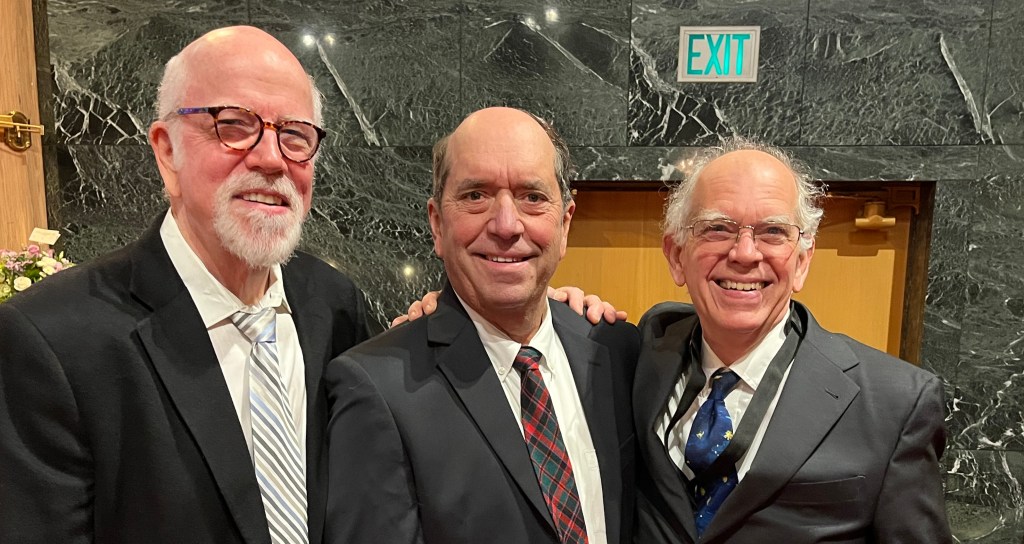
John McCutcheon, Walter & Doug Cumming
Boundaries were at the center of American politics in our recent election. The southern border, in particular. Trump is an embodiment of P.T. Barnum bunkum, “The Greatest Show on Earth,” so he knew instinctively that “Build the Wall” was effective shorthand for the fear we have of being “invaded” by worlds of foreign cultures and strangers. He was lucky (as he always seems to be) that in fact, hordes of immigrants, legal and not, came pouring over that border in the first three years of Biden’s presidency. The disaster had a number of causes, some Biden’s anti-Trump impulses. In any case, when Biden finally capitulated to a compromise on the border, Trump was lucky to get his allies to kill it, and to have most Americans miss the fact that Biden, finally, stopped the “invasion.” Too late.
I can think poetically about boundaries, fearlessly, because I am cushioned in my very comfortable life. I have cozy quilts of education that puts Frost’s poetry on the shelf with my well-annotated Oxford Bible. My life in Decatur “flows on in endless song/Above earth’s lamentation,” as John McCutcheon sings in his early recording of “How Can I Stop From Singing?”
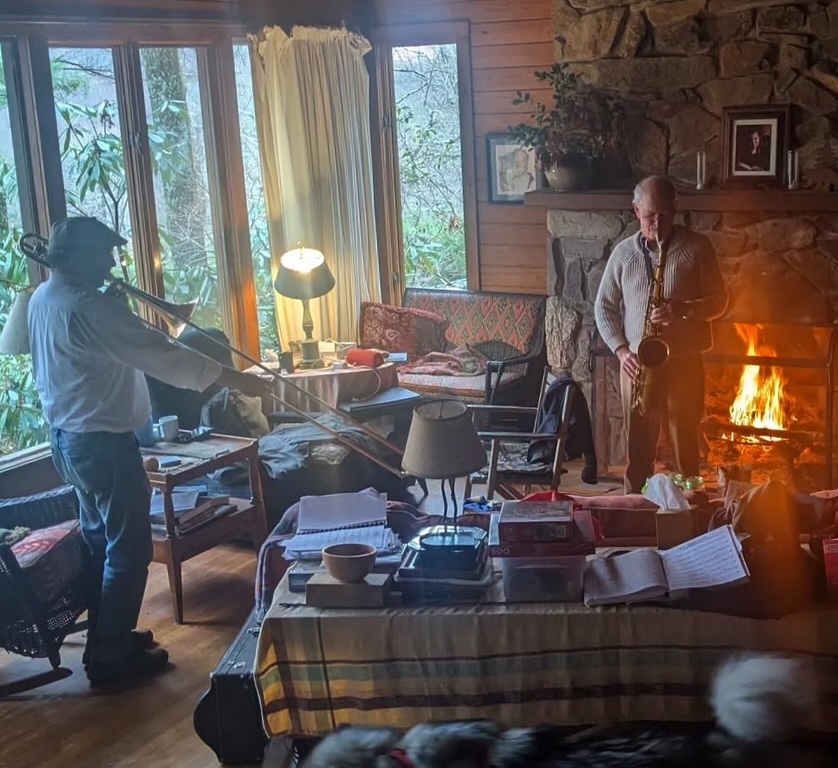
Yesterday, for example, was overflowing with this life for me. John McCutcheon himself hired three of us local musicians to play “When the Saints Go Marching In” to his banjo plunking at the funeral of his sister-in-law, Tersi Agra Bendiburg. John is married to Tersi’s younger sister Carmen, both sisters having immigrated from Havana as children fleeing Castro’s Revolution when they were children in 1964, under the Cuban Refugee Act. They were sponsored and welcomed by First Baptist Church of Decatur, whose pastor spoke at the funeral.
That’s the kind of immigration policy and welcoming church I wish people – voters – would support today. I see the homeless beginning to bundle themselves on the portico of Decatur United Methodist Church now that it’s getting cold. I saw another single bundle like that on the porch of First Christian Church of Decatur, where we played our jazz concert last night. Whoever was under that blanket outside had a worn-looking Bible beside his blanket. I asked William, the long-time music director, about this camper. He’s ok, he said, but didn’t know the man’s name yet. William was dressed in a feminine jacket with rings of fuzzy applique on the sleeves and a fur collar. His gayness, when one is as comfortable as I am with my identity and Christianity, was of course not a put-off but its opposite, an occasion to make a new friend.
But I’ve been thinking about boundaries as an important truth in our public life. Boundaries are a reality, a truth that Democrats need to acknowledge not only as the basis for our Constitutional rule-of-law but as essential for people’s sense of safety, for protection of the soul. People with fewer resources and comforts know when borders are being too-easily crossed. It gives them a feeling of rising crime, of their familiar culture being dissolved, of their values being disregarded.
Borders are important, but so is another reality, which is our world increasingly crowded with a multiplicity of cultures, religious traditions, and beliefs. Jewish and Christian tradition says to welcome the stranger. Further, Jesus said not to resist evil – whether it’s violence or the implied force of a wall – but to turn the other cheek and give more than a beggar asks for. But who is “the stranger”? In a world of multiple religious beliefs, and evaporating beliefs – are not we as much strangers as “them”? We are all strangers.
I look for a word to describe a value that transcends the paradox of borders. The word “pluralism” may be the best, but doesn’t have the appeal of a deep human value – at least not yet. It smacks too much of an academic abstraction. But it is the value that seems the one we need the most. (Most desperately, today, in places of savage chaos like Sudan, or the hopeful chaos of a liberated Syria.) Dig into the ideal of pluralism in America, and you find that American philosophy called Pragmatism, the animating spirit of action and unfolding truth behind the Age of Reform from Grover Cleveland to Teddy Roosevelt. Barack Obama took pluralism as his message in a lecture he gave in Chicago the other day. He said problems emerged with the rise of identity as a soul-forming element and the jostling of identity coalitions that followed.
“[P]olitics,” Obama said, “wasn’t just a fight about tax rates or roads anymore. It was about more fundamental issues that went to the core of our being and how we expected society to structure itself. Issues of identity and status and gender. Issues of family, values, and faith…. [A] lot of people…began to feel that their way of life, the American way of life, was under attack” just as increasing economic inequality made them think that other people were benefiting at their expense.
It’s about action, commented Heather Cox Richardson, rather than just words, because action requires that people invest themselves in a common project. “It won’t eradicate people’s prejudices,” Obama said, “but it will remind people that they don’t have to agree on everything to at least agree on some things. And that there are some things we cannot do alone.”
“It’s about agency and relationships.”


 Docs and musings