
In May 1994, a conservative politics professor who would be my colleague at Washington and Lee University years later, Bill Connelly, was co-author of a new book on why Republicans were forever losing in Congress. It was titled, Congress’ Permanent Minority: Republicans in the U.S. House.
Later that year, Republican House leader Newt Gingrich released a “Contract for America.”
It was brilliant. It was clear. And it worked – in that the GOP took control of the House for the first time since 1953. And it took the Senate.
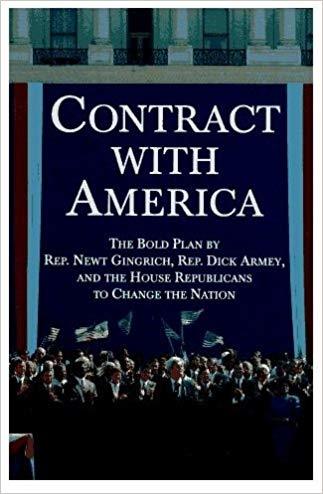
Gingrich and co-author Dick Armey had found issues that more than 60 percent of Americans agreed with, and included in the “Contract” eight bills to implement reforms in those “safe” areas. It avoided more controversial issues like abortion and school prayer.
It also described ten bills, less certain of outcome, that it promised to bring to the House floor.
The Contract for America fluffed itself out with text from Ronald Reagan’s 1985 Inaugural Address. It was released six weeks before the Nov. 8 midterm election in President Clinton’s first term.
The Republican Party flipped both chambers, gaining 54 House seats and eight Senate seats. Its legislative agenda was not a great success – most of the Contract’s bills failed or were vetoed by Clinton. But giving the “out” party control of Congress put that branch of government back in play as a co-equal balance, installed Gringrich as House speaker, and set a foundation for a conservative agenda that would grow and grow. The Heritage Foundation, which wrote Trump’s Project 2025, was responsible for most of the ideas in the Contract for America.
Credit for the Republican Revolution of 1995 might not rest entirely on the Contract.
But the Democratic Party should study it closely, and not wait until six weeks before midterm elections Nov. 3 to promise the American people something specific and popular. The Contract, signed by most Republican members of the House and Senate, nationalized the midterms. Democrats should do the same.
Smart people in the national Democratic Party should be able to come up with the wording on bills for things most people care about:
- Help with the cost of healthcare, including mental health, and healthcare insurance.
- Affordable quality childcare to provide families with choices and not discourage the having and raising of children.
- Retain middleclass tax breaks but not for the super rich. Individuals earning more than – pick a high annual figure, including stock values – will be taxed at higher rates.
- Some kind of reasonable regulation of AI and crypto currency that gives the American people at least a seat at the table with Big Tech.
- Something about investment in a clean-energy future, emphasizing the opportunities for jobs and restoring America’s standing as a world leader on energy, not an imperialist plunderer of foreign oil.
- Laws to clean up Congress’s own act. The Contract for America was explicit on ways to make Congress itself more transparent and less corrupt. Democrats could promise campaign finance reform, laws of self-restraint and maybe at least a debate on term limits.
- A law protecting the independence of agencies whose non-partisanship was assumed, like with the Federal Reserve and the CDC. Also, restoring the role of inspectors-generals and other objective measures for holding government accountable, in both branches. Maybe also a law saying Presidential candidates must release tax forms and their physical reports.
- A law that make explicit what is in the Constitution already, that the President cannot take or make money (much less, billions from foreign interests) for himself or his family while President.
Trump is scared of the scenario. The Democrats win both chambers and he may be impeached again – and this time convicted. That may be. Jack Smith has testified about a strong case his team gathered for felony convictions on charges that were not brought in time for a trial. These were criminal charges, on solid law and evidence, that would make Trump the worst kind of criminal in U.S. history since Benedict Arnold.
But a Promise, or Covenant, or Contract from Democrats should be silent on Trump. It doesn’t move the needle to jump on Trump, except in Trump’s favor, oddly enough. This contract should not even propose an obvious Constitutional amendment not allowing a convicted felon to hold office. (He was convicted, remember, on a case much less important than the ones Jack Smith could have brought.)

Nor should it bring up ICE’s Storm Trooper actions, which are social-media content-providers that Trump and Miller have cultivated because it distracts Democrats and Resisters from their best winning issues with a losing issue for the Dems: immigration. All Americans support legal immigration and border security. But, sorry, Joe Biden’s tardiness in stopping a surge in illegal entry was part of his tragic hubris and identity politics.
Instead, a Democratic contract should focus on laws that will bolster the power of Congress to check abusive Presidential power in the future, Right or Left, so that the legislative branch never again falls into the abyss where it stands today. For example, a law that says the President can’t “claw back” money already appropriated by Congress.
If I spend time this summer knocking on doors in the reddest congressional district in Virginia, which I hope to do for Beth Macy (a fellow retired journalist, author most recently of Paper Girl, pictured here), I want to be able to say what the Democrats will do if they win the House and Senate. And I hope the people I talk to can say, “Oh yes, I know what the Democrats have promised to do.” They may not agree with it, but at least they know what it is.
I don’t think any of us knows what it is yet.


 Docs and musings
Doug, Get your article to every democratic operative you can!