
“So this monument, lifted far above our daily strife of narrow interests and often narrower passions and misunderstandings, becomes a monument to more than its one great and rightly loved original. It symbolizes our whole South’s better self; the finer part which the world not always sees; unaggressive, but brave, calm, thoughtful, broad-minded, dispassionate, sincere, and, in the din of boisterous error round about it, all too mute.”
— 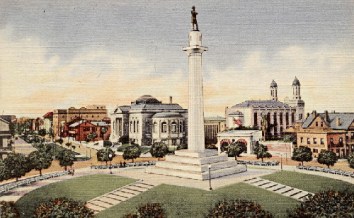 from George Washington Cable, “The Silent South,” 1884
The distinction of New Orleans is in its cemeteries, from miniature cathedrals “to a small artificial mountain containing the mausoleum of the Army of the Tennessee, General Albert Sidney Johnston atop, astride his horse and still in command. The great Texas general gazes at Robert E. Lee himself atop his column across town. It is easy to imagine a slightly bemused expression on the faces of these stern Anglo-Saxon commanders as they contemplate between them this their greatest city and yet surely the one place in the South most foreign to them.”
— Walker Percy, “The City of the Dead,” 1984
“To literally put the Confederacy on a pedestal in our most prominent places of honor is an inaccurate recitation of our full past. It is an affront to our present, and it is a bad prescription for our future. History cannot be changed. It cannot be moved like a statue. What is done is done. The Civil War is over, and the Confederacy lost and we are better for it. Surely we are far enough removed from this dark time to acknowledge that the cause of the Confederacy was wrong.”
— New Orleans Mayor Mitch Landrieu, 2017


 Docs and musings