
A “mushroom hike” is a slow-moving thing. The two organizers of our hike last Saturday were debating which trails to follow, thinking the 14 of us would cover a mile or two. But one of our two guides, Sam Landes, treasurer of the Mushroom Club of Georgia, stopped them. We’re only going to cover a few hundred feet every 15 minutes, he said.
The 2 ½ hour hike would cover about a half mile up the abandoned Drunken Spring Road and Corn Hill Knob trail, since that was the wetter choice, three days after the last rain. He and his wife, a pediatrician and researcher in economic botany named Cornelia Cho, were leading. They had come to this North Georgia mountain in a car with the license plate of “FUNGI” and Sam wearing a pro-mushroom t-shirt and bearing a basket with a plastic container for about two dozen specimens and two magnifying loops.
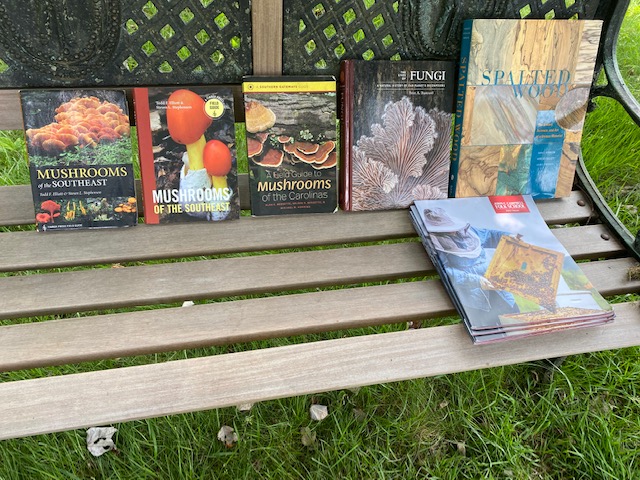
Our fungi hike also included four rambunctious dogs who got up to their dew claws in mud. After the hike, we gathered for a sweet picnic in a maple’s shade, piling goodies on bagel slices downed with bubbly. Sam didn’t give the summing up lecture I was hoping for, but he had spread five beautiful books on the old golf links bench – The Lives of Fungi: A Natural History of Our Planet’s Decomposers, Bunyard; A Field Guide to Mushrooms of the Carolinas, Bessette, et al; Mushrooms of the Southeast, Todd Elliott et al; Spalted Wood, on the lovely blue-green wood of the fruited Emerald elf cup (chlorociboria aerugiosa), and catalogues to the Campbell Folk School. And he did answer questions while I took notes.
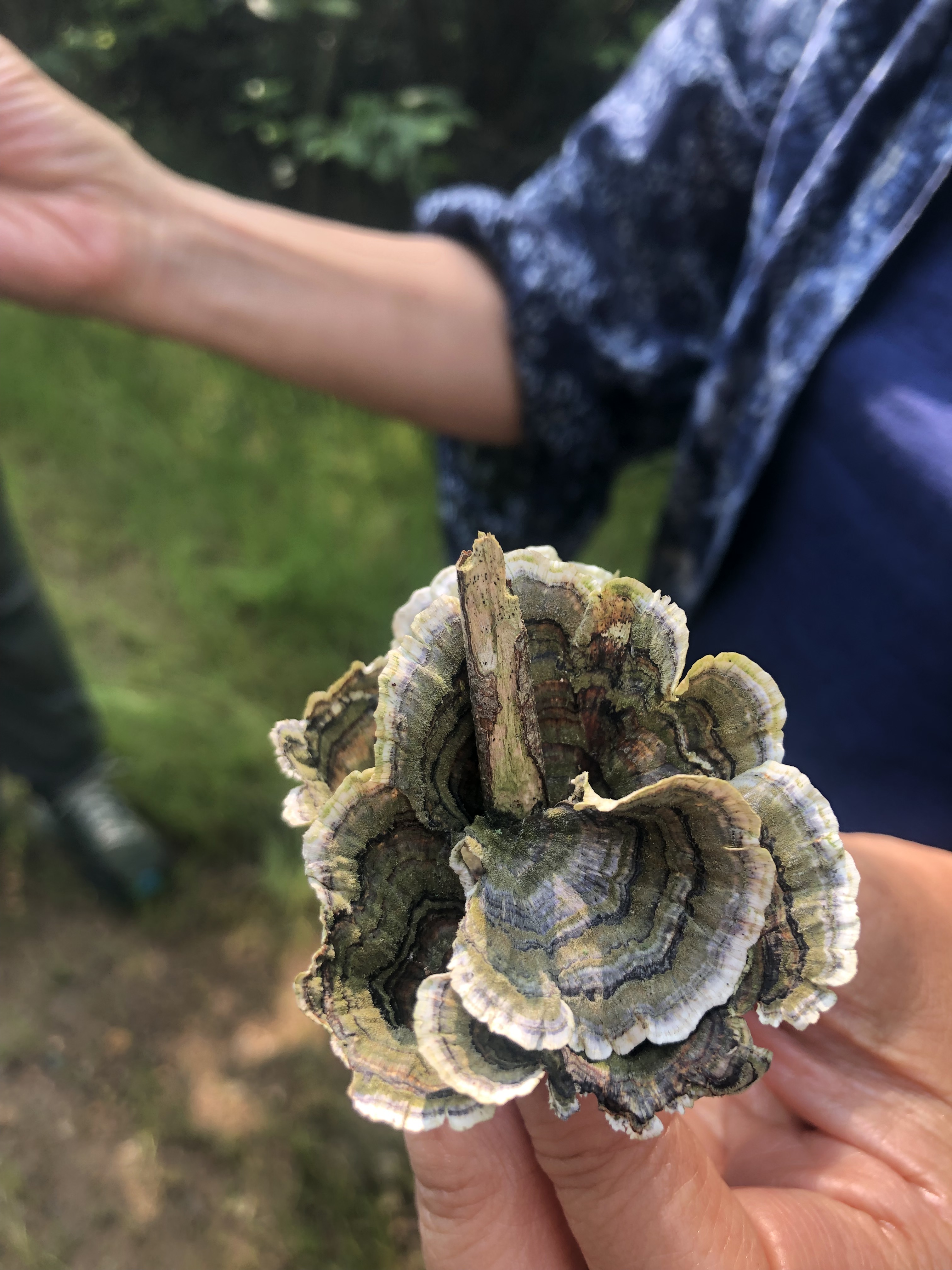
Too many kinds of fungi fill the woods for our decomposing brains. But there was something exciting about the knowledge Sam and Cornelia were wasting on us. They spoke Latin names of genus and species of Russula, morels and Amanita, naming parts too small to see without a loop: gills, spores, and the tiny pin holes on the underside of the polypores. They told hopeful stories of natural medicinal values, like the extract from the true Turkey Tail (pictured above) that can boost the immune system against certain cancers, and the spit poultice from the common plantain weed that once stanched swelling when Cornelia was stung in her hand by a few yellow-jackets, she told us. Sam would vanish into dark bracken grottoes to find the tiny red pimples called Wolf’s Milk or a slime mold (not a fungi but a mycoparasite, not to be confused with mold in your house). He would explain the morphology of what you see on the ground or on rotting logs, and what you don’t see, the vast networks of mycelia that communicate and transact energy with “mother trees” in ways that make the science of it sound mystical. Or at least Lamarkian.
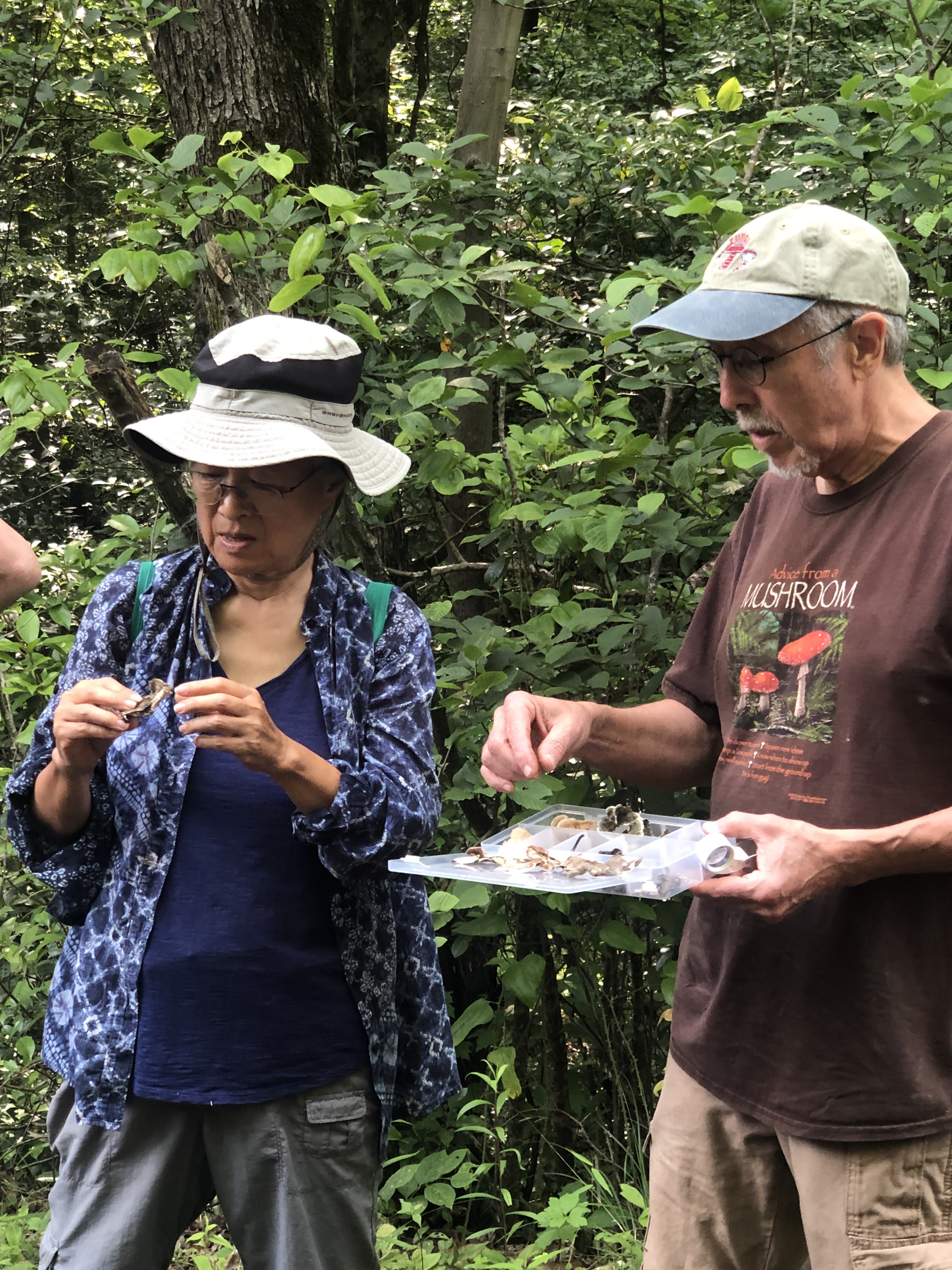
Sam and Cho brought us more than the names we couldn’t remember, let alone spell. They opened our eyes to a glittering reality deep in the dank cycles of life at our feet, a magic we previously only suspected in our savage love of these familiar trails.This is what Sam and Cornelia actually left in our brains, the experience of the naming that science does, but in this case narrowly focused on the life of our wild woods. In a dazzling documentary I watched later on Netflix, “Fantastic Fungi,” Michael Pollan describes fungi enthusiasts like Sam and Cho as being in the tradition of 19th century amateur botanists and naturalists, the scientists of their day. Whether we remember the names or the parts, we know that these have names and categories that have been discovered by “amateur” scientists like Sam and Cornelia.
We are now a part of that, the shared world of human language at the delectable tip of human curiosity (like the tip of cat briar we were invited to chew like deer). Language is the human mycelial mat, concepts mysteriously networked in our neural pathways and shared everywhere in our books, picnic conversations and iPhones. We feel sanctified by a collective curiosity, stalking fungi that emerged even before the flowers, the angiosperms of our 100-million-year period (represented by what remained of the pink lady slippers at our feet, flowers that bloomed briefly in April). They emerged even before lichen, which Sam described as “fungi that has taken up agriculture,” usually two merged fungi with a bit of algae to share its photosynthesis.The fantastic fungi were here even before the photosynthesis of plants, which let animal life flourish, We are learning how the trees cooperate in a beautiful communication and trade policy with fungi, which sequester 70% of the carbon that trees breath in from the air, thank you very much.
They were here before us, and as the documentary says, they’ll be here long after, if we don’t learn how to live in harmony with these efficient underworld decomposers and resurrectionists.


 Docs and musings