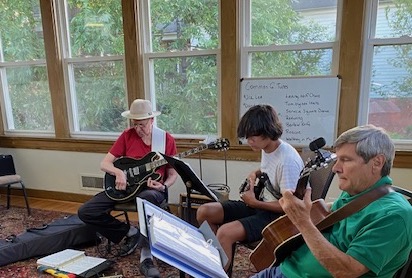
[from my profile of Frank Hamilton in Salvation South]
I guess you could say I became part of the Frank Hamilton community before I met him.

I realized this one Sunday afternoon as I sat listening to the Showcase, a recital of all the Frank Hamilton School’s classes at the end of each eight-week term. Our daughter, Sarah, would sing “Summertime” with her harmonica class. My wife, Libby, would play stand-up bass with her string-bass class and sing with my sister, Anne Preston, in their “Sing Your Heart Out” class.
And though I had taken no classes, the harmonica class was letting me play my tenor saxophone on “Watermelon Man.”
Each class performed on a tiny stage, in between school director Maura Nicholson’s cheerful groan-worthy jokes. This was in the administration building of what had been a sprawling Methodist orphanage across the street from Columbia Theological Seminary. Many in the audience were also performers, but some were not. The local physical therapist of my wife and daughter was in the audience (sitting beside Frank Hamilton, by chance) because they invited him. I recognized some old family friends near the front—local actress Carolyn Cook and her husband Matt Cook, a retired radio newsman my father had taught in college. I have no idea why they were there.
Sitting at ease in this audience, I had an epiphany. I turned to my sister, and whispered, “Do you realize that none of the women here are wearing makeup and none of the men have tucked in their shirts?” Most of them wore T-shirts. These are our kind of people, I said.
No, that sounds too exclusive. At the Frank Hamilton School, the cultural identity is loose, open, accepting, and honestly joyful. The variety of musical styles and musical skill levels signifies that openness. Music is a unifier. The humanity of the whole world is here.
As I was thinking about this, a young woman with beautiful dark Middle Eastern eyebrows above her black N95 mask played a hurdy-gurdy, one of her hands cranking it as her other hand played something fast with nimble fingers. The musical mode was one I had never heard before, and it made me smile. The teacher on the hurdy-gurdy was Melissa Kacalanos of New York. Her four adult students were all pounding out the same hypnotic rhythm on hand-held Goblet drums, the Egyptian doumbek. They were all beginners.
It transported us at no cost to another part of the world, to another age, and felt all the more that we belonged to the present in our home community.