
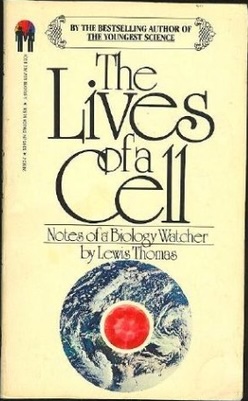
In the early 1970s, Lewis Thomas wrote an essay about computers that is painfully outdated now. I just re-read it in an old collection called The Penguin Book of America’s Best Essays. To me, reading Thomas’s “Computers” is painful because he was such a great writer in his day, combining the laconic humanist style of his Princeton education with the insights of biological science. He was president of the Sloan-Kettering Institute, the cancer research center in New York, and a regular columnist for The New England Journal of Medicine. This essay appeared in that great book, The Lives of a Cell, in which Thomas puts each of his biological and technological subjects into the reassuring perspective of our greater humanity, language, and art. At the time, when I first read the book with awe, this essay seemed a brilliant insight into computers, claiming that they were a long way from replicating the human connections that wrapped the entire globe, like a cosmic cell, in an infinite network of shared “information.”
But that is no longer true, with the advent of Artificial Intelligence.
One thing Thomas missed was the inexorable shrinking of the size and cost of microcircuitry. He imagined the limits of a “machine as big as Texas,” should computers reach that size. And he couldn’t imagine the wealth that our tech oligopolists have amassed today. Another thing he missed is the billion-voiced internet and the way AI has stolen not only 30 years of our infinite human chatter online, but gigantic libraries of what was in books before that. All of it, I say, was stolen without permission or payment and the Big Theft was protected by the delusion that social media companies were merely “common carrier” utilities.
“To match what we can do,” Thomas wrote, “there would have to be 3 billion of them (the population of the world is now around 8.3 billion) with more coming down the assembly line, and I doubt that anyone will put up the money, much less make room. And even so, they would all have to be wired together, intricately and delicately, as we are, communicating with each other, talking incessantly, listening.”
Well, this is exactly what AI is doing, and at speeds that seem instantaneous compared to our slow stroll of thought and need for solitude. In the latest iteration—are you following it?—discreet AI assignments, called “agents,” are working together as “swarms” like bee or ant colonies that need no leader or human oversight. They are poised to conquer unimaginable new realms. The only limit is that they are immaterial, without a physical body. But Incarnation is at hand. Imagine a swarm taking over Waymos, the self-driving cars. Or getting into our nuclear missile systems, heretofore placated by Mutually Assured Destruction (the MAD part that has kept us un-bombed was purely human, remember?). Or a bio lab where a Covid-like virus could be programed to be far more effective than Covid-19 at weeding down humanity.
Alarmists coming out of Anthropic are giving us an apocalyptic warning that AI could kill us all within 10 years. Maybe. Or cure cancer.
But either way, this kind of thinking has given the too-rich oligarchs of Big Tech a feeling that they are gods of a new religion. They are building their own protected paradises in Hawaii and Argentina, or convinced that they can escape Armageddon on Earth for Mars, or somehow achieve digital immortality.
The growing opposition to new data centers seems to be coming from the public’s realization that these High Tech gods are, maybe, completely insane. I hope it’s not too late to pump the brakes a little, at least. I can’t think of any better way to do that than to vote for Democrats up and down the ballot in the coming midterm elections. The Democratic Party may be as discombobulated as the other one. But it least at can bring Congress back to life and bring some accountability to this insanity.


