
There’s this memory I have, but it couldn’t have been mine because this is before I was born. It’s 1946, thereabouts. The memory is of a college campus high in the Cumberlands of Tennessee, misty Gothic buildings, professors in loose academic gowns. An undergraduate history major has just finished reading Robert Penn Warren’s new novel, “All the King’s Men.”
He walks across the quiet campus after midnight with the novel’s last phrase in his head, “. . .out of history into history and the awful responsibility of Time.” He is re-entering his own Time, but with his imagination on fire, like the red-hot glow of heat shields when a spacecraft re-enters the earth’s atmosphere.

This is not me, but my father, Joe Cumming, who must’ve implanted that memory in me. Whether he told me about it or it came to me by the unscientific mystery of epigenetics, I have lived a life that feels supported by my father’s liberal-arts education.
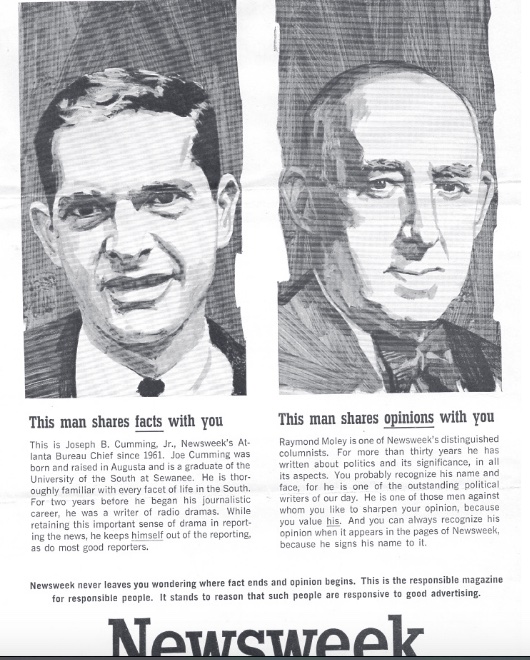
I followed in his footsteps, by dumb luck and privilege, without a map. He was a journalist, the Southern bureau chief for Newsweek magazine from 1961 to 1979. Then he earned a master’s degree from Emory University and enjoyed a second career with ten years of teaching at West Georgia College in Carrollton, Georgia.
Me? I was a newspaper reporter for twenty-five years, after a liberal arts college education. In 2002, I got a Ph.D. in mass communication and taught undergraduate courses for the next twenty years.
Now, I realize, I do have a map. It’s one that Daddy created to help his journalism students understand the connections – the goddam relevance – of history and news. He called it a Time Map.
His Time Map was the ultimate learning tool, a picture in your head that lays the foundation for more learning. A lot more. It was a mental scaffolding, a framework built out of Three Centuries, Four Wars, Six Presidents and various inventions, all dolled up in visual imagery. Think of three football fields, the 50-yard line marked off in each as 1750, 1850 and 1950. Now, rough in those Four Wars, Six Presidents and so on. Daddy loved the theater, so he also drew these Three Centuries as proscenium stages, with curtains opened on colorful costumes, personalities and cultural icons.
Woven through this time grid, like golden threads, were Four Big Ideas.

With a highly visual Time Map, your brain was ready to build a lifetime of knowledge and information that fit together. It was not rote memorization, but a map, neatly unfolding over a lifetime. Coherence would be joyously made out of the scraps coming at you in college history classrooms, movies, books, the latest technology, daily news, politics, work and, whizzing by you, life itself.
Daddy developed and field-tested his Time Map for twenty years, with college students, high school students, fourth graders, “Continuing Education” adults, friends and family members. He taught it for free, no grades and no credit. He sent it off to newspapers and to retired Supreme Court Justice Sandra Day O’Connor. He tried repeatedly to give it away to the Education Establishment, which repeatedly rebuffed it. His Time Map died.
But I find myself coming back to it these days, especially the Four Big Ideas.
- Democracy
- Free Press
- Checks and Balances
- Free Enterprise
Understand these ideas historically, in their Eighteenth Century incubation and three centuries of evolution, and you will be less bored with your job, if you have one. You will grasp the news in the undertow of its true meaning. Understand these ideas historically, and we might grope our way out of the tribal identities that are dividing us and driving us crazy. Driving me crazy, anyway.
***
Democracy? It’s not just the word for something Democrats say they’re worried about losing. Hell, Trump folks think they are the ones supporting democracy by holding on to a voluntary movement of Real People under his powerful sway, questioning no-excuses pandemic-era mail-in voting and hating the rule of elite “experts.” In the Time Map framework, Democracy has deep roots in ancient Greece and is incarnate in the writings of John Locke and Jefferson’s Declaration, the self-evident truth that “all men are created equal” and have equal rights. It’s a Big Idea, breaking the shell of the word “men” to mean “human beings,” as history hatched better ways of living together. But how are human beings equal, with such inequality all around? It’s only under the law, such as it is – equal on a jury, in the dock and with a voting ballot.

But voting isn’t equal under the Electoral College system, you say. True, and that brings us to Checks and Balances. It’s common today to say those “checks and balances” were about giving Southern slave states a check on the growing industrial population of free-labor states, and this is true. But as a concept from the 18th century, checks-and-balances was not a compromise but a scientific principle. Montesquieu (1689-1755, with about 10 names in his full aristocratic French title, like Lafayette’s) wrote about the spirit of the law as if it were a philosopher’s version of the clockwork universe of Sir Isaac Newton and Johannes Kepler. He also argued for religious tolerance as if it were a law of history and natural philosophy. The Founding Fathers drew on Montesquieu in writing the Constitution and Bill of Rights, and Daddy had this 18th century background in his head when he would teach a news story about a conflict on the Supreme Court or in Congress. The Time Map made that connection between history’s personalities, today’s news, and you and me.
Free Press? The First Amendment, marked in 1791 on the Time Map, tells Congress to “make no law abridging the freedom . . .of the press.” “The press,” at that time, was a marvelous machine that had not changed much since it was designed by Johannes Gutenberg around three hundred and fifty years earlier. The printing press, with movable type, had such power to change the Western world, the English Crown limited who could operate one. Royal licensing extended to the American colonies. Benjamin Franklin’s brother James flouted that and was jailed. Another colonial editor made the royal governor of New York look bad by printing the truth about him, which landed the fellow in jail. He was freed by a jury that defied the law of “seditious libel.” That’s the background to freedom of the “press” – a word that in the 20th century came to mean members of a respectable estate called journalists. Daddy was a journalist who would trace ideas of freedom and truth back to the poet John Milton and his famous defense of an unlicensed press. In 1644, Milton said: Let Truth and Falsehood grapple in a fair contest. “Who ever knew Truth put to the worse, in a free and open encounter?”
Milton, thou shouldst be living at this hour! These days, Falsehood seems to win quite a few of those encounters. These days, a free “press” is indiscriminately identified as “the media,” and attacked from all sides, from the Left, the Right and from your average non-news-reader.
Free enterprise? Capitalism is blamed for a lot of ills today, and rightly so. Its theory of individual freedom can be blind to the common good and to the damage that perpetual growth inflicts on the earth by over-extracting resources. But the theory behind free enterprise is another one of those 18th Century Big Ideas that needs to be understood in its place on the Time Map. Conveniently, Adam Smith’s classic on the theory, The Wealth of Nations, was published in 1776, the year of the Declaration of Independence.

As Adam Smith described it – and recommended it – free enterprise was an “invisible hand” that benefited everybody when each individual was free to pursue selfish interests. I know, it sounds disastrous, and immoral. But it assumed each individual had “moral sentiments,” which was the subject of an earlier book by the good Scotsman, Mr. Smith. Free enterprise also benefited from what’s called the “division of labor.” If I specialize in what I’m good at and enjoy, and you do your specialized job, then, instead of my spending a year trying to manufacture a pin to sew my own clothes, everybody can buy pins and clothes. Rather than my gain being your loss (the jungle of zero-sum competition), the division of labor gave the world an unparalleled abundance, after centuries of hoarding by the strong and scarcity for the rest of us. Capitalism harnessed the great human energy of greed, domesticating it into the profit motive, and created the best life that average people have ever known.
But it went off the rails. Or rather, monopolized the rails (and steel and oil) and made consumers pay whatever was asked. The beauty of Daddy’s Time Map is that, as Gertrude Stein said of history, “it takes time.” Things change. The muckrakers and Teddy Roosevelt broke up the trusts, taxed the Robber Barons, and made the income tax “progressive” by graduating tax rates upward for high incomes. Government regulations shut down quack medicines and made meat safe. Utilities got protected as “natural monopolies.” When I covered the “energy” beat for a New England newspaper in the 1980s, I watched the partial deregulation of airlines, Ma Bell, cable TV and energy, as government adapted to new technology and consumer demands. Those were mostly bipartisan fixes, in those days.
***
January 6, 2021, changed everything. The New York Times described the day this way: “Militiamen showed up proudly bearing the emblems of their groups – American flags with the stars replaced by the Roman numeral III, patches that read ‘Oath Keepers.’ Alt-right types wore Pepe the Frog masks, and QAnon adherents could be seen in T-shirts urging people to ‘Trust the Plan.’ White supremacists brought their variant of the Crusader cross.”

Daddy had died two months earlier in a pleasant life-care facility, where he had lived among his books and journal scrawls ever since Mama died four years before that. He didn’t contract Covid, but the isolation of its social distancing finally did him in.
It was remarkable – frightening, really – how close we came to losing those Four Big Ideas at that moment in history. Georgia was at the center. Remember? The day before the Capitol riot, January 5, in my native state of Georgia, we had two – Two! – runoff elections for U.S. Senators, and Democrats won both. This gave the newly elected President, Joe Biden, the bare majority he needed in both the House and Senate to get much of his agenda passed over the next two years. (Look now at all the new “green” jobs Georgia has in manufacturing. Thank you, Democrats!)
Meanwhile, the loser of Nov. 3, 2020, President Donald Trump, needed only a few legitimate doubts to support his wild and insistent claims that he had actually won in the few states where close votes swung the election to Biden, including Georgia. Amazingly – a miracle from above? – no legitimate doubts were found, despite 62 lawsuits Trump filed questioning the votes in those swing states. Conservative Republican officials, back then, stood up for the rule of law and the Constitution, even when they might have felt bullied by Trump. For example, Judge Bobby Lee Christine, a Trump appointee briefly serving as Acting U.S. Attorney for the Northern District of Georgia to replace the one fired by Trump, found no voter fraud. Just think: What if he had gone along with Trump and “found” something? In those few days when Democracy, Checks and Balances and all the rest bore the strain of an “unprecedented” President, the thread held.
But miracles like that cannot hold beyond their day. You can’t build booths on the hill of a transfiguration. People forget. Politicians change with the polls.
***
A simplistic framework of American history seemed a hopeless project, especially one as liberal and democratic as Daddy’s. He would laugh at the irony of Newt Gingrich and Donald Trump trying to kidnap a liberal, self-correcting Enlightenment story and turn it into an un-evolved, Bible-blessed, right-wing American history. But Daddy was not a real historian. He was a liberal journalist. Journalism was not quite a real profession, like medicine or the law, and not quite a real academic discipline. It was an American improvisation, like jazz. Journalism was applied liberal arts, without certification.
Government was neither the solution nor “the problem,” as Reagan called it. It was part of a great human story, if you had the map to follow it. It was a story of old injustices being faced, protested, and imperfectly reduced. It was one problem after another, grindingly fixed under an ever-changing order still called democracy, with checks and balances and so on. On balance, Daddy and I both believed, America was a self-correcting system that bent slowly, like the arc of the universe, toward justice. If you know where you came from, you can see the improvement, and what the next real problems are.
It’s 2024. Daddy’s dead, and I can’t find anybody who believes all that anymore. I read the news every morning, and it still makes sense to me. I understand why many are discouraged and depressed. But I keep the faith.
“It is sad to squint the eyes into the future years of people who separate learning from life,” Joe Cumming wrote in one of his biweekly columns on the book page of the Atlanta Journal-Constitution in 1983. “Students who persist in this will become dangerously bored and boring when the fluff of youth wears off. Such a dumb doom is unnecessary. Once the flame of learning catches it can, in time, become a firestorm.”
Another version of this essay was published in Salvation South, the online magazine, May 25, 2024.


 Docs and musings
This is terrific! Thank you.
Pingback: Populism vs. ‘Civilization’ – An American journalist heads for Italy to see his country changing from afar.