Term’s End

Another semester is ending. It always feels a little messy, like cleaning up a gymnasium after a big dance party during which (you remember) some things happened you wish had not happened. But several of my students have sent me emails exclaiming what a great experience they had, and this makes me remember the good that has come out of the two courses I taught.

Especially JOUR318, “The Literature of Journalism.” We read and discussed, in grad-school seminar fashion, most of the great American writers who combined journalism and prose craft: Stephen Crane, Lafcadio Hearn, W.E.B. DuBois, Joseph Mitchell, Gay Talese, Truman Capote, Joan Didion, Hunter Thompson, Tom Wolfe, Ted Conover, Isabel Wilkinson and more. The nine students also tried their hand at a news feature, most of which were published (guest appearances) on our department’s weekly Rockbridge Report website. A few examples here, and here.

But what most floors me are several of their final projects. Some did research papers, but others tried long-form journalism, or what might be called creative non-fiction. In one, Alexandra Seymour wrote a poignant narrative about the incredible life of her 81-year-old father, who pioneered global clothing imports such as pocket-tees and managed old pop-chart figures, including Chubby Checker. Another, by Jackie Clifford, turned interviews with her grandfather into a tightly crafted thriller about his surviving 43 hours in the water after his aircraft carrier was sunk in the Pacific by a Japanese shell. Caroline Holloway, who discovered Freddie Goodhart’s magical shop of priceless junk in a class exercise in which we scattered around Lexington in pairs, wrote a charming profile of that free-spirited descendant of the McCormick family. I would love to see these published in some classy magazine. But wait – why not just put them on the web?

You hear people saying negative things about the Internet, but I’m thinking good thoughts about it at this beginning of Advent. It’s a great light for a people who dwell in darkness. I’m thinking of all the WordPress blog posts I’ve written, from Ireland and Italy and for my parish church. They’re all there, a link away.  I don’t bother to push these out to the world with keywords or Search Engine Optimization, but I know how to find them, like journals of my last 10 years sitting on a shelf in my bedroom. I think of good feature stories that some of my students have written, and realize that I can call up many of them in half a minute. To pick one I just remembered, somewhat at random, here’s a fine narrative about the little town that has almost vanished, Rapp’s Mill. There are a lot more, the culmination of semesters past and (nearly) forgotten.

Posted in Uncategorized | Leave a comment

Emily, a full life, complete

In the Atlanta Journal-Constitution, Dec. 1, 2016:

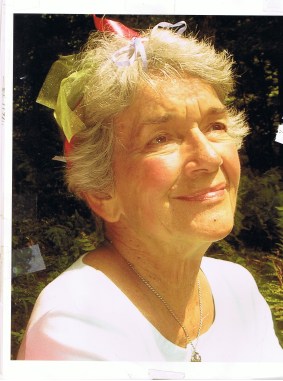
emily-cumming-head-shotEmily Wright Cumming, a multi-talented, dynamic fourth-generation Atlantan, died Nov. 27 at age 90 after a brief illness.
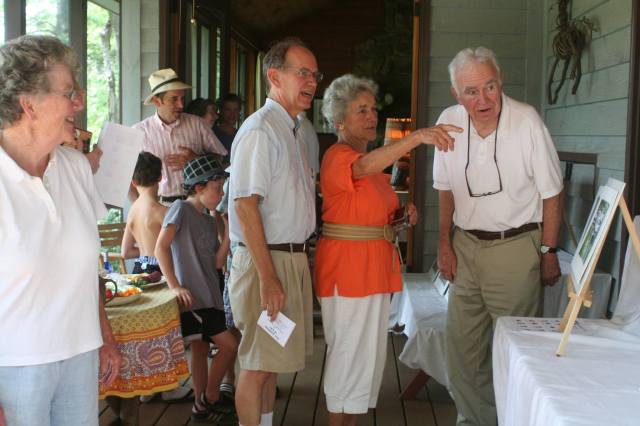
She is survived by her husband of 68 years, Joseph B. Cumming, Jr.; four children; seven grandchildren, and three great-granddaughters. Together, Emily and Joe Cumming set in motion circles of friends who joined them across the decades in a creative life of work and play in Augusta, Atlanta, and Carrollton.

She was a longtime member of the Habersham Garden Club, which her mother Gertrude Wright helped start in the 1920s, and wrote its “Modest History and Apocrypha.” A passionate environmentalist, she was also active in projects of the Georgia Conservancy and helped start a recycling program and tree-plantings in Carrollton. She was a member of the Colonial Dames, the Junior League of Atlanta, and the Episcopal Church Women of St. Anne’s Episcopal Church.

She was born in Atlanta on Sept. 2, 1926, the second of five children of Gertrude (Whittier) and Douglas Berry Wright. As she wrote to her namesake, her one-month-old great-granddaughter Emily Beckley, in 2014: “How lucky I was, from the beginning. First, to have two smart, shy parents, who were gifted, artistic, and really serious about raising healthy, unspoiled children. Second, to be raised in a deep forest in a big stone house, with plenty of room for playing or hiding, or privacy for reading, and great spaces for big dinners or dances when we were teenagers.”

Emily was a competitive child athlete, winning state awards in diving and badminton. She was educated at St. Genevieve-of-the-Pines, Washington Seminary, Hollins College, and Agnes Scott College. In 1948, she married Joe Cumming and they moved to his ancestral home, Augusta, where all four children, Bryan, Doug, Walter, and Anne, were born. In 1956, the family moved to Atlanta. Joe worked there for 22 years reporting on the South for Newsweek magazine.

Emily, through those years, managed a vibrant family life of jazz-band parties, literary house parties in a vacation home in North Georgia, and environmental activism. She worked in public relations for a clean-energy company and campaigned in Wisconsin for Jimmy Carter. In these years, “I discovered I could write,” she wrote to little Emily. She had an essay in Newsweek and Reader’s Digest, and wrote several privately printed histories, including one about the family tree of her great-grandfather Maxwell Rufus Berry (1823-1909).

She and her husband were an energy-generating unit, in a marriage that Joe Cumming wrote about in Esquire magazine in 1977 proposing a new verb, “monog-ing,”  for the “dark magic practiced by certain married folk.” From that article:

“. . .let me describe Emily as I see her: a broad-browed and smiling brunette with short, often unmanageable hair, as lithe and light of step as when I first met her in World War II (I won’t ask you to believe under the Biltmore clock, but it’s true), cool as a schoolgirl lit with mischief, yet warm in the womanly ways of a world-famed mistress. I could go on and mention qualities from the likes of Julie Andrews, Erma Bombeck and Annie Dillard, but it would embarrass her and make you suspicious.”

Her surviving brother is Jim Wright (Emily), of Dixon Cove, Tenn. Siblings who preceded her in death were Whittier Wright (Sena), Oliver Wright (Mary Semmes), and Miriam Kiser (John). Besides her husband, she is survived by her children and their spouses, Joseph Bryan Cumming III (Holly) of Nashville; Douglas O. Cumming (Elizabeth) of Lexington, Va.; Walter W. Cumming of Holly Springs; Anne Cumming Preston (Clay) of Decatur. Also, grandchildren Anna (Cumming) Beckley (Gary), Alston Cumming (Julie), Helen Preston, Paul Preston, Daniel Cumming, William Cumming, and Sarah Rose Cumming; and great-grandchildren Ella, Katharine, and Emily Beckley.

A memorial service will be held at St. Anne’s Episcopal Church, 3098 St. Annes Lane, Atlanta 30327, at 2 p.m. Saturday, Dec. 3. Interment of cremated remains will be at Summerville Cemetery, Augusta, at a later date. In lieu of flowers, the family asks that donations be made to Mountain Conservation Trust (P.O. Box 35, Jasper, GA 30143).

miriam-embo-doug-and-joe-w

Posted in Uncategorized | Leave a comment

Stephen Sandy, 1934-2016

My friend and mentor, poet Stephen Sandy, died last week in Bennington, Vt., at 82. I learned this in an email announcement from Bennington College. That’s where he taught when he became my literature teacher, adviser and senior-thesis tutor.

Although life eventually led me through the Ph.D. gauntlet to my current work as college professor, I was never good at keeping in touch with my own college professors – except for Stephen. He would send me his poems, often published in limited editions printed by letterpress on handmade paper, his Japanese stamp on the envelope. I would send him my feeble poems in Kinko chapbooks. Once, he came to visit us in Atlanta. We sat one evening in my Uncle Whit’s cigar-fragrant house, front door wide open to the springtime darkness, talking about Andrew Lytle and the Fugitives. I took him to Agnes Scott to talk to a poetry class. And I took him to Tate, where he explained his long poem “The Tack” as we walked around the lake. “Chilly glimpses of eternity” he said of the lake.

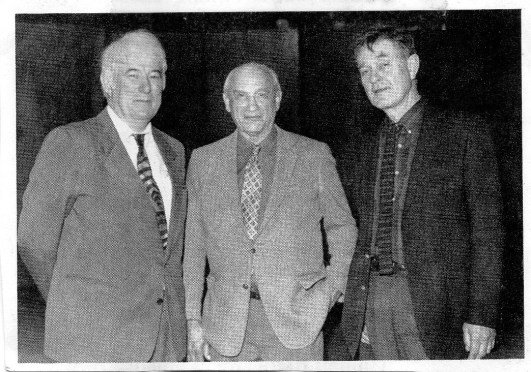
poet-trio007Now these three great poets that I have been fortunate to know and to have as classroom teachers, Seamus Heaney, Ben Belitt (who taught me Blake, and translated Neruda), and Stephen, are all gone. They live on in their poems, those chilly glimpses of eternity.
The last I heard from Stephen, he was fighting cancer. The end of his poem “Around Our Table” salutes a friend of his named Stephen Fels, who died of cancer in 1989.

Stephen, you were
The message we waited for, glowing face
Like a lamp in the dark around our table.

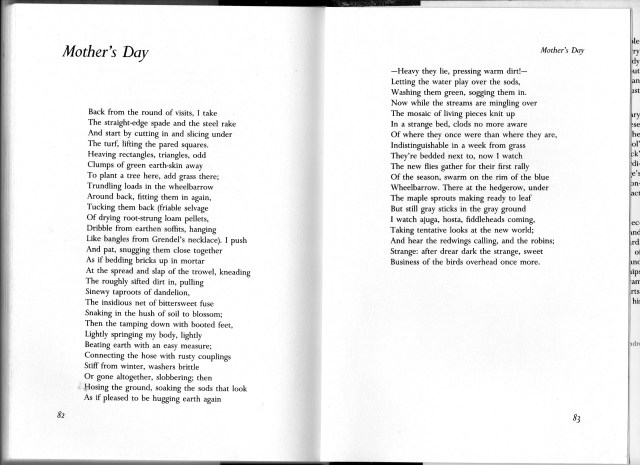
So many Stephen Sandy poems bear reading over, and over, years after reading them for the first time. As Frost says of a true poem, like metal to the tongue, they never lose their freshness. I’ve gone back to Thanksgiving Over the Water (Episcopalians will recognize the reference), one of his 11 books of poetry. The last poem in that collection is “Mother’s Day.” Even the most obscure-sounding phrases, like “friable selvage,” if you look up the words, glow in the dark with precise meaning, a shared experience of transplanting a tree and squares of grass. This could be an homage to Seamus Heaney.

poet-trio009-2

Posted in Uncategorized | 2 Comments

Notes from a Son

Why is it, I asked Daddy, that we two writers, with such rich material to work with, have never made fiction out of our family? Pat Conroy did it with his family. Yeah, he said, and it wasn’t very nice when he wrote about ours.

I read Daddy a short story by Mary Hood called “Manly Conclusions.” Mary Hood was his pal. We wondered how she got the detail for this great story. Was she married? Did she have a son like the boy in the story? Was she still alive? He didn’t know. But we enjoyed the story together. Literature, memory, and good meals for four days in Anne and Clay’s house. Most of that time allowed them to be away at Tate hosting half a dozen couples in their couples group. Every day for Daddy and me revolved around a visit to Mama in room 340, Emory Rehab.daddy-in-decatur

From this experience, I would highly recommend that anyone wishing to help should be with Daddy in units of at least 24 hours at a time, fixing and enjoying three good meals, easy walks with him, rest time for both, porch sitting, and good company without having to do anything that takes sustained concentration. In contrast, visit Mama in units of no more than an hour at a time.

“Precious pair of poets,” Mama said when Daddy and I blundered past her rehab roommate and into Mama’s space. She was quoting a Conrad Aiken poem that came welling up between me and Mama in fragments. “Rimbaud and Verlaine, precious pair of poets.” Playing chess in a sidewalk café in Paris, chestnut blossoms falling in blonde beer. In her corner bed by the window, sunlight squared on flowers and cards, not between knight and bishop.

Mama is making determined progress. When Walter was with us, he was jubilant at the improvement since he had last seen her a week before. The stroke was Sept. 25. This was Oct. 15 when their pals Ginger Birdsie and Kitty Farnham were sitting with us on that third floor hallway and saw Mama being wheeled out from her room to come to us. She pumped her free right hand in the air and kicked one leg straight out like cheerleader, even strapped in.

Talking with Mama was like poetry, shrewd compacted meanings, full of private references. She told us about her speech therapist trying to convince her to enlarge her understanding of the resurrection of Christ and a better world awaiting us. You sure he wasn’t the chaplain? I asked. No, the speech therapist, she said, “trying to save my soul.” By her account, she met this with logic and what I consider good sound incarnational theology – the proposition that this life and this world are as good a gift we can humanly imagine from a loving God. I’m impressed with a certain flinty glee showing in her slightly drooping face. I tell her she reminds me a little of Grandfather Douglas when he was old and being logical. She brushes that away as a bad comparison.

The physical attachment that Mama and Daddy have for each other is so touching under these constraints. They touch and kiss, then try to communicate out of their opposite hemispheres of cerebral strength. Mama’s all left brain. Daddy’s drawing on his right brain. I serve as translator, and that seems to be deeply satisfying for all three of us in snatches.

I am left with this concern – the need for a third-party translator, ideally a family member. That’s what I so enjoyed doing for four days. Being with Daddy in-between visits was one of the greatest experiences of love a son can have. It was like the best moments in the movie “Rain Man,” where the Tom Cruise character learns the meaning of love in action.  .  .except that Daddy’s part is so much more civilized and pleasant than Dustin Hoffman’s role, with its panic attacks. Daddy and I were both operating on some inexhaustible supply of affection and patience. I didn’t much care that I wasn’t getting work done on my job.

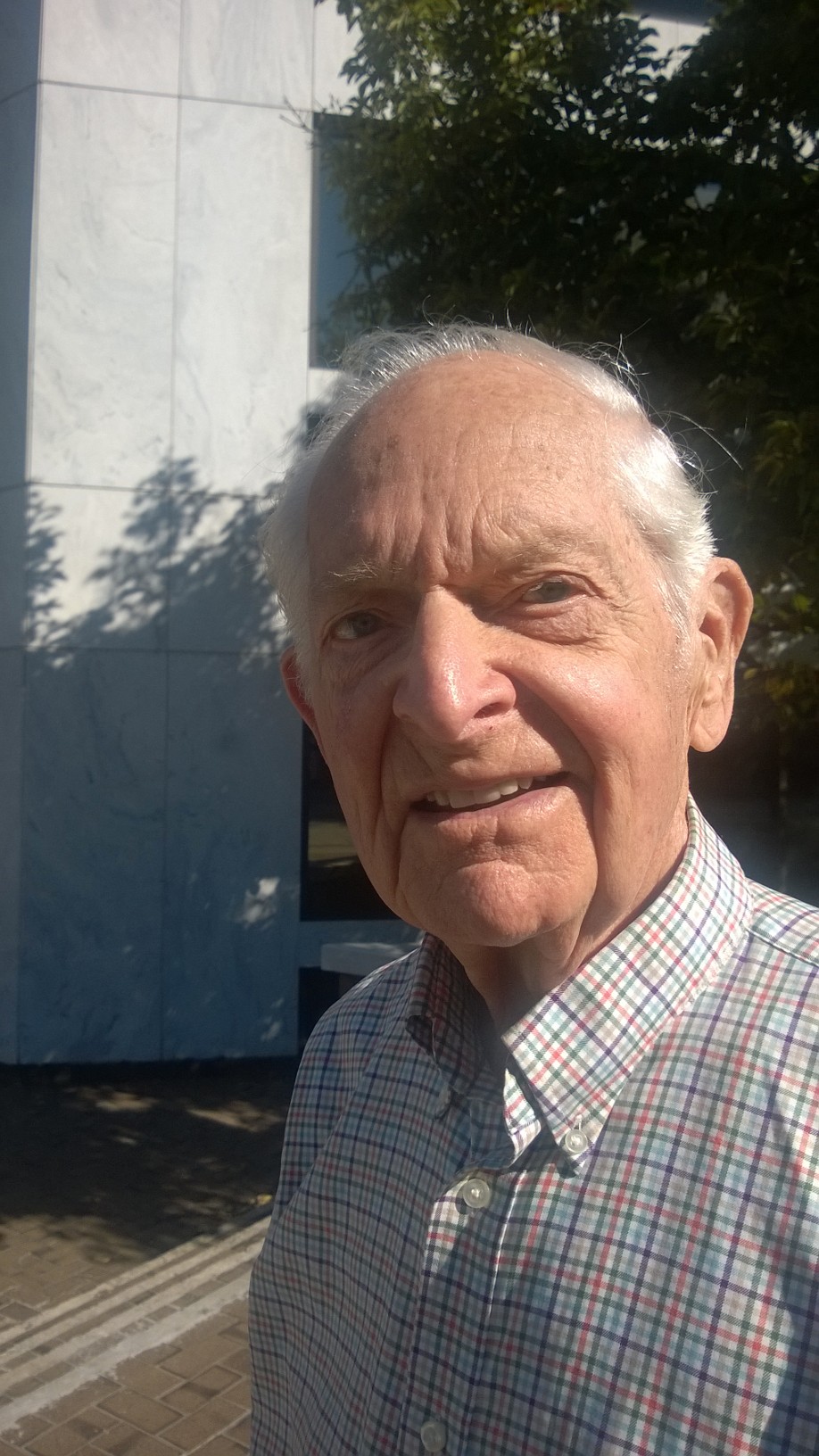
We watched movies together – actually, the only two DVDs I could find in the whole house: the 1950s home-movie pastiche called “The Cumming Thing” and David Lean’s engaging “Passage to India.” We walked to nearby Holy Trinity Episcopal Church for the 10:30 service this morning. My first day there, I took Daddy on foot to get a haircut at Maxim Barbers, a hip place with an actual barber’s pole twirling outside. I told him the haircut made him look like Alistair Cooke, and took a couple of pictures of him.

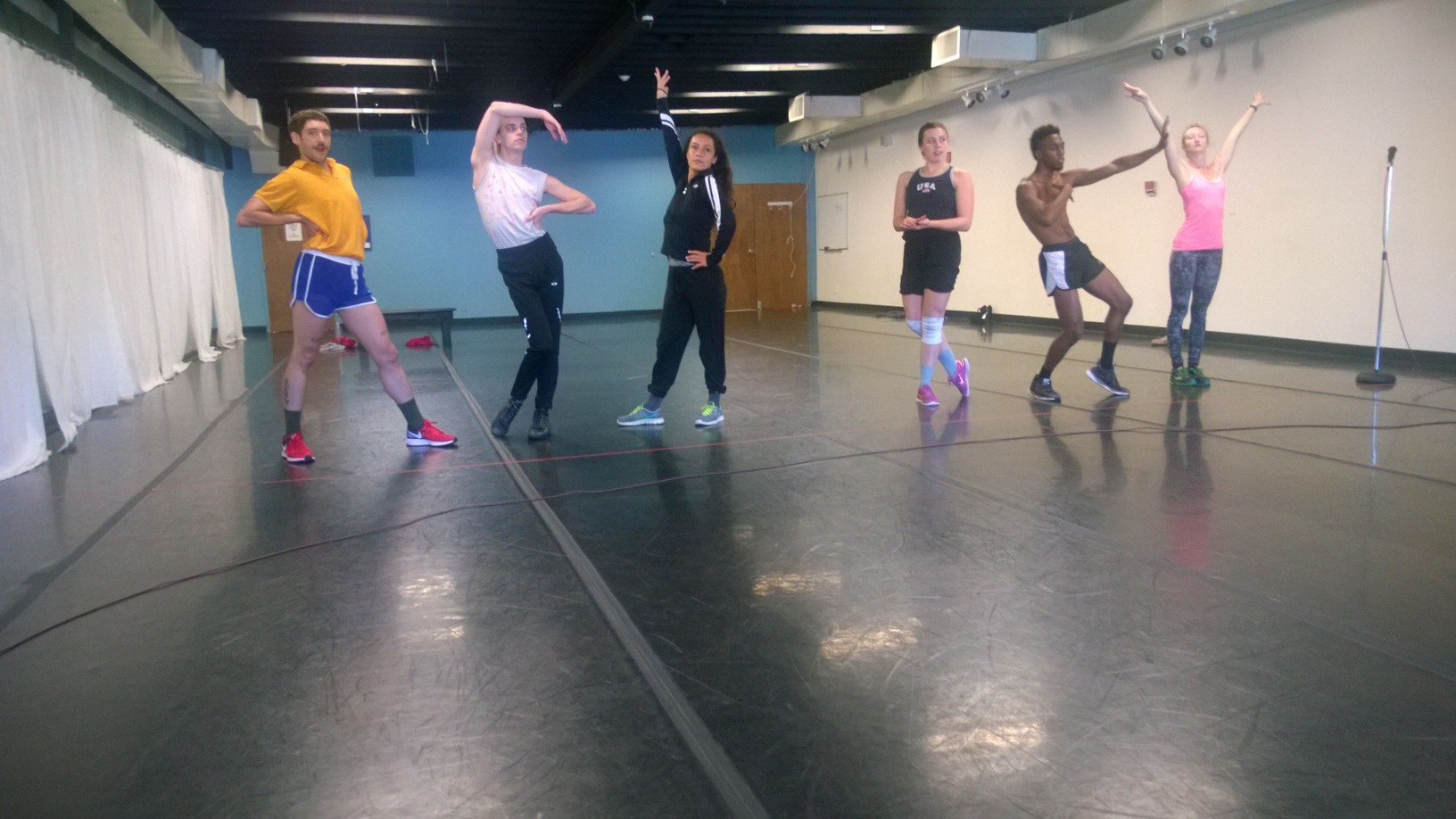
dancers-in-decaturWe strolled on into the heart of Decatur, a couple of boulevardiers. A choreographer from Israel named Oren sized us up as a likely audience for a modern dance he was producing. We followed him up an alley beside Core studio and upstairs to a large dance space where six dancers greeted us, three males and three females, although gender identity was pretty fluid even before the performance began. Daddy and I sat transfixed for 45 minutes by the abstract movements of “American Playground,” part improvised, part classical ballet, some children’s games, the whole thing like Mick Jagger acting silly but with impressive physical grace and contortions.  What a cool place Decatur can be. (Another day, jogging to the beautiful Agnes Scott campus – shades of Granny, mother and Robert Frost in past epochs – I spied Bo & Maureen walking on the other side of the street, on their way to the Decatur Beer Festival in the Square.)

Daddy is diligent with projects that can absorb him for hours at a time. He was delighted to find his own writing in a hardback copy of Bylines. He writes in a journal and notebooks, processing information like what day it is and what we just talked about. He worked for more than an hour trying to re-commit to memory the first page of Benet’s “The Mountain Whippoorwill.” He told a number of wonderful stories I had never heard before. Here’s one, about a gal named Joan.

He and Joan were not an item, back then, right out of high school, but they were friends. WWII gave Augusta a kind of rule-breaking jauntiness. Two or three times a week you could count 52 bombers flying over Augusta in formation, Daddy said. Joan was sophisticated for her age. Drinking Cokes at the Partridge Inn wasn’t cool enough, so Joan said come on, let’s go across the street to the Bon Air Hotel for some real drinks. They went, four of them, and at a cocktail bar with paper napkins, Joan said, hey here’s an idea, let’s write a poem or something for the one on this side of you. And she wrote a poem for Daddy. It went like this (Daddy didn’t keep the napkin, but remembered the poem):

Joseph B., of temperament mild
A magnolia sort of Oscar Wilde
Wherein cavalier and poet are blended,
The times you spend with him are splendid.*

(*not sure of this line, except the final rhyme)

A few days later, Joan told Daddy, “I’m going to New York.”

“Oh Joan.”

“Yes.” She went.

Daddy got a letter from her not long after saying she was in New York, but the people there were all manikins, caring about nothing but the clothes they wore. Sometime after that, she called Daddy long distance to say she got married, but now she wanted a divorce. She needed a Georgia lawyer, and she knew Daddy’s father was one. She needed a legal question answered. Daddy asked his father and got the answer for Joan. She could get the divorce if she was still a Georgia individual, and that was defined in the law by whether her “heart was in Georgia.”

I’m on the train back to Virginia, thinking about how much I am still of Georgia.

Posted in Uncategorized | 1 Comment

Some notes on brass

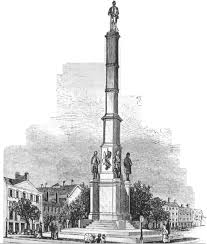
My daddy, now 90, entertains us with an endless scroll of family stories, and I had never heard this one until recently. One year, when he was a boy, he rode his father’s horse in the Confederate Memorial Day parade up Broad in Augusta, Ga., augusta-2a city that his Cumming forebears had co-founded and helped develop. This would’ve been the 1930s. When the horse reached the towering Confederate Memorial Monument it stopped. Uh-oh. Everybody knows what it means when a horse stops in a parade. This time it was a liquid stream that came, and kept coming, ostentatiously spattering the base of the monument, leaving the crowds aghast. It was such a lavish performance, the horse seemed almost to be making a statement.
I recently saw that same 1878 monument from the window of a tour bus going through my ancestral home. The inscription at the bottom says: “No nation rose so white and fair, None fell so pure of crime.” White? Pure of crime? I thought it was a strange word choice.

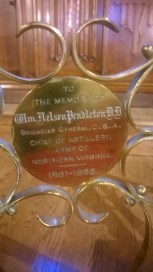
But you see wording like that on a lot of Confederate memorials – purity, honor, unsullied devotion, as if to emphasize instead of just a loving memory, Yes, we lost, but there’s no guilt to be exculpated. Yesterday, I discovered an echo of that in the round brass plaques held in the double gate of our altar rail. The one on the left says TO THE MEMORY OF William Nelson Pendleton, D.D., Brigadier General, C.S.A., CHIEF OF ARTILLERY, ARMY OF NORTHERN VIRGINIA, 1861-1865. On the right, a matching lozenge reads: FROM FRIENDS AND FELLOW SOLDIERS IN TESTIMONY OF HIS DEVOTION TO DUTY AND UNSULLIED PURITY OF CHARACTER. 1902.pendleton-plaque

I know a little about William Nelson Pendleton. He was this church’s longest-serving rector, from 1853 till his death 1883 (minus those years mentioned above, when he was away at war). He was a mathematics professor at West Point, founder and headmaster of Episcopal High in Alexandria, a scholar of both science and Christianity, a close friend of Robert E. Lee, and an advocate and organizer of education for blacks in this area after the Civil War. His funeral was the first service ever held in our current sanctuary, and it was packed to the balcony. Pendleton’s energy and intellect in the life in the church and in civil society are well documented in George M. Brooke Jr.’s history of our church. Yet what is inscribed in our sanctuary honors only his service as artillery general, and the unsullied purity of his character.

It’s a tiny inscription that I had never noticed before.

There is much bigger and more beautiful brass work around the sanctuary with no Roman-Stoic references to the War. Most magnificent are the grand eagle of the lectern and the ornate symbols of the four evangelists in the filigree around the pulpit. Those are memorials to the families of William Preston Johnston and of Col. William Gilham, two men who taught, respectively, at Washington & Lee and VMI.

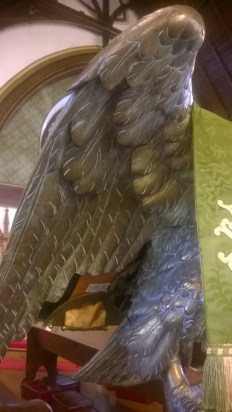
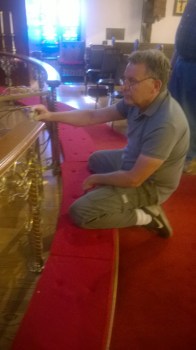
eagle-wingThe lovely brass work throughout the chancel has grown tarnished and in some place, such as in the feathers of the eagle, clotted with Brasso that should not have been used. For about two years now, Woody Sadler and Mo Littlefield have been quietly researching how to restore and save this legacy in brass. They have been working with Steve Roy, the New York-based master of brass artwork who has restored the bronze statues of Cyrus McCormick, Francis Smith, and “Stonewall” Jackson on our neighboring campuses. Woody and Mo have secured an $11,000 matching grant from the Gadsden Trust, a $5,000 grant from a Virginia-based family foundation called the Titmus Foundation, and enough pledges from several other parishioners (one of them my generous mother-in-law Avis Waring) to reach the $22,000 that Steve Roy originally bid two years ago.
The work is not only cleaning and restoring, but also adding a finishing lacquer that should keep the brass as bright as new, never needing polish again. This means the brass will be gorgeous and radiant for at least the remainder of this century. . .unless someone tries to use Brasso on it. Note to Future: Please don’t put polish on it, ever. That could ruin the finish.

steve-roy

Steve Roy, brass-restoration craftsman, examining the problem.

Steve Roy was looking over the brass on Friday with Mo and me, to come up with a new estimate. Before, he wanted to take the brass up to his New York foundry. This time, he’s looking at setting up a tent outside the church for a couple of weeks to do the work there, and perhaps segment the work to give us options to keep the cost down.

In any case, we should have some radiant brass by Christmas. Laus Deo!

Posted in Uncategorized | Leave a comment

Getting scooped by 85-year-old Tom Wolfe

Tom Wolfe, you old rascal! You’ve done it again. You’ve taken on the entire academic field of linguistics – as an outsider, a mere journalist – and played your snappy Emperor-has-no-clothes game on them. Bingo!

wolfe-4-5-13-1

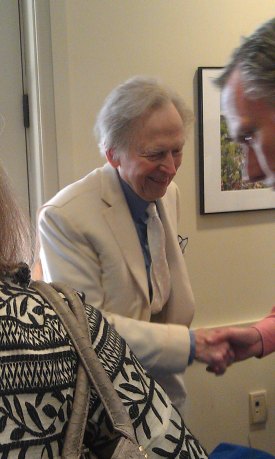
Wolfe at W&L booksigning, 2013. Photo by me.

And once again, you’ve stolen one of my ideas. But then, I never did anything with it. You did. Good show!

Getting my Harper’s magazine out of the mailbox recently, I couldn’t believe Wolfe, at age 85, was again doing what he did in Harper’s back in 1975. Back then, I was just starting out as a newspaper reporter when I read that long cover story, “The Painted Word,” with a kid’s excitement. Here was a funny, intellectual journalist, a Virginia neo-duelist taking on the pretensions of all those abstract expressionist painters – Mark Rothko, Jasper Johns, Morris Louis, Helen Frankenthaler. They were gods where I had just graduated from college, Bennington College. Wolfe deflated them all with good old reporting and satire.

Now, almost every year since I’ve been teaching journalism at Washington & Lee University, I’ve seen Wolfe visit, increasingly stooped and guarded in his fancy white suits, two-tone shoes, white-framed reading glasses, and for an honorary degree, white academic robe. He is a W&L alumnus, class of ’51. I remain in amused awe of his work – his New Journalism, good fat novels, moral mockery, punctuation!!!! But he was looking in decline.

Not at all!!! He has a new nonfiction book out now – The Kingdom of Speech, excerpted in the current Harper’s as “The Origins of Speech – In the Beginning was Chomsky.”

When I saw that, I had an Emersonian moment.

Ralph Waldo Emerson wanted Americans to realize that we were geniuses, every single one of us. But we fail to realize our genius, he said, because we defer to others – to Europeans, to experts, to published writers. Emerson virtually invented American individualism, and maybe he was a little too successful in getting everybody else to come around to that belief.

But anyway, when I saw that Tom Wolfe had done a number on “the origins of speech,” I thought of what Emerson said about the embarrassing experience of recognizing our own thoughts – my ideas – in someone else’s writing. “In every work of genius we recognize our own rejected thoughts: they come back to us with a certain alienated majesty.”  You can find that in Emerson’s essay “Self-Reliance.”

Wolfe’s insight is that language is the distinguishing characteristic, “the attribute of attributes,” of the human species. Now that might seem obvious. But there’s a second part: Human language is like nothing else in the known universe, from subatomic particles to sex-drives in pigeons to every known physical law. What is it then, this very thing that makes us human – and accounts for our incredible success as a species?

We don’t know. They don’t know. It’s a mystery. If it’s not like anything else we know in the animal kingdom, then it didn’t evolve. Wolfe rejects the Darwinian view, and says language was invented. It is the human thing.

No one knows how it originated. No one has discovered a “primitive” language – except maybe a heroic linguist working in the jungles of Brazil who figures in Wolfe’s new book. In any case, we have a lot of theories and a lot of data about language, but we don’t really have a picture of what it is like. Of what it is. It’s bizarre.

Another Southern writer, the novelist Dr. Walker Percy, published academic articles on this failure to understand the bizarre thing, human language, back in the 1950s. Like Wolfe, Percy coyly noted that the weirdness of human language baffled all scientific theories. Back then, it was B.F. Skinner who tried to explain language as merely behaviorism – our animal attribute, like a dog doing a trick for a bone. Noam Chomsky at MIT destroyed that theory, and Percy admired Chomsky’s respect for the bizarreness of language. Now Wolfe is mocking Chomsky’s theories.

But the point is, we just don’t know. And that is an idea I have toyed with ever since I absorbed Walker Percy’s brilliant skepticism. I’m no Creationist. Journalists don’t know anything. But they do tend to know when people who claim to know things don’t, really. I have for many years found it interesting that we don’t really know the origin of this most central fact of our human story. “In the beginning was the Word” makes as much sense as anything.

There are two other great mysteries I have long been obsessed with, but never pursued. I wish Tom Wolfe would report on these. One is the fact that we don’t really know how life – DNA – originated. And two, we don’t know how anything – matter itself – came into being. If Wolfe doesn’t report on those questions, somebody should.

[this is in the Roanoke Times, Sept. 11, 2016]

Posted in Uncategorized | Leave a comment

Teaching my old beat — covering schools

JOUR395 F17 Specialty Reporting (Education)
Douglas O. Cumming, associate professor

Notes toward a SYLLABUS – 8/27/16

This course fulfills the requirement for a 3-credit specialty reporting class required for majors in the Journalism sequence. Journalism and Strategic Communications majors must have taken J201 as a prerequisite. Juniors and seniors with other majors are welcome, especially those minoring in education or education policy.

In Jour 395, students will learn about:

  • key institutions that shape and influence this field

Local public and private schools and universities, school districts (their administration and school boards), state Department of Education, U.S. Department of Education, state and national laws and policies pertaining to education (and legislative and funding bodies responsible for these); organizations of teachers/professors, principals, administrators, school boards, parents, and students; colleges for teacher training and research on teaching and learning.

  •  specific terms essential to understand to report and write about the topic with authority

Education insiders and experts use a lot of jargon. Sometimes their obscure terms need to be understood and translated. Educationese can be shorthand for a significant set of meanings, or they contain a history that needs to be told in a nutshell. Other times, the jargon is smoke an education reporter should learn to fan away: it can be merely the empty code that members of a sect use to distinguish insiders from outsiders, or the trick bureaucrats and politicians employ to avoid accountability.

  •  credible resources and sources to which a reporter can turn for stories on this topic

Ed Beat: Education Writers Association (join it, consider attending an EWA workshop or following the listserv, and bookmark the website for backgrounders), The Hechinger Report, Journalism Center on Children & Families (University of Maryland J school), Education Week, Chronicle of Higher Education, Inside Higher Ed, Pew Research Center (Education).

K-12 student achievement: NAEP (National Assessment of Education Progress), IPEDS (DOE data on higher ed), Institute for Education Statistics (IES), state and local assessment offices, and for a dissenting view, FairTest.

Professional education organizations: e.g. National School Boards Association;  National Association of Secondary School Principals , etc.

  •  specific journalistic associations for writers in this field

For Ed Beat writers: EWA (see above), SPJ, Spencer Foundation, Poynter Institute.

  •  specific ethical issues that reporters encounter in this field

Ethics: Sarah Carr’s standards & ethics for education reporting.

Students will read exemplary examples of the particular type of specialty reporting and practice the craft themselves through the reporting and writing of numerous stories.  When possible, the class will meet with veterans in the field through class visits or Skype sessions.

 Some award-winning examples:  of Boston Globe columnist Farah Stockman’s Pulitzer-winning columns on busing crisis 40 years after;  other EWA award winters; Tampa Bay Times’ “Failure Factories” , Baltimore Sun’s “Unsettled Journeys,” blogs from Valerie Strauss’ “Answer Sheet” blog in Washington Post, Sara Gregory’s series on Rethinking Discipline, and Columbia Dispatch project she helped, won the Pulliam First Amendment Award; a Washington Post story on a bereaved father’s promise to help other Asian-American parents understand their children’s urge to assimilate. A Center for Public Integrity article on Virginia’s high rate of suspensions. Articles by the professor from when he was senior education writer at The Atlanta Journal-Constitution.

 Also: Students must cover (and find news from) school board meeting, do a profile of a student and a profile of teacher (ideally, around an issue or narrative), and complete a final in-depth multi-media project. This is the minimal requirement for news stories that a student will produce.

And: A unit on the history of American education, its philosophical and political battles, and how it has been constructed in popular culture and covered in mass communication, from Joseph Rice’s series in Forum (1890s) to coverage of A Nation at Risk (1983) and  test scores under NCLB. (Lawrence A. Cremin volumes on American education; literary nonfiction from the classroom perspective such as by Kozol, Kidder, etc, and portrayal in film).

And: Students will establish contact with an education reporter early in the term and follow that reporter’s work and social-media presence. By the end of the term, the student will write a report on that education-beat reporter that must be shared with the reporter before being submitted for a grade.

Possible guests in class or by Skype: Sara Gregory of Roanoke Times, Aaron Richardson of web-only Charlottesville Tomorrow, Maureen Downy of Atlanta Journal Constitution, Emily Richmond of EWA, Sarah Carr of The Teacher Project at Columbia University School of Journalism.

Posted in Uncategorized | Leave a comment

Almost Heaven

Steve tearing down ceilingIt’s a convenient catastrophe for us, another post-Katrina experience just an hour and fifteen minutes to the west. There is a house in Caldwell, W. Va., one among hundreds, soaked by the Flood of ’16 and abandoned by a widow lady who drives a bus for Mountain Transportation Authority. We feel that R. E. Lee Memorial Church can take on this house and bring Martha Elmore back home. We could bring this home to better condition even than its antediluvian state. Jerry Nay, remember, organized eight trips to New Orleans, and Steve Shultis was part of that Operation Golden Rule. Now, the human need is not far over the state line around Lewisburg, W. Va.

We might also become neighbor-friends with St. James Episcopal Church there in Lewisburg.

Steve was smote by the call to help after that deadly deluge that hit the Greenbrier Valley on June 23. So he roared over the mountains in his Harley last Thursday for what he calls V.R. – visual reconnaissance.

Contact was made. Established comm (Steve’s Marine talk) with the very young Rev. Joshua Saxe, rector; Trish Parker, staff, and Crissy, a gal who is helping at the rectory). Logistics prob: we brought shovels and crowbars for demo, not Jerrytools for drywall. But then it turned out, a lot more demo was needed before we could get to drywall. “Like when you go to war,” says Steve, who was reminding me of Buzz Lightyear, “you don’t want the cooks and the bakers coming first.” St. James is filled to brimming with donations. Busy in the vortex of the learning curve, it is longing to be a church again.

Under the Chinaberry tree

A truck in Martha’s backyard under the chinaberry shade tree.

Steve, Jerry and I drove there in two cars Wednesday the 6th. Sunshine turned to drizzle when we crossed into West Virginia. Lewisburg is about the size and feel of Lexington. We dropped off the stuff R.E. Lee parishioners had left for us and went to work.

Jerry met the AmeriCorps folks at the Greenbrier Volunteer West Virginia reception center (hotline: 304-808-1872). Steve and I drove to Martha’s house (5846 Monroe Draft, Caldwell), as Father Josh told us to. It’s about six miles east of Lewisburg, just off Route 60. Martha wasn’t there because she had to go back to work, but the Cyrus family was inside – Ron Lee Cyrus, a retired truck driver and mechanic with bad lungs from his time in the military, his wife Drema, and their college-student daughter Lakin, called “Sunshine.” The Cyrus family has taken in Martha. Drema and Martha are close friends and sing in a church choir together, although the Cyruses are Missionary Baptist and Martha is Pentecostal Holiness.

Doug in the houseSteve and I picked up where the Cyruses left off putting down plywood subfloor in the front room. Job finished, we moved on to ripping down the rotting ceiling, spilling its blown insulation down on donated blue-plastic drop cloths. It’s just a start. As we worked, highway crews were surveying the ruined road (also called Highway 63) that crosses Howard Creek (the one that flooded this area) to a one-lane tunnel. A few hundred yards downstream, the creek hits the Greenbrier River. A helicopter whumped overhead still looking for the body of a 14-year-old girl missing in the flood.

St James

The entryway to the parish house of St. James Episcopal Church, Lewisburg, W. Va.

Steve, Jerry and I will be meeting Friday with Father Tom and others to sketch out a plan to rebuild Martha’s house over the coming months, however long it takes. It’s just a tiny help in a devastated area of West Virginia, but it’s a focus that we feel will bring rewarding results and living relationships.

Steve outside

Posted in Uncategorized | 2 Comments

The Periodical Room

The RoomIn the 1920s, according to the sign outside the heavy door, DeWitt Wallace spent countless hours in the high-ceilinged sanctum within, reading and condensing magazine articles. This was how he filled Reader’s Digest, the unorthodox little magazine he and his wife, Lila, had launched in 1922, their only child. At first, they didn’t bother with advertising or writers or illustrators. It was all about circulation, which by 1946 reached about eight million. Reader’s Digest became the most widely read magazine in the world.

I brought my magazine class of 14 undergraduates to this Periodical Room of the main New York Public Library building on 5th Avenue. It’s an awesome space, although there were no magazines in sight. Instead, almost every wooden chair lined up on both sides of long tables was occupied by someone working on a MacBook. My students sized up the place in a jiffy, and with my bemused permission left the room and the building for free time in the city. With their iPhones in hand, they had better things to do than waste time in this silent tomb of twentieth century print culture.

But I took the road less traveled by. I asked at the window for copies of some magazines from 1967. Sorry, the man said, we keep only recent issues here. He sent me walking down a long hallway to the room with old periodicals. There, researchers at tables and microfilm machines were digging their gopher holes into history, but still I didn’t see any magazines. I asked at the desk for The Saturday Evening Post and Look from ancient times when Joan Didion and George Leonard were writing about Haight-Ashbury for those magazines.

First, I needed to fill out the form for a library card. Done. Then I needed to fill out a request for the bound copies of Look for the years I wanted. Done. It would be up from the vaults . . . in about 40 minutes. Meanwhile, here’s the microfilm for the Saturday Evening Post issues I wanted. Sorry, none of the microfilm machines were available in this room. I was directed to yet another room down more long hallways.

Have my students ever used a microfilm machine? I doubt it. It took a while to get that giant toaster working. The Post, once the most popular magazine in America, was running some pretty good articles in ’67 on a fire-fight in Vietnam, by an American soldier who was in the middle of it, and on the Mamas and the Papas. The magazine would be dead within two years.

Back in the old periodical room, four very heavy volumes of Look had arrived. I found a full-page ad from the ad bureau of the Magazine Publishers Association. Here was the desperate pitch from America’s last great general interest magazines: “The magazine is a treasury of contemporary ideas and information. It is traditional in its consistent quality from one issue to the next. It is modern in its treatment of an infinite variety of subjects. It is influential in its continuous introduction of new thoughts, styles and trends.” A photograph of a young woman who might have just arrived in Manhattan right out of Sarah Lawrence, thoughtfully drinking something dark through a straw at an outdoor table. “Her presence creates a stir,” the caption says. “Conversations pause. Activities cease.”

The conversations resumed, the activities picked up, the magazines died, time marched on. What was that about? I went back to the DeWitt Wallace Periodical Room to contemplate, once more, what David Sumner’s book calls The Magazine Century. The majestic room has thirteen murals of the great magazine publishing houses in Manhattan, part of the room’s restoration in 1983 underwritten by DeWitt Wallace legacy funds.

These were grand buildings, the Puck Building, Harper’s, the Look Building, Herald Square, Time-Life Building, the Hearst Building. Some are still around, re-purposed. Time Inc. has moved downtown. The Art Deco Hearst Building has become the base of a dazzling 44-floor glass tower clad in diamond-shaped facets. We would hear from the head of magazine marketing in that building the next day, and the students would be given good news about Hearst’s peak profits last year, from using multiple platforms nimbly and targeting native advertising.

Magazines, it seems, will survive. But something troubles me about how sluggish I felt trying to dig into the great magazines of the past. I don’t blame my students for getting out of the New York Public Library as fast as they could. It’s a beautiful building, but in their world it’s a dead tomb of dead books and magazines that aren’t even out in the open. As the man at Hearst would tell us, with an iPhone you don’t want advertising or irrelevant content. You want what you want, when you want it. How many “snap”? he asked, meaning Snapchat. All 14 raised their hands. And how many regularly read magazines? A tentative pause, and only about half the hands went up. And this was for a class called “The Magazine: Past, Present and Future.”

Posted in Uncategorized | Leave a comment

Lou Hodges v. the W&L Board of Trustees

I just received the sad news that Lou Hodges, the elder statesman of this Journalism & Mass Communications department,  has died at the age of 83. Farmer, preacher, professor, profane and funny Christian ethicist, the grumpy and joyous man who stuck his head in my office to bark “Impersonating a scholar again, I see,” he will be missed.  A student of mine wrote this illuminating story about Lou for a class I taught a few years ago.

By Mark Gensburg, ‘16

Civil rights legend Martin Luther King Jr., in the midst of one of his toughest protest campaigns, almost came to give a speech at the very place where Robert E. Lee is buried, Washington & Lee University.

Lou Hodges mug1

Lou Hodges

In 1961, associate professor of theology Dr. Lou Hodges took two vans full of students over the Blue Ridge to Lynchburg to watch a speech of Martin Luther King Jr. Not long after that, these students asked King to lead a seminar on Christian ideals at Washington and Lee.

Yet the University Christian Association (UCA), which was in charge of the seminar and of which Hodges was the faculty advisor, decided on a 7-2 decision to first seek the formal approval of the board of trustees to invite King.

Much to the dismay of Hodges and the UCA, the board of trustees denied the group permission to invite him. With no justification for its decision, the board quickly came under fire from both the faculty and students alike. And Dr. Hodges led the charge.

Quoted in the Oct. 20, 1961, issue of the Ring-tum Phi, Hodges said, “The board gave us an answer, but no excuse.”

Soon a firestorm of contempt aimed at the board of trustees swept across campus. The decision was decried in five different issues of the Ring-tum Phi and in a survey presented on Oct. 27, 1961, no student on campus could be found who supported the board’s apparently arbitrary decision.

The controversy spread and was headline news in newspapers as far away as Nova Scotia. Closer to home, it was publicized in the Roanoke Times and Virginia Inquirer.

The school and its reputation, it seemed, was being dragged through the mud. Critics from inside and out called the decision to prevent Dr. King from speaking as a decision to restrict the students’ “freedom of inquiry.” Many charged that the board was politicizing the students’ education and the Ring-tum Phi cried that the decision violated the students’ “liberty of mind.”

It was at this point that Hodges was summoned to speak privately with Fred Cole, president of the University.

“Well this will be the dismissal of me,” Hodges recalled in an interview in December 2012. “I had only been on for one year. I thought that I would be fired.”

Hodges was not fired. In fact, he went on to get tenure and teach at W&L for another four decades. He pioneered W&L’s ethics-in-the-professions series, which spawned the journalism ethics chair that he held until retiring in 2002. He came to be known nationally as one of the pioneers of journalism ethics education.

President Cole was not even upset with the controversy the King invitation had caused, said Hodges.

“Invitations of speakers should never need to go to the board of Trustees,” Hodges recalled President Cole saying.

“A new rule was created which dealt with the board [of trustees] and got it fixed that the board would never again do what they did to me.”

Eventually the controversy faded and life on campus returned to normal. Yet, Professor Hodges remained in contact with Dr. King. He said he even received a letter from King from the Birmingham jail in 1963 – not the famous one King wrote from that jail cell, to moderate white ministers in Birmingham, criticizing them for seeking patience from protesters.

While the decision to prevent King from speaking was never reversed, the conflict resulted in the a slew of expanded freedoms for the department of religious studies.

Although the trustees never released a reason for their decision, Hodges suspects that it was based in racial prejudices.

“The group seemed to think ‘Negro’ speakers were inferior to white people,” he said.

That is only his hypothesis. But this is a fact he could utter with a smile on his face: “Now faculty can invite whoever they want.”

Posted in Uncategorized | 1 Comment