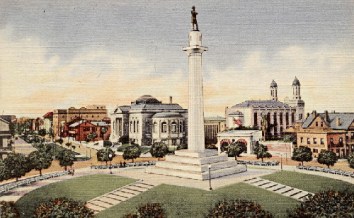
Lee at Tivoli Circle

“So this monument, lifted far above our daily strife of narrow interests and often narrower passions and misunderstandings, becomes a monument to more than its one great and rightly loved original. It symbolizes our whole South’s better self; the finer part which the world not always sees; unaggressive, but brave, calm, thoughtful, broad-minded, dispassionate, sincere, and, in the din of boisterous error round about it, all too mute.”
N_LeeCircle_LibraryShriners_infrogmation_ed3from George Washington Cable, “The Silent South,” 1884

The distinction of New Orleans is in its cemeteries, from miniature cathedrals “to  a small artificial mountain containing the mausoleum of the Army of the Tennessee, General Albert Sidney Johnston atop, astride his horse and still in command. The great Texas general gazes at Robert E. Lee himself atop his column across town. It is easy to imagine a slightly bemused expression on the faces of these stern Anglo-Saxon commanders as they contemplate between them this their greatest city and yet surely the one place in the South most foreign to them.”
— Walker Percy, “The City of the Dead,” 1984

“To literally put the Confederacy on a pedestal in our most prominent places of honor is an inaccurate recitation of our full past. It is an affront to our present, and it is a bad prescription for our future. History cannot be changed. It cannot be moved like a statue. What is done is done. The Civil War is over, and the Confederacy lost and we are better for it. Surely we are far enough removed from this dark time to acknowledge that the cause of the Confederacy was wrong.”

— New Orleans Mayor Mitch Landrieu, 2017

Posted in Uncategorized | Leave a comment

Endnotes in Strange Times

The research papers came in on the All-Academic website. I sent them out to reviewers. Then by May 1, the reviews came in, and we’re off to the races.

What an amazing system! And what a privilege for me.

AEJMC Chicago

I get to see the work of my fellow media history scholars, papers with strata of endnotes labored out of solitary time in Presidential libraries or oral-history interviews or after-hours in your campus offices. Then I get to see the Likert scores and thoughtful comments of all those volunteer reviewers.

At the upcoming conference in Chicago and in the next Clio, I’ll give the final statistics on papers submitted and accepted. As the song says, “Won’t you please come to Chicago for the help that we can bring.” (We can change the world?)

For now, I’d like to reflect a bit on what this system of paper-submission and blind review means today, especially when we’re doing history.

These are strange times. As a New Year cartoon in my local newspaper had it, pigs representing 2016 were flying with these labels: Bob Dylan wins the Nobel for Literature, Chicago Cubs win the World Series, and Trump is elected President.  The psychic atmosphere is captured well in the title of a new book by “On the Media” co-host Brooke Gladstone, “The Trouble with Reality: A Rumination on Moral Panic in Our Time.”

In the early days of the Internet, there was a hopeful anticipation of vast quantities of digitized “information” and democratized technology. But this has been darkened considerably by doubts and downsides. Such doubts were always hanging around. (I was taken by critiques of technology from Lewis Mumford and Jacques Ellul way back in my post-adolescent Romantic Age.)

President Clinton in his 1996 nomination speech talked about “Building a Bridge to the 21st Century,” and while this covered a standard policy menu, the idea became associated with Vice President Gore’s call for an Internet Superhighway. Neil Postman, the wise media ecologist at New York University at the time, responded with a 1999 book he titled “Building a Bridge to the 18th Century: How the Past Can Improve Our Future.”

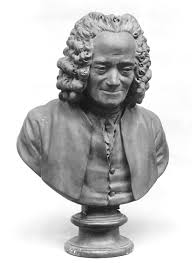
VoltairePostman, who died in 2003, noted a curious fact: the Age of Enlightenment had no use for the word “information.” He found it missing from the indexes of every single book he had read on 18th century thought, nearly 100 works in all. (Google Books Ngram Viewer finds the frequency of the word “information” rising like a steep mountain since 1940, especially since the ‘60s, becoming three or four times more common in 2000 than “knowledge” or “reality,” which had enjoyed stable use in print since 1800.)

Postman’s explanation is that the Age of Reason understood that isolated facts – mere “information” – had absolutely no value unless contributing to something larger. That something larger was “knowledge,” the obsession of philosophes like Voltaire with his “History of the World,” or polymaths like Samuel Johnson with his “Dictionary.” What we call critical thinking they valued as skepticism, but such lucidity always had a higher purpose, and in America, it had the pragmatic result of our founding documents. Postman argues that mere information, no matter how vast and speedy, needs context and ultimately, a sustaining narrative.

We don’t study history to learn from the mistakes of the past. History isn’t a bunch of lessons for our benefit, never mind Santayana’s oft- repeated quote. (My version: Those who remember that quote are condemned to repeat it — endlessly.) I have come to believe that the best use of history is to know where we/I stand in the narrative – really, how we/I fit into any number of shared narratives. Whether regional, media, gender, national, or global history, Postman says we need narratives that we can believe in and that are of good use. If the story has religious overtones, so be it. “The purpose of a narrative is to give meaning to the world, not to describe it scientifically.”[1]

Santayana’s quote needs context as well. What he wrote in “The Life of Reason,” before condemning those who cannot remember history, is that progress is built on what is retained from the past, like a scene in a good story. “When change is absolute,” he wrote, “there remains no being to improve and no direction is set for possible improvement: and when experience is not retained, as among savages, infancy is perpetual.”

I have just spent some of a sabbatical-semester reading about the 18th century Enlightenment. This Eurocentric outburst seems to be a good source of the narrative we need today. It is our source for checks and balances (from Montesquieu’s analogy with the solar system in “The Spirit of the Law”), free trade (Adam Smith’s “Wealth of Nations”), a free press, evidence-based science, representative democracy and all that.

Our division’s accepted papers explore “new knowledge” ranging from an analysis of how “fake news” fits into the history of hoaxes to an argument that a co-founder of Freedom’s Journal embraced the controversial crusade against the American Colonization Society. The quiet pursuit of seemingly obscure or theoretical corners of media history reminds me of the camera shots at the beginning of Pare Lorenz’s documentary The River, raindrops and creek heads delicately building into the tributaries that will become the Mississippi.

It may be a stretch in this post-modern time, but I like to think of these research papers and their blind reviews in the context of the Enlightenment narrative, a vast project of skepticism and enlarged understanding. It joins us to what was said about the great French historian Marc Bloch, who was executed by the Nazis in an open field in France near the end of World War II: “He was capable of infinite attention to detail, but he never forgot that the details had meaning only in the larger framework of the history of human society.”[2]

[1] Neil Postman, Building a Bridge to the 18th Century (New York: Knopf, 1999), 109-10.

[2] Joseph R. Strayer, “Introduction,” The Historian’s Craft by Marc Bloch, trans. Peter Putnam (New York: Knopf, 1953), x.

Posted in Uncategorized | Leave a comment

Dispatch from Atlanta

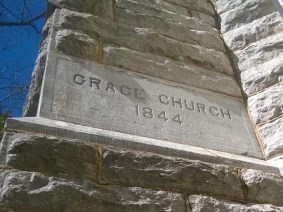
“The committee further recommends that the name of the church be officially restored to its former name of Grace Episcopal Church, to be completed no later than the last meeting of the current vestry.”

  • From “Final Report,” Conflict Transformation Process at R.E. Lee Memorial Episcopal Church, “Discovery and Discernment,” Lexington, Va.
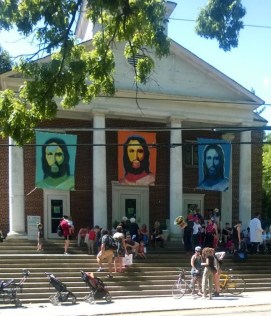
Atlanta Methodist Church2In one of Atlanta’s flourishing in-town areas, Candler Park, the portico of an old United Methodist Church is hung with three big canvases, each about 12-by-6-feet, like colorful sails. Each one is the same cool portrait of Jesus’s face, but in different colors like an Andy Warhol triptych of Marilyn Monroe. Beneath these banners on April 22, Earth Day, was a happy crowd of New Orleans-style musicians getting ready to play for the March for Science Atlanta.

I was visiting my old hometown, and the day was gorgeously April blue, so I joined my cousin Mimi for the march. The Atlanta Coalition Ensemble, the band tuning up on the church portico, seemed to have enjoyed getting costumed for the event. The purple bell of the Sousaphone was decorated with a spray of Christmas lights, and the heavily bearded man playing it was wearing a lab coat.

It was not the parade so much as this church that caught my attention. Mimi, who works for a global health-and-religion program at Emory, said it had been called Epworth United Methodist, but the “Epworth” was removed. I could see where the word was literally removed from a post in back that said United Methodist Church. It is temporarily called the New Atlanta United Methodist Church, a merger of Epworth and one of the big established Methodist churches in nearby Druid Hills. I was shocked to learn that this other church, in a ritzy area of Atlanta, had dwindled so much that it needed to merge with Epworth. Now grafted into this old church building, the new congregation is growing, discovering new life, and looking for a name.

“It’s so interesting,” Mimi said. “Churches are reinventing themselves.”

At R.E. Lee Memorial, we are also seeking to re-invent ourselves, in our very different little town of Lexington. The name of our church is held dear to many long-time members, but is troubling to other parishioners. How it is taken by outsiders is also split, apparently – some people are glad to see a church have the nerve to name itself for the legendary Confederate general while others are as offended as they would be if they saw a Confederate flag instead of a banner of Jesus out front.RE Lee sign
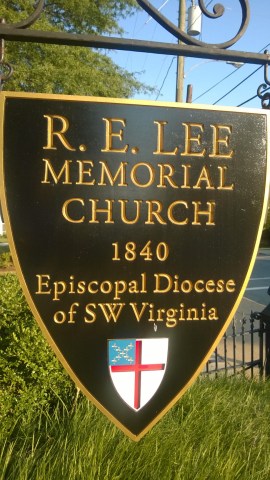
While I lingered in Atlanta on Sunday morning, my church in Virginia held a parish meeting at which the Vestry presented an important report about how our church can re-invent itself. From what I’ve heard, the controversy remains in suspended animation. And so my hope and heartbreak remain in a kind of suspended animation.

Two years ago, I was scared that we were headed for a bad split over the name. Our attempt to listen to each other’s points of view, to find compromise and God’s will, never got beyond the opinions held by each side. As a Vestry member, I was forced to vote my conscience, to change the name, but as a professor of communication, I was dismayed that we had no plan for how to make this change in a way that showed respect for Robert E. Lee. My biggest fear was a bunch of national news stories about how a faction of the church had made a knee-jerk decision in the wake of the Charleston shootings and, in another battle of political correctness, had blotted out its own history and the name of Robert E. Lee. We kept the name, barely.

We needed healing after that. I worked hard to help create the committee for healing and reconciliation, which named itself “Discovery & Discernment.” I had no idea what it would come up with after nine months of intense and careful work, under the guidance of two consultants that cost us $16,000.

I now see that what the committee came up with was worth the time, prayers, effort, and money. The Vestry approved almost all of the recommendations, but rather than split along the old fissure, we found consensus only in an ambiguous statement that we “may at some point” restore the earlier name of Grace Episcopal.

Yes, we may. Or we may not. “At some point” could be five years from now, or 20 years. Or never. I don’t mean to quibble, but it could also mean next month. We should take that shot.

No one in the beginning expected the committee to suggest we re-visit the church name. But now I see how it fits with the entire committee report – especially creation of a sub-committee to highlight Lee’s historic role in our church, with “deep respect and appreciation,” and work on separating our proud history from our Christian mission. WP_20170311_001The Vestry approved those elements. But I am disappointed that we are punting on restoring our historic name. We could go for a touchdown. Thanks to the D&D committee’s work and report, we are in the best position we will ever be in to do the hard but right thing. I think this moment of grace will not last more than a month or two.
Half the Vestry feels otherwise, that waiting until the congregation is more settled and “ready” is the right approach.

Two years ago, I couldn’t figure out how we could change the name without a majority of the parish condemning our action, along with much of the community and the wider world. In the future, after the committee’s work fades from memory, the parish will be in the same situation. Why would a future Vestry even bring this up? It if does, it would probably be from a faction that has little respect at all for Robert E. Lee (such people are in our church now, though leaving steadily, or at least willing to live uncomfortably with the name).

What the D&D committee handed us, on a silver platter costing $16,000, is a way to solve this problem now, a brilliant compromise. It listened deeply to the congregation, and found a solution: honor Lee, tell the story of his role in our church, emphasize our history, but separate our history from our mission. Lee would want us to recover the name that he knew and loved. It is at once respectful, historical. . . and beautiful: Grace.

Once done, while some might feel hurt, at least this time there would be an authentic, faithful process behind it. The future would be a gift to everybody. God smiles. That controversy would be over. This may be the last time we can do this in a way that is truly respectful of Lee. It would break my heart to see it left to be done, or not, in some other way, at some point in some future of a church in decline.
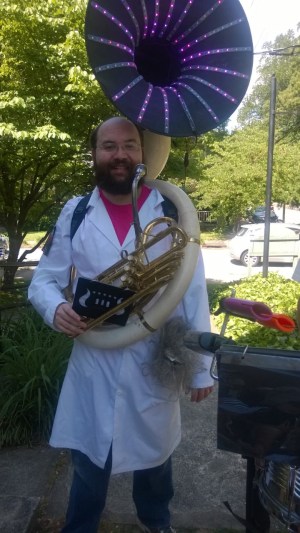
Sousaphone guy.

Posted in Uncategorized | Leave a comment

A theory of the leisure class

The release by the White House of the financial worth of President Trump’s top advisors, in a Friday night dump timed for underplaying bad news (an April Fool’s joke on us?), was a face punch that we needed. While we were all staggering to understand Trump and his election – baffled, as Steve Bannon told us we were – this knocks us upright, a clarifying blow. These guys, Steve Bannon, son-in-law Jered Kushner, Gary Cohn, Kellyanne Conway and all, are worth hundreds of millions. Added to the billionaires on the cabinet, the West Wing cocktail party guests are worth a total of $12 billion, according to Bloomberg.images

The investigation of ties with Russia, now underway by Senate Select Committee on Intelligence, might turn out to be less about meddling in the election and more about Trump associates investing in Russian deals. Corruption in Russia’s crony capitalism is at carnival scale now, and you can follow the trail of it by looking at the dead Russians, the ones dying mysteriously all over the world because of what they know.

This is not just Watergate redux. It’s the Gilded Age. It’s Robber Barons and politicos on a Trump Tower scale, a gigantic gilt-edged flimflam. Dear Trump voters, brothers and sisters in Perry County, in Fannin County, in Pontiac: We have heard your message. Now look at the mess you’ve made.

The lucre these slick-haired salesmen make (a lot of it as “consultants” to dark-money right-wingers like Robert Mercer) is way beyond the comfortable salaries of the professionals and bureaucrats Trump voters thought were the enemy – the government bureaucrats, lawyers, media workers, professors, New York Times reporters, scientists, liberal bishops. Those are people I look up to, the ones who set standards I try to honor and meet, as a former news reporter and university professor.

This more modest “elite” is a class of folk that may have lost touch with the pain of the laid-off coal miner or autoworker, but they aren’t the enemy. They are the educated members of modern guilds that follow the rules from the 18th century Enlightenment: checks and balances, codes of ethics, cycles of reform (as alternative to Revolution), rules of evidence, skeptical thinking, education, service to the common good.

trevithicklocomotiveIn George Eliot’s Middlemarch, you see the rise of this new class of do-gooders just before the Reform Act of 1832, as the steam-engine shakes up the old order controlled by the holders of vast wealth and the “resolute submission” of well-bred ladies. Tertius Lydgate makes no money as a newly arrived young doctor in Middlemarch, with a passion for making medicine a science and making health “public.” Going into the law or the church is respectable, but considered risky because of the low income. The young Fred Vincy, his upper-class status undone by gambling debts, considers going into the church for mere respectability, but realizes he needs to find a true calling, to learn the modern facts and to work for his bread. He does this by learning land-management from the father of the woman he loves, and thus finds his happiness in the new order of progress.
Less respectable is the romantic figure Will Ladislaw, a talented young freedom-lover who dabbles – in art, in music, in writing for the local paper, and writing a reform platform for “the worst landlord in the county,” the carefree Arthur Brooke of Tipton. Brooke decides to stand for Parliament but doesn’t stand for anything else except his own well-being.

These two are Bannon and Trump, characters trying to find their place in the new order (or now, a long-established order) organized and civilized by professionals.

Call it the elite. Call it the Deep State. These professionals are the people who submit to a faith in the Enlightenment idea on which liberal democracy was founded. Now the older regime of money is back in power. The tribal underclass thought it was supporting a Revolution. What they got was just the old money class back in power.

Posted in Uncategorized | Leave a comment

Sharing our healthcare story with Donald Trump

A friend sent us the invitation from the White House to share our story about Obamacare. I was glad to do so, below.

Obamacare has led to higher costs and fewer health insurance options for millions of Americans. How has it impacted you? Share your story with the President.

We are profoundly grateful to have had our own good health insurance from the private university where my wife and I teach.

Starting in 2005, it covered our daughter Sarah’s treatment for bone cancer, which produced a sudden tumor in the site of a broken right humerus. She had chemo and limb-sparing surgery. Two years later, it metastasized in the lungs. Lung surgery and more chemo followed. The year after that, she was diagnosed with Acute Myeloid Leukemia, one of the risks of the previous chemo she had endured. She then had a bone-marrow transplant. All of this came before her high school graduation.

Since then, apparently cancer-free, she had a terrifically successful college career and was working in New York City. Then, suddenly, she suffered a massive seizure. It turned out, she had a slow-growing brain tumor — again, probably due to the earlier chemo.

There is great longevity in our families, and Sarah lived the healthiest lifestyle you could have.

There is no way that what she has endured is her “fault.” [added aside: It could happen to the most healthy person, such as those who gripe about having to buy health insurance that meets minimal federal standards.]

Sarah is currently helping support the arts and culture of people in the coalfields of Kentucky, overwhelmingly Trump voters. She is planning to go to graduate school, if her seizures and the steady-state of the remaining brain tumor permit.

As I say, we are deeply grateful for the health insurance we had. But we are also deeply experienced in dealing with health-insurance issues. We are both university professors, and we have learned that the complexities of health insurance and major health treatment make it almost impossible for even the most educated Americans to navigate a system with too many so-called “choices.”

“Choice” is definitely NOT the solution to our health-insurance problems. Quite the opposite. We would like to see universal health insurance. We consider that a moral position of conscience, not a political one.

But short of that, we express our gratitude for having had good health insurance by supporting, every chance we can, the Affordable Care Act that covers some 20 million Americans who were not covered before. Sarah would be dead if she were from one of those families before the ACA came about. Sarah, now 26, is the poster child for “pre-existing condition.”

I also routinely donate platelets at the Red Cross in a city an hour away, and pray for Democrats and Republicans to get serious about fixing the problems underlying rising health costs, but doing so without dismantling Medicaid or misapplying our wonderful free-market system to an area of life (healthcare and health insurance) where we know from experience that it does not work.

Thank you, God, and thank you, national leaders for seeking good healthcare for all.

(Please stop using the word “access” when it means having to untangle an incomprehensible bunch of options marketed by competing profiteers who will be held to lower standards of coverage and care. Access. . .if you can pay for it!)

Posted in Uncategorized | Leave a comment

When fact-finding was a practice

Objectivity is not neutrality, as historian Thomas L. Haskell puts it. In my years as a news reporter in the last quarter of the 20th century, journalistic objectivity was not stenography either. For us, it involved moving around, hanging out with one side and then the other, and scuffing your deepest values with these other perspectives.

Whether we called it objectivity, fairness or balance, it was never a scientific claim but an ingrained practice – a habit of behaving decently among people caught up in a crisis or controversy and listening, as best you can.

I have a good example of that in the files I’ve been poring over from my father’s filing cabinet. He was the Newsweek bureau chief in Atlanta in the 1960s and ‘70s, covering the civil rights movement across the South. He’s 90 now, and having lost his wife of 68 years, my mother, and downsized to an assisted living apartment, he’s passed on to me some familiar furniture and family records.

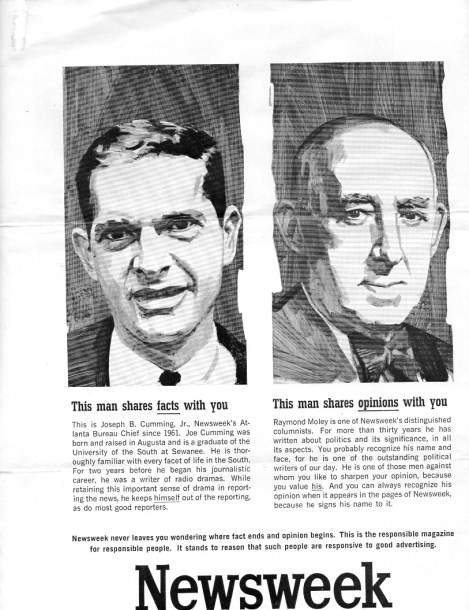
Newsweek adI found examples of “objectivity-in-practice” from these files, and used them in a talk I gave recently to a “Contemporary Issues” class at Southern Virginia University. First, I felt I needed to explain the great American consensus of the mid-20th century – that a separation of “Fact” from “Opinion” was valuable, and possible. (I was lecturing on the subject of the op-ed, the guest opinion column launched by New York Times editor John B. Oakes in 1970). An ad for Newsweek that ran in some magazines, and was a big poster in New York subways, touted that distinction with a drawing of my father, Joseph B. Cumming, to illustrate the “facts” side. The “opinions” side was represented by a bow-tied Raymond Moley, a conservative columnist whose name and face “you probably recognize,” the ad stated.
Today, I doubt if most people would recognize the names, or the value then given to separating Fact from Opinion.

And then there was this editorial column I found from Feb. 27, 1965, by Eugene Patterson, editor of the Atlanta Constitution. Patterson described a speech my father had just given at the Georgia Press Institute in Athens. Cumming described why a reporter – even a white sixth-generation Georgian like him – became an outsider to his Southern brethren simply by doing the work of a good reporter. In 1964, he stood with the mayor and white residents of a Mississippi town as they grumbled about scruffy young outsiders who were piling off of a bus to begin their work for Freedom Summer.

Then he moved into the little house where these workers set up a Freedom School for black kids. Patterson wrote: “He observed, listened and came to understand that these students were as innocently unaware of the gap between themselves and the townspeople as the townspeople had been unaware of the opposite.”

I also found a letter in which my father wrote to a clergyman at the national Episcopal Church headquarters in New York referring to that same encounter in Mississippi. He said he felt sometimes that the only hopeful group was the youth. Most of them – not all, he added – have an attitude that can bring the race problem “within the American concept,” as he put it. “I do think there are some things I would tell them although I certainly learned much more than I could ever impart.”

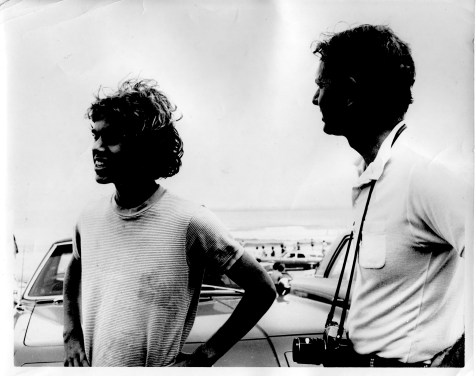
Following the career pattern of my father, I left 26 years in news reporting for grad school and a university position teaching journalism. My earliest lessons in journalism were from my father – really, my only lessons until I began work in a newsroom right out of college. In these family files, I found a picture of myself at around age 16 with him on a story he was freelancing for another magazine, updating “Where the Boys Are” at Daytona Beach.

His lessons in journalism were also lessons in the broader life skills of fairness and the magic of storytelling. I like to tell my students that these basic journalistic practices are also an excellent addition to general college learning, critical thinking and good writing. The practices of journalism are the core “objectivity” of applied liberal arts.

This appeared as a column in the spring 2017 issue of  Clio Among the Media, the newsletter of the History Division of AEJMC.

jbc-jr005

Posted in Uncategorized | Leave a comment

Counting the Cost

A letter to my parish church, Feb. 28.

“Suppose one of you wants to build a tower. Will he not first sit down and estimate the cost to see if he has enough money to complete it? For if he lays the foundation and is not able to finish it, everyone who sees it will ridicule him, saying, ‘This fellow began to build and was not able to finish.’” – Luke 14:28-30

We began building a tower last year. No, not the elevator. And not the college room. Those were temporal, necessary things, and parishioners generously responded with Capital Campaign donations and pledges that have already covered the staggering cost — $600,000.

hermitage-window-crossThe tower I mean is the work of six parishioners who have met almost every other Thursday night for two hours since last June. In addition, in pairs, they have led 13 focus groups and conducted four individual interviews. This allowed more than 100 parishioners and staff to speak candidly about our church. Individuals spoke from the heart about the good and the bad. All points of view were invited and honored.

This “tower” is not temporal. It’s not even necessary – if God’s will for us is to maintain the status quo. But if we are actually striving “to renew the mission of [God’s] Church as Christ’s mission,” then this is the central project of that prayer we’ve been saying every Sunday. It is hard work. It is soul work.

The group of six volunteers began their labor with some hesitancy. The Vestry, I admit, was not very clear on the mission. We said we wanted “healing and reconciliation” after the wreckage left from our church-name decision.

Guided by two consultants from Cooperative by Design, the six met. They talked. They prayed. They asked for our prayers. Somehow they found enough clarity to give the group a name: The Discovery and Discernment Committee. At the heart of their work was an agreement they reached early on, a bond of trust. Members of the group represent divergent views on all kinds of church matters – not only the meaning of the name “R.E. Lee Memorial Church.” But they agreed to a strict code of confidentiality. They would not speak out as individuals, but speak only as a group. This was a covenant with each other and with the Holy Spirit.

While they will not voice individual viewpoints, they allow themselves to speak of their individual experiences. I have heard several of them say that the experience has been intensely spiritual.  They have knit themselves together in a bond of Christian love. They have come to know and trust each other on a plane resting above their differences. It was a surprise to some of them. It took time and trust.

hermitage-altarWe now have the first phase of their work, the “Discovery” part. On the weekend of Jan. 13-15, the D&D Committee presented an eight-page report to the Vestry and to parishioners summarizing the feelings of all the church members who participated. Organized as themes or answers to eight questions, the report noted many good feelings and some serious problems. This is now the status of our tower: A foundation laid.

On Feb. 20, a letter from the two consultants arrived just minutes before copies were circulated at the Vestry meeting. Due to “unforeseen issues” that drove up their expenses and the time involved, they wrote, the $12,000 the Vestry had agreed on last April is not enough to complete the process. The consultants have already billed us for a little more than $11,000. They will need about $6,000 more than the original estimate to complete the job. It was supposed to be completed in March, but now it looks like it could go as late as May, they said.

The Vestry was concerned. That seemed like quite a cost overrun – 50 percent. Also, it was hard enough waiting for recommendations until March, and now it might take an additional two months? We discussed the matter with serious due diligence. We decided to have Keith Gibson, the Vestry member serving on the D&D committee as liaison, see if we can negotiate a less expensive conclusion. (That is to be discussed at the D&D meeting on Thursday night, March 2.) Could the length of planned meetings of the D&D and Vestry around the recommendations be shortened? Could we use one consultant rather than both?

reading-writingIt is now a week later. I am alone in a small cabin on Anne Grizzle’s farm, a sort of writer’s paradise called The Hermitage. Down the road is The Bellfry, the beautiful house where the Vestry held its retreat in 2016 in which the two Cooperative by Design consultants first made their pitch. Last month, we had our retreat there again, and had the consultants present the interim “listening phase” report. As I write this, the long-view of the mountains brings perspective.

What drove up the cost and the time was not the consultants’ doing, but the seriousness that the members of the D&D committee brought to this effort. Anne Hansen, a member of committee who is now on the Vestry, said this at last Monday’ meeting. The D&D members are all thoughtful parishioners who have held back nothing in the endeavor. Anne laughed to say she probably knows the others better than she knows anyone. Keith made a similar point. It is our faithful parishioners who are driving this thing. That’s how the consultants described their approach at the beginning. It is our path, our transformation, “by design.”

I understand the Vestry’s concern about the extra $6,000. I know some members of the parish were opposed to hiring the consultants in the first place.

But we are at a crucial point now, one in which balking over this could leave the whole process unfinished. If members of the D&D committee are being low-key about this, it’s because they are not ready to present action items. But there is no good shortcut. Several of them have made that clear to me. One even said the effort would be rendered “meaningless” if the consultants were cut back now. This is our expense that we caused, for good reason. It’s not like Nielsen  Inc. discovering our stone walls were a lot thicker than they realized. We have made the commitment to the consultants and there’s an obligation attached.

Really, it’s not a lot of money for what we are faithfully seeking. We need a little patience and faith. My own sense of this process is that the most powerful result will be not so much in the recommended “action items” we will get at the end. Rather, it will be in the experience of the Discovery & Discernment Committee that is bodied forth as a model, a light that can be replicated and multiplied among us. pear-orchard-cabin

Posted in Uncategorized | Leave a comment

Defense, Defense.

Southerners are said to be obsessed with their own history. It’s true, belying that old dictum that history is always written by the winners. Even now, well into the 21st century, I find myself wading into the murky waters of that Southern obsession with the past, which invariably goes back to slavery and the War.

dew-book005This obsession animates the 2016 book I have just finished reading, The Making of a Racist: A Southerner Reflects on Family, History, and the Slave Trade, by historian Charles B. Dew. And I feel it in myself as I riffle through about 40 pounds of family files I recently hauled up from Atlanta to Virginia.

Charles Dew, a professor at Williams College, has written books about antebellum industrial production in Virginia that used slave labor and a book about the secession commissioners who brought on the Civil War (Apostles of Disunion). But The Making of a Racist is different, a personal narrative that is half about his own growing up in segregated St. Petersburg, Fla., in the 1940s and ‘50s and half about how it feels for a historian to read documents about the business of the South’s flourishing slave traffic.

He stitches the two halves together skillfully, painfully. The banal mercantile language of the slave buyers and sellers is almost exactly the same as that of livestock traders. Cotton and slave prices rise together with the intoxicating power of an economic bubble in the 1850s. It had become just another face of capitalism, protected by the Constitution. Long after the African slave-shipping trade was abolished, Richmond auction houses sold slaves bred by the thousands, often in families that were then torn apart by that hot market.

Southern apologists for slavery, by then, had worked out their sacred dogma of white supremacy. One of these early apologists, the historian Dew confesses, was an ancestor of his named Thomas Roderick Dew, who wrote in the 1830s of Virginia as “a negro raising state.” T.R. Dew proposed that these slaves were “harmless and happy” but could be turned into “dark designing and desperate rebels” by those sinister northern abolitionists.

After World War II, the Jim Crow system that became the Southern way of life for young Charles Dew was softer, of course, but the underlying assumptions were the same, he argues. Whites believed that race relations, under segregation, were good, that Sambo books were funny, and that maids like the one the Dews employed were loyal and content, if only the NAACP and other outside agitators didn’t stir things up. Charles Dew, as a teenager, began to stray from the conservative attitudes of his gruff lawyer father and polished upper-class mother. He drove their maid home and visited with her. He went far off to Williams College in Massachusetts, learning just how much of a “Southern white” he was. He studied Southern history. He changed.

I recognize the white South of Dew’s youth, because its fading details still lingered in my salad days in Atlanta in the 1960s and early ‘70s. The roots of his family tree go deep into 19th century Tennessee and West Virginia, while mine go back at least as far in Georgia history. The letters and other documents I’m pawing through from my parents’ file cabinet and boxes tell stories that I have known most of my life. I always took a quiet pride in these stories.

In contrast to Charles Dew’s pro-slavery ancestor, mine in the Cumming line were lawyers whose letters and speeches tended to be about the dignity of the law, the virtue of public service, the charm of classical and romantic literature, and the need for industrial uplift in their fair city, Augusta. My grandfather Joseph B. Cumming was an FDR and LBJ Democrat. He served in the 1920s on an inter-racial committee to address racial problems and in the 1940s led a reform movement against the corrupt “Cracker Party” in the Georgia legislature. His son, my father, was ready for the civil rights movement as a liberal Democrat. More than that, he was in the middle of the movement, covering it for Newsweek magazine.

In one folder, I found a photo of him interviewing civil rights hero Rev. Fred Shuttlesworth in Birmingham in 1963, the two pressed together from behind by a group of blacks on the move.jbc-shuttlesworth001

Reading my family’s papers, I don’t experience the kind of guilt that waylaid Dew as he unearthed the past. But I have been disconcerted by something I found in the family record. It’s not exactly racist, but is related. What I found was a prickly defensiveness. The Confederate army fought a good defensive war, and its descendants have remained defensive ever since.

It’s a matter of honor and reputation. I can’t argue with the defense when it is based on evidence and history, as it is with my family. Still, it was disorienting for me to find the old defensiveness coming from my own flesh and blood, because I know that this protective pose has always been one of the main reasons white Southerners are incapable of facing what Charles Dew experiences as our deep collective sin.

My mother died peacefully a few months ago at age 90. Back in 1980, she wrote a well-researched family history constructed around her great-grandfather, Maxwell Rufus Berry, who waited out the Civil War as a money clerk in downtown Atlanta. He didn’t care about slavery or politics; he cared about business. True, he had friends and relatives who were Union sympathizers. But he was not a Unionist himself, my mother wrote in her Berry family history. The distinction was important.

So in a letter to the director of the Atlanta History Center, she said she was “shocked” to see Maxwell Berry described in an ad for a Georgia public TV feature, “Georgia’s Civil War,” as a Union sympathizer. He was a “non-combatant,” she said. Not that my mother admired our ancestor’s “practical and self-serving realism.”

mr-berry004-2

Maxwell Rufus Berry (1823-1909), portrait by Whittier Wright

But she was proud to note that he survived to be a major player in the rebuilding of Atlanta from the ashes, and that his 10-year-old daughter’s diary of Sherman’s bombardment was featured on Georgia public television that season. The history center’s director apologized for the error, and thanked my mother for her support.

A far more lavish Southern defensiveness I found in a nine-page single-spaced letter that my grandfather, the Augusta lawyer, wrote to journalist James Wooten in 1978.

Wooten, a New York Times reporter based in Atlanta and later with ABC News (not to be confused with an Atlanta Journal columnist with the same name), had published a biography of the newly elected President, Jimmy Carter. My grandfather’s letter criticized the subtle but pervasive anti-Southern bias that he detected in that biography, Dasher. It’s an essay-worthy letter, typed on the stiff stationery of the Augusta law firm from which he had retired and withdrawn the Cumming name.

He complains about Wooten rendering quotes phonetically, such as Miss Lillian saying “negra.” He questions why Wooten made a point of the local pronunciation of Albany, Ga., as Al-BIN-y. My Granddaddy was known for his florid vocabulary, his extraordinary recall of Shakespeare and other literary touchstones, and his powerful courtroom manner, in the tradition of an earlier Augusta lawyer whose oratorical sway of juries was said to be grounds for an appeal.

“My son, Joe, tells me that you regard yourself as a Southerner,” Granddaddy writes, but then sets Wooten straight. Atlanta, he says, is no more Southern than St. Augustine is Spanish or Mobile is French. Lest Wooten think this Augusta lawyer is provincial, Granddaddy notes that he was in boarding school, Princeton, Harvard Law and the Army outside his native Deep South, and in his youth was quite taken by it all. But with mature judgment, he came to regard everything north of the Potomac a mere “sub-culture” with few of the abiding standards and virtues of the ages.

jbc-sr

Joseph B. Cumming Sr. in his library in Augusta, Ga.

In fact, he argues, it’s New Yorkers who are ignorant of the correct “iambic” pronunciation of “Albany,” he writes. (“Witness the half dozen largest cities in Georgia where the accent is on the penult.”) Wooten’s attempt at local dialect reminded Granddaddy of what Shakespeare did in Henry V with the Welsh speech of Fluellen (“The Welshman in the Globe Theater when that play was performed was not amused”).

Granddaddy was not amused. Or maybe he was – amused with himself. He cites historical tidbits that range from the Edict of Caligula to what he claims were the peculiar causes of the 1970 racial disturbance in Augusta – a city, he says, with a long history of racial harmony. His arguments sound original and even charming, full of the kind of historical flourishes we always enjoyed hearing from him. He was chairman of the Georgia Historical Commission, president of the Georgia Bar, a national advisor on historic preservation and an honorary Cherokee Indian. He wrote long well-reasoned arguments against Nixon, against pure laissez-faire capitalism, against Christian fundamentalism. . . and all in perfect rhyming couplets, in the 18th century style. He seemed to know everything and everybody.

But the defensiveness I found unbecoming. Granddaddy, not quite digging the journalistic style of Wooten (or his son or me, who also became a journalist), in this letter spoils his few gracious comments with peevish insults. Words like “supercilious” “derisive,” “patronizing,” and “offensive” call to mind the luxurious language of Southern gentlemen making a challenge for a duel. Granddaddy knew the old insulting vocabulary of the code duello. He had written a monograph about the duels between his distant ancestor William Cumming (for whom Cumming, Ga., is named) and a governor of South Carolina. In a note I found addressed to my father, he complains – self-mockingly, I hope – about a “base, false, perfidious, whoreson knave” who had failed to return one of his books.

The defensiveness, in the end, is a cover-up. At one point, Granddaddy criticizes Wooten for mentioning that a train’s passenger car was segregated. “So what’s new?” he writes, calling segregation at that time an immutable part of the then-existing circumstances of life. “None objected and all recognized that it was desirable, eliminating possible friction.” Granddaddy was buried in the historic Summerville Cemetery on Cumming Road some thirty-three years ago.

I have no wish to blame my eminent, idealistic Granddaddy for his worldview any more than he was willing to blame his Confederate forebears for being products of their time. It is not blame so much as blindness that Charles Dew tries to reveal in the white South, a moral blindness in the slave auctioneers, in his parents, and in himself. If we can see that blindness in the past, maybe we can begin to see it in our day too, and see to see.

Posted in Uncategorized | Leave a comment

‘Lucky Me’

For Pam

I was just beginning, in that clammy
August, to pick up the riff of the teaching gig
when I flew from New Orleans off to Miami,
the two U.S. cities we journalists dig.

It felt like betrayal of old newsroom friends
to be hot in pursuit of another career,
where readers are counted down in the tens
and deadlines perk up about once a year.

Abject, name-tagged, I joined the whir
of meat-market interviewees on the path,
blind to the grandeur of the gaudy Fountainebleu,
figuring long odds, doing the math.

Then (on cue, play the James Bond theme),
across the lofty lobby’s dazzling space
you appeared on the minute, as out of a dream,
a civilized, intelligent embodiment of grace.

How we clicked, over coffee, playing Who do you know?,
our geographic coordinates just out of sync —
you were the editor I needed years ago,
and now my professor type, tinged with ink.

So thanks for that appointment, and this scene
of liberal arts, news and philosophies,
for a tenure track through a valley so green.
How lucky this family of news refugees!

pam-luecke-1-26-17

Pam Luecke, at TAPS, Lexington, a toast to our colleague stepping down as department head.

Posted in Uncategorized | Leave a comment

Winners and losers

The American South isn’t the only place where heritage groups claim a particular day to wave their flags.

flaggers-at-sj-cemetery

Photos by Sarah Cumming

When I was in Northern Ireland a few years ago, a nervous public waited to see whether the traditional July 12 parades of the Protestant Orangemen, dressed oddly enough like Edwardian bankers of London, would re-kindle old hostilities as they marched through Catholic neighborhoods. They carried Union Jacks and flags of the bloody hand. But good behavior on everybody’s part kept things calm that year.

A similar civic pride was displayed in South Africa under apartheid, as I learned when I visited the imposing Voortrekker Monument outside Pretoria in the 1980s. The central identity story of the white Afrikaners was the Covenant – the belief that their ancestors made a vow with God before the Battle of Blood River in 1838, and that God kept His side of the bargain by helping only a few hundred of their armed men slaughter thousands of Zulu warriors, and suffer no casualties. The Day of the Covenant was celebrated every year on Dec. 16 until the new South Africa under Nelson Mandela changed the name to Day of Reconciliation.  It is still a public holiday in South Africa.

Northern Ireland and South Africa are beautiful lands that have achieved a relatively miraculous peace after long histories of bloody conflict. Both of these holidays, with their parades and saltire flags, recall some part of the bloody conflict. The Orangemen of Ulster are celebrating the victory of William of Orange’s forces over those of the Catholic King James II at the Battle of the Boyne in 1690, on the banks of the Boyne River in eastern Ireland. The Afrikaners looked back to their triumph at the Ncome River in Natal Province.

Folks here in Lexington are stirred up again about the Confederate flag. Once more, the unresolved civic symbols of Martin Luther King Day and Lee-Jackson Day fall crosswise in the middle of January. But this time, a new group called the Community Anti-Racism Education (CARE) Initiative succeeded in getting a parade permit for Saturday – Jan. 14 – that was traditionally the day the Sons of Confederate Veterans marched in honor of Generals Robert E. Lee and Stonewall Jackson, flaunting their Confederate costumes and flags. This “Martin Luther King Jr. Community Parade” commences at 10 a.m. from the historically black Randolph Street United Methodist Church.confederates-marching

Five years ago, the local chapter of the Sons of Confederate Veterans felt excluded from a heated public hearing when the Lexington City Council was considering putting an end to Confederate flags on city-owned poles during Lee-Jackson weekend, such as along the bridge over the Maury River. City residents, overwhelmingly in favor of the ban, packed the council room before the flaggers arrived. About 30 or 40 supporters of the Confederate flag, after holding a rally on Hopkins Green, had to wait outside the room. Besides that, the council decided to let people speak in the order in which they signed up and to let city residents speak first.

The ordinance, which passed 4-1, banned from city streets all flags and banners other than those of national, state and local governments, without prejudice. This official neutrality protected Lexington from the charge of unconstitutionally infringing on free speech, the claim of a federal lawsuit that the Sons of Confederate Veterans filed, and lost.

Having been preempted again by local opponents, the Sons of Confederate Veterans took out a permit to march on Sunday, Jan. 15, at 3 p.m. The following day, Monday, is the official King Holiday this year. A more flagrant group of Confederate activists called the Virginia Flaggers withdrew its request for a parade permit on King Day, but may well gather at Stonewall Jackson Memorial Cemetery in Lexington on Friday, Lee-Jackson Day, or sometime over the weekend. No permit is required for that.

What is a good, civil response to all this?

A friend of mine who feels the anti-racism CARE parade may be unduly provocative – what he called “poking the bear” in his local newspaper column – had an alternative suggestion. He said citizens should line Main Street for the Confederate flag-wavers parade, turn their backs on it and remain silent. My son, a former Marine, suggested Lexingtonians should join the Sons of Confederate Veterans parade with white flags of surrender, to remind us of the final flag of the Confederacy that mattered the most.

Don’t think my son and I don’t appreciate Southern “heritage,” whatever that is. My great-great grandfather and his four brothers were all Confederate officers from Georgia. Three were seriously wounded. Alfred Cumming, in fact, was wounded in three different battles and Thomas Cumming was taken prisoner three times, I’ve read in a history book. From another history book I read that their father, a lawyer, defied federal troops when Jefferson Davis was paraded through the streets of Augusta after his capture. Henry Cumming stepped forward, removed his hat and said, “Mr. President, I salute you.” The leader of the guard demanded his name, and he told them.

A century later, my Southern family was witness to another historical turn. My father covered the Civil Rights movement for Newsweek magazine. He knew the smell of tear gas and the hair-raising harmonies of mass meetings in black churches. Against the background of that great moral crusade, growing up, my siblings and I saw the Georgia state flag changed to include the Confederate flag in 1956 as a sign of defending segregation, and I noticed that flag popping up in bad places, at Klan marches and on billboards calling King a communist and Chief Justice Earl Warren impeachable.

When I look at the Virginia Flaggers’ website, I get the impression that the Confederate battle flag means something else to them now. I sense that it has more to do with a cultural identity in an age when that identity is under attack and disrespected. The Afrikaners and the Protestant Unionists of Northern Ireland have good reason to worry about the future of their identity. But the flaggers need not be so defensive. Let other tribes celebrate distant wars their mythic forebears won. Let us remember that the Confederacy lost, and seek to understand the profound meaning of that loss. This is the larger identity that includes our many distinct identities, thanks to another flag, the white flag of surrender. The American idea won – in 1865 and in 1965.

If there’s a Southern heritage to honor and practice, I think it was best expressed by the first speaker at the 2011 city council hearing on the flag ban. Patrick Hinely was the only speaker that night who criticized both sides – the city council for borderline censorship and the flaggers for beating a dead horse. To both, he recommended common decency. He received only a smattering of applause, and the council decided at that point to ban any further applause.

Hinely didn’t bring up race, but it has always seemed obvious to me that when any group says that a symbol or word is offensive, it is up to the offender, not the offended, to have the common decency to desist. Hinely put it this way: “Growing up in the South, I came to understand that a fundamental element of the unwritten code of proper comportment in polite society is that a gentleman never gives offense to anyone unless it is absolutely necessary. In this case, it is not.”

A much shorter version of this was published in The Roanoke Times, Jan. 11, 2017.

Posted in Uncategorized | Leave a comment