In Close Vote, R.E. Lee Memorial Church Retains Its Name

FOR IMMEDIATE RELEASE. Nov. 16, 2015

The lay governing body of Lexington, Va.’s historic Episcopal church voted 9-6 to remove the name R.E. Lee from the church’s name, falling one vote short of the super-majority of 10 it needed to make the change.

In concluding an emotional discussion that has animated the congregation for five months, the Vestry voted Monday by secret ballot while 33 parishioners silently observed. The 15-member Vestry had decided earlier that such a momentous decision needed the support of at least two-thirds of the Vestry.

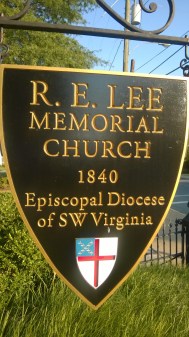
RE Lee signWhile the vote leaves “R.E. Lee” in the name, the Vestry followed this vote with near-unanimous approval of adding “Episcopal” to the official name, and creating a new sign that displays that name and adds “Founded as Grace Church.”

The church was founded in 1840 mainly to provide Episcopal services for cadets at the newly establish Virginia Military Institute in the heavily-Presbyterian town of Lexington, Va. It was called Grace Church by the time Robert E. Lee arrived in Lexington in September 1865, the revered leader of a defeated Confederate army. Lee, who had agreed to be president of Washington College, joined Grace Church and was elected senior warden. He worshipped at the church and led the Vestry as senior warden until his death at age 63 in October 1870. He was also instrumental in the construction on the adjacent college campus of a chapel that became Lee Chapel, where Lee and members of his family are buried.

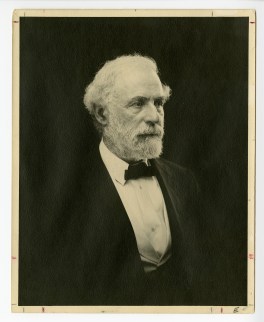
After Lee’s death, the church became “Grace Memorial Church,” and the college, a totally separate entity, was re-named Washington and Lee. In 1883, a larger church building, the current stone Gothic Revival structure at the corner of W. Washington Street and Lee Avenue, began holding services. In 1903, the Vestry re-named the church R.E. Lee Memorial, although no record can be found of reasons for this change or a debate over it. This year is the church’s 175th Anniversary, which was celebrated this month with a reception after an All Saint’s Day Choral Evensong service Nov. 1.RE Lee 1870

Off and on, members of the church have quietly discussed whether the name was inappropriate or misunderstood in the 21st century as the name for a church seeking to be, like all Christian churches, part of the “Body of Christ.” But loyalty to tradition and attachment to the name as an identity made the issue too emotional for an all-out debate – until this summer. Two weeks after the horrific fatal shooting of nine leaders of an African Methodist Episcopal church in Charleston, S.C., a member of R.E. Lee Memorial Church wrote a letter to the church rector, senior warden and junior warden saying she felt that, in the wake of the tragedy, it was “time for us to have a frank, Christ-centered discussion about the name that our church has borne since 1903.” The church leaders responded by presenting the issue to the Vestry in July, leading to months of discussion and discernment through forums, house meetings and a survey sent to all 390 active adult members of the church.

The Vestry had previously decided to respond to the question with a vote at its monthly meeting Nov. 16. It also decided that, because of the deeply felt and consequential weight of the decision, a name-change would require a super-majority of at least 10 votes on the 15-member Vestry.

Some Vestry members made statements after the vote. The Vestry has set up a special email account for anyone wishing to contact the body on the matter, warden@releechurch.org.

***

Posted in Uncategorized | Leave a comment

Two of my published articles on Marshall Frady

The late Marshall Frady, a New Journalism magazine writer from Georgia, wrote in a way that gave some of us a sugar high. Others felt his prose was too rich. Anyway, when I dip back into his books, I find myself writing down his phrases in a journal. Like this, on where Will Campbell found his ministry (the rural South where Trump would find support): “. . .the shabby outer precincts of the nation’s promise.” Or on Campbell himself: “. . his trust in all the mysterious supernatural machineries and alchemies of the Incarnation, the Blood Atonement. . .”

Here are two 2014 articles I wrote based on my research in the Frady Papers at Emory, one published in Literary Journalism Studies and the other in Journalism History.

‘Just as I Am’? Marshall Frady’s Making of Billy Graham

Cumming ‘So Splendid It Hurts,’ article in Journalism History Spring 2014 (40,1) pp. 59-64.

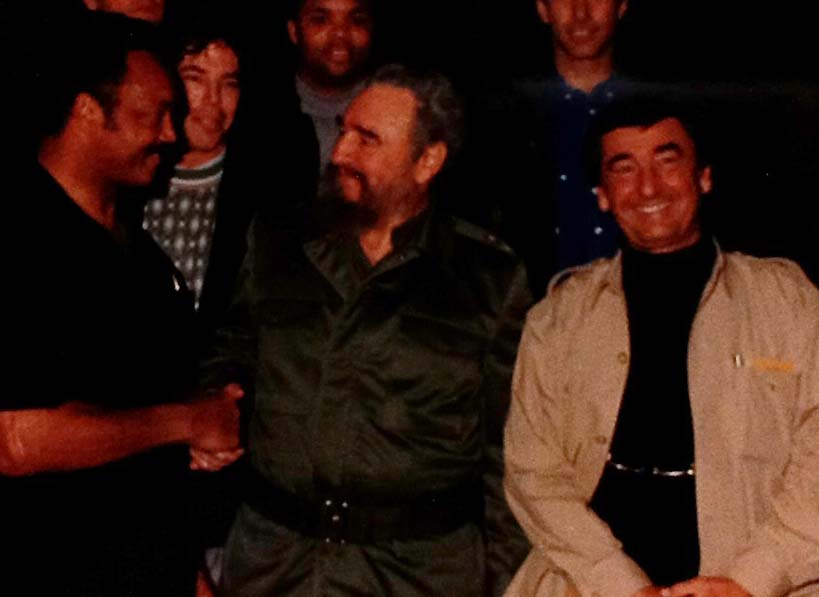
Jesse Fidel & Marshall

Jesse Jackson, Fidel Castro, and Marshall Frady, who seems happy to have finally met Fidel, nearly 40 years after Frady’s failed adolescent efforts to cover the Revolution.

Posted in Uncategorized | Leave a comment

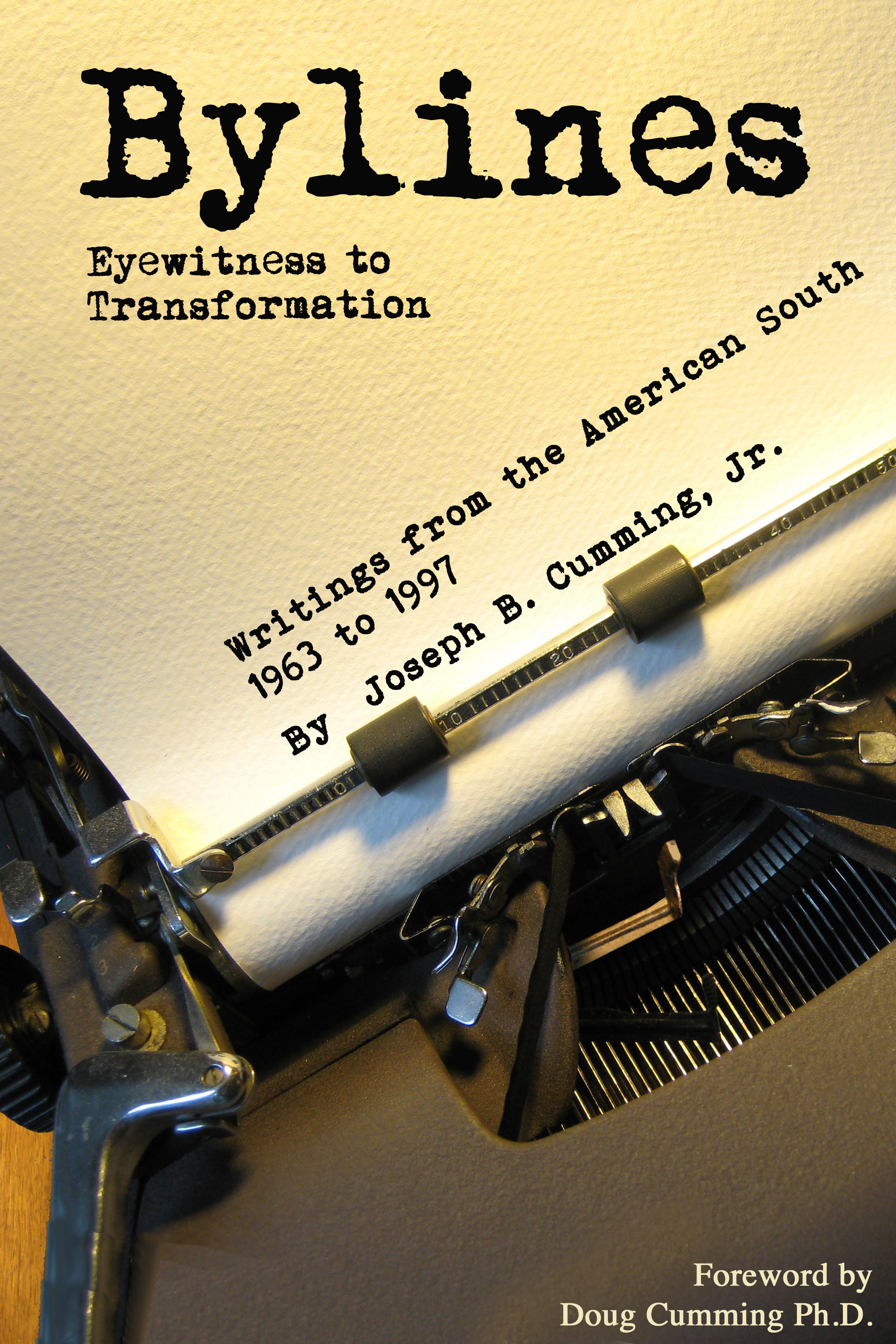
“Foreword” to Bylines book

from the book Bylines: Writings from the American South, 1963 to 1997, by Joseph B. Cumming, Jr., 2010.
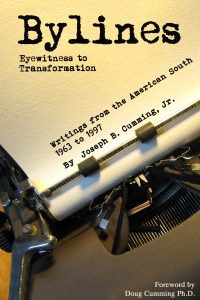
Bylines cover6Joe Cumming was a most unusual sort of journalist. For twenty-two years he covered the American South for Newsweek magazine, the very years when the civil rights struggle (an epic clash in constitutional law, then in soul-force protest) made that territory a beat with as much excitement and consequence as one finds anywhere in the history of journalism. Yet he came to this job with zero training, no college courses in journalism, nor a single day of work at a newspaper or wire service. His preparation was writing poetry and radio dramas, selling building supplies and making commercial films for a few years. His education, from childhood through the University of the South at Sewanee, was a deep liberal-arts immersion in literature and history. An unusual journalist, yes, but then, he is a most unusual sort of person.

Joseph Bryan Cumming, Jr., grew up on genteel, easygoing Cumming Road, a world that looked down a little, in physical elevation as well as social class, on the rest of the historic river city of Augusta, Georgia. This world was at once vanishing to the tiny phosphorescence of a firefly, and looming large as the harbor view from a tall ship’s topmast. It was a micro-world filled with historic time. Family stories harked back to when President Buchanan made Uncle Alfred governor of the Utah Territory or the night President Taft dropped in on the Cumming house for dinner.

Born on February 26, 1926, Joe was the only son of two strong leaders of local civic life, his father being a prominent lawyer and scion of what some encyclopedias refer to as “one of the most distinguished families in Georgia.” Joe Jr. was a skinny lad with a Roman nose, soft mouth, ears that stuck out, and aster-blue eyes. He had permission and a capacity to dream away the time on a pony or at the piano. His great inheritance was such stuff as dreams are made on, not privilege or wealth. In a spiritual sense, he joined American life, just missing World War II action but not the jazzy action that followed. He got his ears pinned back, got married, settled in Augusta, sired four children, then set out for Atlanta, like so many other small-town Southerners, to find his destiny.

That destiny turned out to be magazine journalism. William A. Emerson Jr., a friend who had worked on the Harvard Advocate and at Colliers, had set himself up as a one-person regional bureau in Atlanta for Newsweek in the early fifties. By 1957, after the year-long Montgomery bus boycott had grabbed the world’s attention and before the Little Rock crisis erupted, Emerson realized he needed help. Riots were breaking out. Instead of getting an experienced news hand—someone like wire-service trouper Claude Sitton, who was about to open a New York Times bureau in Atlanta—he hired Joe Cumming, a sweet-natured gentleman with a poet’s love of words. It was a risky, intuitive gamble.

Within four years, Emerson had moved on to higher realms at Newsweek in New York, leaving his younger colleague as bureau chief. Cumming was ambitious and scared, so he learned fast what New York expected. Throughout the sixties, the teletype clattered in the bureau offices. The old rotary phones ran up enormous long-distance tolls. Sunday papers from every major Southern city grew in columns against a wall like giant termite colonies. He hired and groomed reporters who would go on to run other Newsweek bureaus around the world or become legendary as reporters and writers: Gerald Lubenow, Karl Fleming, Andrew Jaffe, Hank Leiferman, William Cook, Marshall Frady, Eleanor Clift. He selected talented stringers in newsrooms throughout the South to keep watch on the action. The files he sent to New York, in which he rendered exhaustive reporting into sparkling prose, would end up as fragments—a quote or an anecdote here and there in someone else’s sparkling prose. There were few by-lines at Newsweek in those days. The reporting was always re-written.
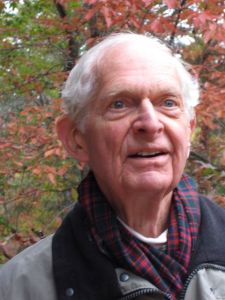
image002But the dreamer had his writing dreams, and like Joseph in Egypt, this Joe could interpret dreams. He had a feeling that he could bear witness to what was happening in the South in some higher form than his Newsweek files. Something told him there was a place for his literary imagination—the peculiar Southern music and the metaphoric flight pattern of his private writing. Now it just so happened that a new kind of journalism was gestating in the precincts of New York in the early sixties. At the New York Herald-Tribune’s Sunday magazine and at Esquire, editors Clay Felker and Harold Hayes (both of them dapper Southern boys) were taking literary leaps with non-fiction writing, going a little wild and crazy to capture the maelstrom energy of this new thing, the sixties. Their magazine experiments would soon be called the New Journalism. Cumming was visiting New York, a guest of Newsweek, when he gained entry into Hayes’s office to pitch a story idea, something like “So What Did You Do in the War, Daddy?” Hayes liked the idea, and told him to send it over. So he did. And that story, the first of the published freelance articles printed in this collection, appeared in the November 1963 issue of Esquire under the title “The Art of Not Being 37.”

Two things about that article are worth noting here. One is that it is not about what this Newsweek bureau chief was covering in the South, but is about his own subjective experience as a 37-year-old American at this particular time and place in the history of civilization. The New Journalism opened up the space of subjective personal experience like a Moog synthesizer or an acid trip. It was perfect for Joe Cumming. And the second thing is this: His article appeared in the same issue with the very first “New Journalism” article by a new talent named Tom Wolfe. Wolfe’s article was titled “There Goes [Varoom! Varoom!] That Kandy-Colored Tangerine-Flake Streamline Baby.”

If some “news muse,” as he puts it (or dumb luck) launched his freelance writing career, I feel blessed with a similar luck or muse for having grown up with Joe Cumming as a father. Falling asleep upstairs in the Cumming house was a cozy way to go. We children could drift off to the sounds of Daddy on the grand piano downstairs, stroking the rich chords and tripping down arpeggios of “Stardust” or “Moonglow.” Or your last dot of consciousness might be the sound of loud storytelling and crowd laughter. Or when only Daddy was still up, under the last light on, I could faintly hear the sweet pattering of his big manual typewriter. He was working on another freelance piece.

But the best part for me came after leaving home for college. That’s when he and I began writing letters back and forth, typewritten riffs of mutual encouragement, show-off literary allusions, and preposterous verbal experimentation. It was a private thing we had going, and I thought I would never find a legitimate description of it until I read this in Nabokov’s Speak, Memory, about his White Russian father: “Our relationship was marked by that habitual exchange of homespun nonsense, comically garbled words, proposed imitations of supposed intonations, and all those private jokes which is the secret code of happy families.” Within my first week as a college freshman, under the spell of courses in history and poetry, I was pecking out trippy letters home. He wrote back, “Your communiqués zip silver about the emptying space, enlivening the growing of light into September.” Once, after he saw a performance of Dylan Thomas’s “Under Milkwood,” he let the fireworks fly in a letter to me. He got rolling on pure sounds of “flush and rush out all old dried up dreams and schemes and new hatched sky-stretched visions from seed to pumpkin, from acorn to solemn oak from molecule to the great globe itself and carefully from the atom to be strewn across the galaxy.” (He still says blessings at family meals like this, too.) Not that anybody can say what it means but let me quote a paragraph from that letter of December 2, 1972:

And last night dreaming of being with mountain people, old Foxfire sorts, in stone crumbling chimneys, good dry-straw-smelling people as I knew were dwelling in my [mind] when hearing and breathing Under Milkwood. For I seem more and more to be drawn toward people I cover [like] Pentecostal preachers (see Newsweek, lead anecdote was mine, Nov. 27th, page 93), country music fans (page 62) in Wheeling, W.Va. . . And just now walking past Union Mission realizing my life’s chance would be to listen with those derelicts and harvest their tales, each representing in human terms the malfunctioning of society. And this is somehow opposite of what I sense is the Political Radical glorification of The People. I feel very out with that impulse, for it is all external to heart and deals with people externally. Liberals and radicals are too often bright pastless people who are bored with human relating and who have no ear for music. It’s cold and insect-like.

Perhaps it was as odd as Joe Cumming becoming a journalist, but in June of 1974 I drove from my graduation at a liberal arts college in Vermont, with no training or education in journalism, straight to my first real job as a summer intern in the newsroom of the Raleigh Times. I learned fast, and kept working for newspapers for the next twenty-six years, with a couple of interludes editing regional magazines and a couple of reverse sabbaticals on Ivy League campuses. We continued writing our glimmering letters, my father and I, and sharing poems we wrote. But my earnest career plan was to make it in the ink-stained profession on my own, not as Joe Cumming’s son.

I think I did pretty well on my own feet, though in truth those last two decades of the Golden Age of American newspapers (a century from about 1890 to 1990) offered a gush of advertising dollars that made it fairly easy for a young reporter to flourish if he or she made half an effort. In Raleigh, I concluded that the excitement of writing up the civil rights movement was just about played out. (In the summer of 1975, the murder trial of a poor black woman named Joan Little, who had ice-picked her white jailor after he forced his porky self on her, drew some of the smart reporters who would go on endlessly seeking a dénouement to the great Homeric saga.) I was lucky to work next at the Providence Journal-Bulletin over a thirteen year period when it was admired as “a writer’s paper.” I thought my connection with my father then was private and precious, like his letters. But here and there, I would run into journalists who wondered if I might be related to. . .[in tones of awe] . . .Joe Cumming. I was not at all embarrassed to acknowledge it. Then they would offer some hushed confession or animated story, the gist of which was that Joe Cumming had changed their life. He had either hired them as a stringer, or taken the time to encourage their writing, or shown them how a journalist could have a sensitive or dreamy side, or made them snap out of their dreamy side, or he simply passed through their consciousness as that piano-playing, poetry-spouting Newsweek bureau chief in Atlanta. I had this experience at surprisingly remote spots, far off on a press junket to see the turbines of Hydro Quebec on the tundra of James Bay, on another junket to the oil patch around Monroe, Louisiana, and even when I dropped into a wire-service bureau in South Africa. Apparently, I was not the only one he had taught and inspired.

In fact, he had been a sort of ring-leader of literary journalism in Atlanta. He had organized various floating downtown lunches for the journalists who worked in the Atlanta bureaus of national news organizations, a weekly salon that for awhile he named “Tuesday Tables.” Dinner parties at the Cumming house, or weekend house parties at our place in the mountains in North Georgia (see the exquisite essay on “Tate” on page xx) would often draw writer friends like Frady, Pat Conroy, Anne Rivers Siddons, and after his return to Atlanta, big Bill Emerson. Later, I would find Daddy’s name exalted in the acknowledgements of their books or disguised in their novels as a character or an anecdote. Occasionally, a well-known writer visiting Atlanta for an article would wind up at our house over drinks or dinner, luminaries like Mary McCarthy and Garry Wills. My parents once took Washington Post publisher Kay Graham to a play.

The end of the seventies swerved, and flung Cumming into a new calling—higher education. He spent a year as a visiting instructor at the University of Georgia, and then earned a master’s degree in liberal arts at Emory University. His master’s thesis was a case study of civil rights journalism, based on the most independent knowledgeable reporter in Mississippi, Bill Minor. During the eighties, he taught in the department of mass communications and theater at what was then called West Georgia College in Carrollton. All the while, he continued to freelance, writing regular columns on the book page of the Atlanta Journal-Constitution about writers and readings. Then he cranked out opinion pieces in other venues, mostly about his well-lathed mental map he called “the new learning.” These ideas are the refinements of a lifetime of wondering, thinking and writing, a lovely cat’s cradle of connections between teaching and learning, news and history. Listen folks, he just wants to pass it on. Take it and use it, somebody, please.

But there was always a bigger project he had in mind. Even in his first letter to me when I went off to college, he referred to beginning work on his movie, tomorrow. “I have a deadline upcoming,” he said, “when the director will be in town.” A few years later, the idea had grown to be a book, a novel. “I take off next week for three weeks to begin the novel,” he wrote me in April of ’72. Later, it grew to be The Project, a little self-mockingly, even acquiring a secret code number. Something was always getting in the way. One more “utterly last statement about the South. . .for a crummy magazine. . .and it is damn good.” Or reading the clips of another young kid fresh out of college who wanted to write for magazines. Or a family vacation, or family crisis. Or Tuesday Tables or another great house party. Or writing an anniversary poem, or another letter to me. Or directing a musical comedy, or writing one. Always something, distractions that piled on other distractions to make up, over the years, the whole of who he really was and is. Like “The Other Wise Man” in that Henry Van Dyke story, he was forever being pulled off his task of reaching Bethlehem by the needs of people on the way, and by his own delight in meeting those needs. Only after a lifetime of frustration in the pattern is it revealed that meeting such needs was, in truth, reaching Bethlehem. Still, he longed to see it in a book, something we can all pull down from the shelf and enjoy, and pass along.

So this, finally, is that book.

Doug Cumming, Ph.D.
Washington & Lee University
Lexington, Virginia

Posted in Uncategorized | Leave a comment

History, Types I and II

They tied a body bag around Cyrus Hall McCormick. The next day, I discovered what they were doing to this bronze campus statue of one of our biggest donors. They were catalyzing the greenish patina back to its original bronze glow.

McCormackMany visitors to Washington & Lee mistake this statue, at a distance, for Robert E. Lee. There is a certain sameness to the look of Prominent Men of the 19th century – the beard, hair flying out at the ears, a chest thrust out like a Pouter pigeon’s from an unbuttoned topcoat, a large Roman nose. The visitors who come looking for Lee’s crypt in Lee Chapel, and their misreading this statue, or confusing my Episcopal church, R.E. Lee Memorial, for Lee Chapel – all this makes me think of the difference between popular history and the history that historians claim. It’s the difference between public celebrations of history and what we mean when we say the “History Division” of the AEJMC.

I would refine that and say there are actually three kinds of history. There’s popular history. Then there is what historians say happened – with younger historians always coming up with new interpretations as time throws new light and shadows, new evidence and loss of artifacts over the significant past. Then, thirdly, there’s what actually happened, an epistemic abstraction that will always elude us.

There’s a brass plaque in the entryway of my building, installed by Sigma Delta Chi 44 years ago on the very day I write this, recognizing that W&L was where “professional education for journalism began.” It was not so much education “in” or “for” journalism, but a liberal arts education and scholarships “for” poor printers, to educate them as future newspaper editors. “Initiated by General Robert E. Lee, then President of Washington College, courses designated to prepare newspapermen for positions of leadership in a defeated South were taught from 1869 to 1878, the first formal instruction in journalism in the history of education.” A local newspaper editor was designated as an instructor in “typography,” and was to put the press-scholarship lads to work in his print shop for an hour each day.

You might say it was not really “professional” education either, in that the rise of a profession of journalism came later, culminating in schools of journalism that began at the University of Missouri in 1908 (see the wonderful chapters collected in Journalism 1908: Birth of a Profession, Betty Houchin Winfield, ed.). Leading editors of the day, including Frederick Hudson of the New York Herald and E.L. Godkin of the New York Evening Post, scoffed at Lee’s idea that journalism could be taught in college.

Lee is an interesting figure of public history. Whatever role he may have played in initiating journalism education, after he died in 1870, his role as a symbol of an honorable-though-defeated white South was confiscated by a powerful ideology. Over the next seven decades, Southern leaders of both high and low station appropriated Lee as a saintly icon of state’s rights and Southern identity. Today, looking back as historians, we see these as codes for the South’s racial apartheid and white supremacy.

Lee as icon was not abused as brazenly as was the Confederate battle flag, waved by a revived KKK and Southern resisters in the 1950s. But as University of Georgia historian James C. Cobb said in his Founder’s Day lecture at W&L earlier this year, Lee became part of a public history, what Robert Penn Warren called the big myths we live by, and in our own living, constantly remake. “Silenced by death,” Cobb said, “Lee could not protest.” Lee had accepted blame for losing at Gettysburg, but after Appomattox, remained silent about the war (and refused to give interviews to journalists). Cobb said this was to turn people’s attention from the war and toward the future. But that didn’t stop those who would not only erect monuments to him, “but actually make a monument of him.”

President Eisenhower hung a portrait of Lee in the White House as one of his military heroes. At W&L, where historical flags of the Confederacy last year were removed from around Lee’s recumbent statue in Lee Chapel for display in the museum below, it is “Mr. Lee” the reconciler and education reformer who is honored today. Still, the contested meanings of public history are gusting strong around Lee. Students who had won a Robert E. Lee Research grants for summer research found it helped in job and grad-school applications to remove that from their résumés, and the university has since changed the name of that grant.

And how about R.E. Lee Memorial Episcopal Church, where he was a devout worshipper and senior warden when it was called Grace Church here in Lexington? “I thought Episcopal churches named for people all took the name of saints,” visitors would say, and the joke was that locals would respond, “Yes, and what’s your point?”

But the name of the leading rebel general who fought to preserve a system that accommodated slavery is not one that well represents the Christian gospel. Not today. I recently invited our director of Special Collections to look at a 1906 engraving of General Lee hanging in the parish house, with a Confederate flag and a W&L flag crossed underneath. I asked, Could we swap that with a reproduction of a Michael Miley photograph of “Mr.” Lee in civilian clothes? He thinks this might be done.

It’s a small thing, against the great ungovernable tides of public history and popular (or unpopular) symbols. But like that statue of Cyrus Hall McCormick (related to Joseph Medill, Col. Robert McCormick and Alicia Patterson), the symbols of our public history need to be occasionally worked on to recover something of their original nature.

Posted in Uncategorized | Leave a comment

A Singular Critter

“The case of the three species of protozoan (I forget the names) which apparently select differently sized grains of sand, etc., is almost the most wonderful fact I ever heard of. One cannot believe that they have mental power enough to do so, and how any structure or kind of viscidity can lead to this result passes all understanding.”

— Charles Darwin, letter to W.B. Carpenter, 1872

A life form found in many eras
Back as far as they can tell
Is called the foraminifera,
Ubiquitous and single-cell.

The thing that makes so many care a
Lot about this bagatelle —
This tiny foraminifera —
Is that it forms a tiny shell.

This makes it be the mini-bearer
Of Life’s long age, capital L,
This runty foraminifera,
The oldest creature in fossil.

And still it lives within e. terra
Oceanus, swamp or well.
Greetings, foraminifera,
We praise the tree from which you fell.

We saw delight, va bene era,
In classes summoned by the bell:
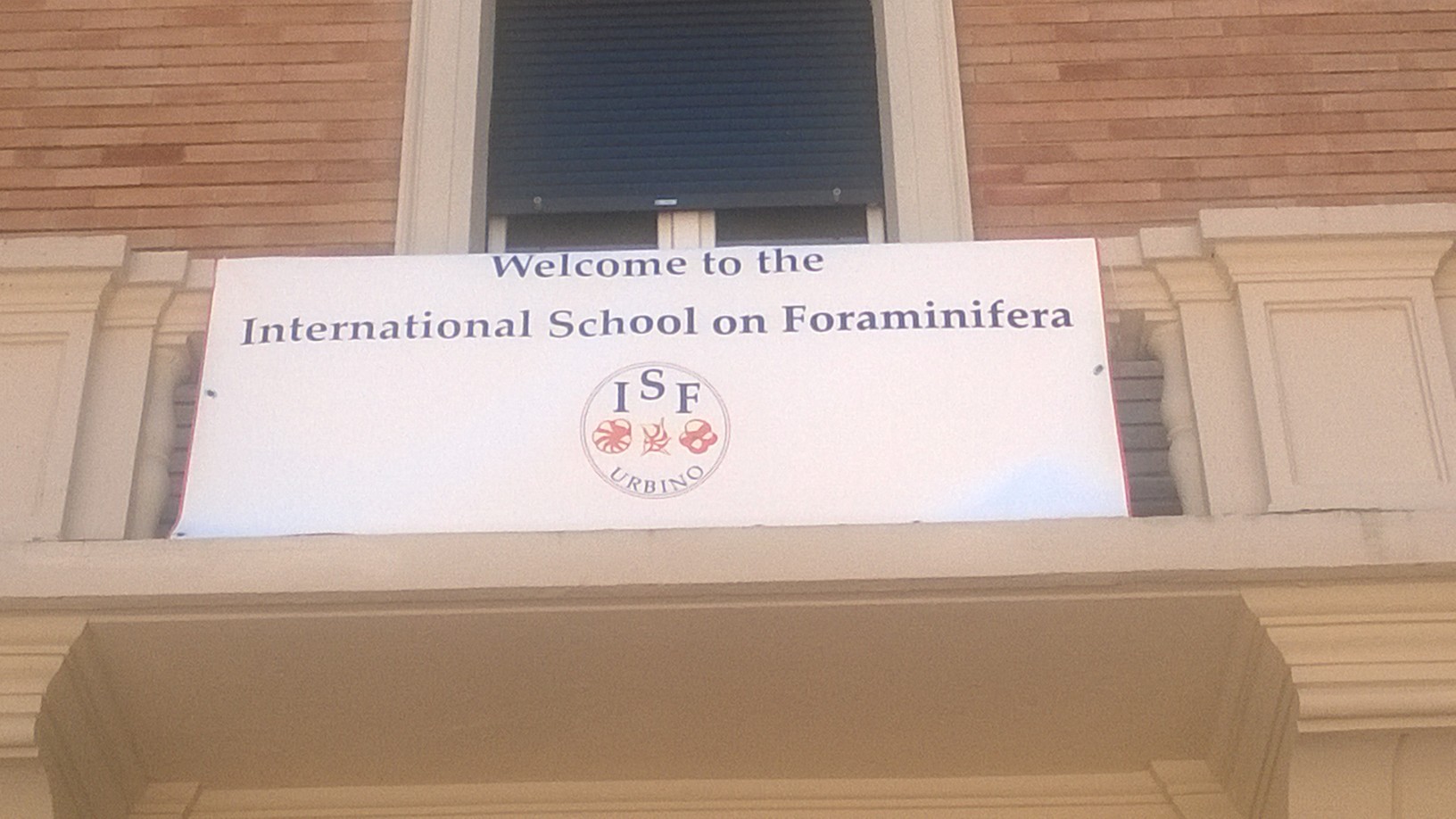
The School on Foraminifera
Is under Urbino’s campanell’.

This 600-million-yearer
Has a product it can sell.
“Look here!” the foraminifera
Tells BP, Exxon-Mobil, Shell.

But science with its skinny mirror
Has other, purer clientele.
Our Brother Foraminifera
Speaks of life twixt heaven and hell.

School on Foraminifera

Posted in Uncategorized | Leave a comment

Visions of New York

A walk in New York City is a passage between the world’s extreme possibilities – in between the horrors of Armageddon and the bliss of an urban paradise. You walk near-sighted, with blinders that hide these wild visions as you pad along between shadowing old buildings. There are craters dug out for new buildings lurking behind plywood screens. Construction cranes tower higher than the imagination or the highest fireworks can go.

On Monday night, the Big Dipper was invisible to me, at first, until our daughter Sarah pointed it out between high buildings on W. 49th Street as we stood around our son Daniel’s parked rental car, a family again for a few more minutes.WTC Earlier that day, Libby and I had explored the 9/11 Memorial – long sheets of water pouring down into the black square void that had been the North Tower’s footprint, a light rain leaving tear drops that ran down the inclined slab of engraved names. Then we went through the 9/11 Museum. I was thinking about the utter destruction of that wrenching day. A billboard in Times Square was flashing “Nothing can prepare you for what’s next!” with scenes from a new movie called “San Andreas.”

Yet all around us, new buildings continue to rise, powerful like the new World Trade Center that checked us thoroughly at Security before we rose in Artificial Intelligence elevators to the offices of Glamour. Or pencil-thin like the high-rises needing only one elevator shaft because they are residences, investments by billionaires from other nations. Tractor trailers continue to 9-11 namesrumble down the West Side into Lower Manhattan, doing the work that trains did in the 19th century at street level until so many pedestrians were killed, they raised the train tracks onto elevated steel girders. Those tracks were abandoned by the mid-20th century, and nearly demolished by the 1970s. But a few “new urbanists” sought to save the elevated line that still stood over W. 34th St. near the Hudson and curved southeast then south to the Village. Now, with the blessing of Mayor de Blasio, it has opened as the pedestrian High Line. Libby and I walked from our hotel down W. 34th Street, past the crowd waiting for the newest mode of public transportation at the Megabus curb, to the northern entrance of the High Line.

It was a lovely twilight hour, with breezes from the river, sailboats jagging randomly, valentine clouds, and all shapes and sizes and colors of peaceful people enjoying their stroll along the gardened path. There were couples dressed for fine dining and a play, hip-hop clusters, pregnant women, a Buddhist panhandler, professors and photographers. No matter what tragic disaster befell, and no matter “what’s next,” it seems that human life will overwhelm the loss with a thousand times more building up and with our irrepressible living. The City of God pushes through the abandoned old systems. The rusty rails become happy trails.Us

Another disaster: an Amtrak train like the one that brought us here two days earlier derails going 106 miles an hour around a curve northeast of Philadelphia. Eight passengers are killed, and hundreds injured. The Amtrak service that was to bring us home is shut down for the week. Scrambling to beat the rush out of New York, I was able to rent two SUVs from Newark Airport that brought us home by 7 p.m. Life goes on, and outgrows itself.

Posted in New York City, Uncategorized | Tagged , , , , , | Leave a comment

Surprised by JOY-FM, Ghana

A good radio voice can work magic, especially in the west African nation of Ghana. Kojo Yankson, visiting our journalism department for the week, has that voice. His father is a biology professor. Kojo had spent about 12 years in England when he returned to Ghana to help his father build a community hospital. He had some business at JOY-FM radio station, and somehow ended up getting interviewed on the Morning show, since the subject was how to attract educated Ghanaian expats back home. With nothing better to do, he returned each morning for more interviews. Eventually, he became the host, and watched his audience grow from two million to more than six million, the biggest audience of any English-language radio show in Ghana. Kojo Yankson

Kojo is now 35. He not only has an elegant British-African voice. He also has a solid belief in the power of public-affairs journalism to check government corruption and secrecy. Apparently, a lot of his listeners share that belief. When they have a problem with infrastructure, he says, they don’t call city government, but call his “Super Morning Show” at JOY-FM radio. And his show, on air, will jump on the case and get the government to do its job. If there’s a crime, the victim won’t call police, but will call Kojo’s radio show, and he’ll call the police and make them respond.

That’s watchdog journalism at its most basic.

Radio is a big deal in an African country like Ghana because 60 to 70 percent of the population there is illiterate. Kojo has a few other theories on why radio is the most popular and powerful medium in his country. The people are very religious – or rather, “superstitious,” he says. And this, he theorizes, is a mindset that responds more deeply to the auditory, to the spoken word, as having authority. Outside the cities like Cape Coast and Accra, it’s also a nation of tribal villages. There, storytelling reigns. As the day fades, the people gather and the storytellers hold forth. Radio news reports, at least in the tribal languages unfettered by libel laws, follow the native story form, he says.

The Ghanaian story form may be relevant to understanding what we mean by “storytelling,” a mystery we’re trying to get at in the class of mine that Kojo visited, “J318 The Literature of Journalism.” It’s journalism; nonfiction; fact-based. But one of the elements that makes it “literature” or creative is story form. Kojo described story form in his country as following a formula that begins with some variation of a statement that is like our “Once upon a time.”

“Kodi Kodi nsio.” It means something like “Can you believe this?,” not so much in skepticism but as an invitation to let yourself believe what the storyteller is about to tell you. Then the storyteller introduces all of the characters in the story – for instance, This is about a fetish priest, a little girl, a black rabbit and a magic tree. . .or whatever. At the end of the story, there’s another ritual line that goes “Asem yi se oye dew o, se onnye wo dew o, mna osii nyen.” And that means something like, “Whether you enjoyed this or not, it’s true.”

That last statement, I realized, is the legend over the license of literary journalism, as John Hersey argued in a famous Yale Review essay about the form, “The Legend Over the License.” I’m not making this up, as Dave Barry likes to say. This really happened. Or Kurt Vonnegut: Listen.

Posted in Uncategorized | Leave a comment

Circuitry: For Sarah

I.

Out of nothing above
the infinite falling of snow.
I lie on a couch face up
watching it fall.
The thought of infinite dropping dots
fills my mind, silently dropping
as numberless as the crumbs of stars
scattered across the tablecloth of night,
or the hundred billion neurons
of the human brain.

There is all this talk now, news and talk
about the brain. Can we live 150 years?
Or forever, replicated? Can the gene
for our bigger brains be given to chimps?
Is the hippocampus fixable? Intelligence squarable?
Brainy babies on the cover of Newsweek and Time.
All this is based on the error of materialism.
It is not the brain alone, but the work we have done with it
for the past, oh, two and a half million days or so.
It’s been quite a project: Making weird sounds
with lips and throat and tongue,
not what they were made for by Nature.
But maybe God said to hell with Nature,
and began with the Word. Making these sounds
mean something meant everything, allowed us
to make wisecracks and love.
Then to further encode that code in marks,
swirls and nicks on stone, rag or vellum,
to write and read, this was a real work of engineering.
It has taken so much time and still takes time.
Everything else is just workshop junk, trial and error.

II.

Weird, you say.
It’s weird how this tumor sits
in the insular cortex where words
like “weird” and “sad” and “steroids”
are formed, and the way the meaning
of those words, if words mean anything,
work to make you weirdly sad and then
you talk a blue streak until the moods build up
and swing into another seizure in the middle of the night.
Then you are weirdly at peace. Is it the steroids

That do this? you wonder.
Or the tumor, intruder in that inner sanctum
of self, the “I” that walks in your shoes and delights
in the boundary fronting nature and all its lovely creatures?

You picture the surgery you are facing as being
like the scooping out of a pumpkin,
one of those myriad memories welling up.
I offer you a different image: It’s like an oyster,
a glistening gray thing that will slide out
neat and whole.

III.

Each night, the curtains rise,
the house goes dark, the mind grows red.
Dark figures on stage will improvise.
Noises in the wings. Nothing said.
Each night this other world
is an ocean of unknowing. We float on top,
asleep, then not. Thoughts come furled
and flow, then tie obsession’s knot.
This is nothing. But if the brain
is invaded, what dreams and memories
rise from the deep, litter the sand?
Crack time’s shell. See what spirit sees.

I could write a ballad of the man
Grover Cleveland Hall, G.C. junior.
His father’s editorials fought the Klan,
won a Pulitzer. The son rose, had a flair
for flippant prose, and roses in lapels:
heir of nonchalance, on history’s hinge.
The world’s attention in ’56 compelled
G.C. to lecture back. It makes one cringe
today to read his righteous briefs
against dumb datelines from Montgomery
while King held high the South’s old griefs
and feet refused to pay the fee.

Old G.C. junior was later hired
in Richmond, but never stopped his self-defense.
Like Wallace, he was Alabama, and so was fired.
Driving back home, he lost his way, his sense
of who he was. Police near Charlotte
threw him in jail.
And there my ballad would be squeezed,
in which he would moan his haunted tale.
For there in a dark cell
an undiagnosed brain tumor had seized
the gift he had squandered, his intelligence.
He languished until a fellow editor got the news
and set him free.

IV.

Light dancer, light as laughter,
no squanderer of gifts, you give us
so much hope we have to laugh.

Each night, a feather-brush of gloom
strokes me awake out of the dark.
Or it’s the cat, your patron saint,
sitting on my supine form
like the night mare in Fuseli’s painting.
Am I awake? Is that you, Sarah?
It’s 1:35 in the morning. Are you asleep
in Brooklyn? Did another night terror
arouse you, and send me this beep?

Your reports from the mind’s front line
fill my brain, and I wonder, lighting on some memory
of when you were little, easy to make laugh,
and colors fill the stage.
The sad fact of unrecoverable time
is buried in snow so deep,
the train of my coming to you
now rushes on
covered, a burrowing bright rush
thrusting drifts ahead of itself
in excited delirium.

Posted in Uncategorized | Leave a comment

Peachtree Heights, Murky Depths

In my JOUR318 Literature of Journalism class, I gave an in-class writing assignment that Rick Bragg once brought into my class when I was teaching in New Orleans. It starts with the prompt “I come from the kind of place where. .  .” Here’s what I wrote:

duck-pondI come from the kind of place where the boys would gather after school behind the billboard draped in kudzu to watch two toughs settle matters between them. One of the toughest I knew showed me a switchblade he owned, but this wasn’t the type of fellow any of the rest of us wanted to imitate or accept. With grease-combed hair and leather jacket, he was an apostle of a figure we had all listened to, the angel-eyed Eros of Tupelo. But the rest of us were limited in fashion and fate by our two-parent Southern families and their sound investment in Coca-Cola stock and membership in Rotary and the Junior League. The neighborhood was the kind of place where the secret violence of alligator snapping turtles lay hid in the muck at the bottom of the duck pond across the street from our magnolia-enshrouded Depression-era house, the way the dismemberment of Sam Hose 50 years earlier by a Coweta County lynch mob lay hid beneath our Buckhead pleasantries. When Flannery O’Connor lived one year in Atlanta at age 13, she lived at 2525 Potomac Ave. in my neighborhood, walking past that duck pond to Christ the King Catholic Church. It was the kind of place, in the 60s, where our public schools remained leprous white well-nigh until the assassination of Martin Luther King Jr. and the deployment of armored tanks in the streets of burning American cities. No such trouble here in Atlanta’s Buckhead, although by the time I graduated from North Fulton High – where O’Connor and James Dickey once walked the halls around the same time circa 1938 – a single black face appeared in the 1969 yearbook on the page of seniors on which my wry smile and black-tie pose appeared.

Posted in Uncategorized | Tagged , , , , , | Leave a comment

Making the Past ‘Relatable’

IMAG0101

Tape deck in RCA’s legendary Studio B in Nashville, hit factory favored by Elvis, Roy Orbison and hundreds of other big names.

The digital/mobile ether that our undergraduates float in these days seems to make the historical past even less relevant than it used to be. Or less “relatable,” the word they use to replace “relevant.” (Check out the two words in Google Books’ remarkable Ngram Viewer, and you see that relevant nearly doubles in use between 1960 and 1980, while relatable doesn’t even appear in that fever chart – but this may be because our students haven’t started publishing their books yet.)

Does the past have a future? When I bring up the invention of the typewriter or the radio in my 101 intro class, it seems as weird as the worm-eaten body of King Richard III being exhumed from under a parking lot in Leicester, England.

At least they’re writing it down now, pen on notepaper. Several of us in my department recently decided to ban laptops as note-taking tools in class. This was prompted by a colleague who shared research published in Psychological Science (APS) that found that students typing notes on a laptop fail to retain or think about the material as well as students taking notes by hand.

Of course. We teach journalism, so we should know the advantages of scribbling notes during an interview or four-alarm fire. When you can’t write fast enough to transcribe every word, you have to listen more intently, process the ideas, use key words and choose good quotes. Students without their laptops must “reframe” the lecture in their own words, as the research article says. Another colleague pointed out that Clay Shirky, New York University’s evangelist for disruptive social media, banned laptops in his class after realizing that whenever he said “lids down,” it was as if fresh air had flooded into the room.

But even requiring quill pens and foolscap wouldn’t be enough to open a window on the past, or as Neil Postman put it in one of his book titles, to build “a Bridge to the Eighteenth Century.” They need something like a mental map.

This was my father’s project after he left nearly 25 years of reporting on the South for Newsweek and was teaching journalism at West Georgia College. He realized that it wasn’t enough to have a “time line.” Memorizing dates was stupid, and he could tell by what his students knew of sports, Greek life, movies or whatever they were interested in, they weren’t stupid. He exploded the one-dimensional “time line” idea into the two dimensions of a map. Picture each of the last three centuries as a football field, 100 yards is 100 years. Now place four big wars (e.g. the Revolution, Civil War, and two World Wars) around their proper yard lines. And four big Presidents. Now, like colors on a map’s legend, add four Big Ideas: democracy, checks & balances, free-market economics, and free press. My old man has a love of the theater, so his image of each century sometimes turned into a proscenium stage, curtains opened on the costumes, music, technology and famous speeches of each. Good period movies helped fill in the mental map.

Teaching an intro to mass media this term, I have struck on another thought-model. Like the marvelously varied traits of an organism, our ways of consuming mass media today contain almost all the previous forms of communication media. These older forms lie buried within, like the genetic material inherited from a species’ evolution or vestigial limbs that have found new uses as fins or wings.

Let’s see how this works. The iPhone and laptop my students use (but not in class) carry the video of CNN or “House of Cards,” which are simply new forms of TV and movies. Yes, Twitter and Facebook and Google are disruptively new, but they mostly take the user back to older forms – news or commentary from a newspaper, photographs, audio recordings, advertising.

There may be a “rear-view mirror” effect, as McLuhan pointed out. We fail to appreciate the newness of a medium because we’re seeing it in terms of the old. We “text” as if we were merely writing interoffice memos at hyper speed. E-mail is just snail mail, faster and free. Files and folders are named for things in a 1950s office; icons for things from the Dark Ages.

Still, the links to the past are real. If you look deep enough, you see that almost nothing disappears. It just takes up a new task or a new shape. One thing leads to another.

Random ancestors: upper left, my great-grandfather Walter Rufus Boyden Whittier, and in front of him and his bride Mimi Fletcher, Mimi's grandfather, Lowell, Mass., newspaper editor, congressman and abolitionist Chauncey Knapp.

Random ancestors: upper left, my great-grandfather Walter Rufus Boyden Whittier, and in front of him and his bride Mimi Fletcher, Mimi’s grandfather, Lowell, Mass., newspaper editor, congressman and abolitionist Chauncey Knapp.

I think this is more true with human communication than it is with, say, artificial light. Since Thomas Edison, we’ve had basically three forms of the light bulb. Incandescent, with a filament glowing and growing hot resisting an electric current. Then the fluorescent bulb, the electricity making a gas fluoresce. And now, the most efficient and practically heatless: the light-emitting diode (LED), coming to your home real soon. Each one has evolved with engineering, but they are completely different ideas one from another.

Human beings have been building one communication system on top of another, or around another, for as far back as you want to go. The effect of this Darwinian evolution is the way the past can begin to seem relatable. Radio began by adopting the arts of vaudeville and the opera house and a whole new kind of news, immediate and unedited. After that, Murrow and others had their radio experience in mind when they switched to TV. The wireless technology of Marconi advanced to carry television signals. Telephone wires, changed to coaxial then fiber, bring us our ESPN and Comedy Central.

The real fun is to take it back a lot further. When you’re texting with thumbs, it goes back to Gutenberg, in a way. That’s type in its most moveable form; press “send.” A book called A History of Communications by Marshall T. Poe names five major stages of mass communications as if they were the taxonomy of humankind’s evolution: Homo loquens (man talking), Homo scriptor (reading/writing), Homo lector (printing), Homo videns (electro-imaging) and Homo somnians (sleepwalking in our web-digital age). I like to remind students that the first of these – encoding meaning into the sounds we make with voice-box, tongue and lips – has got to be the greatest technical invention ever, and it saturates our digital, mobile communications.

The next breakthrough, encoding those weird spoken sounds as phonetic symbols on stone or scroll, has got to be the second greatest engineering feat ever. And this too is as vital to our iPhone functionality as all those microcircuits.

Posted in Uncategorized | Tagged , , , , , | Leave a comment