Journal-keeping in a Digital World

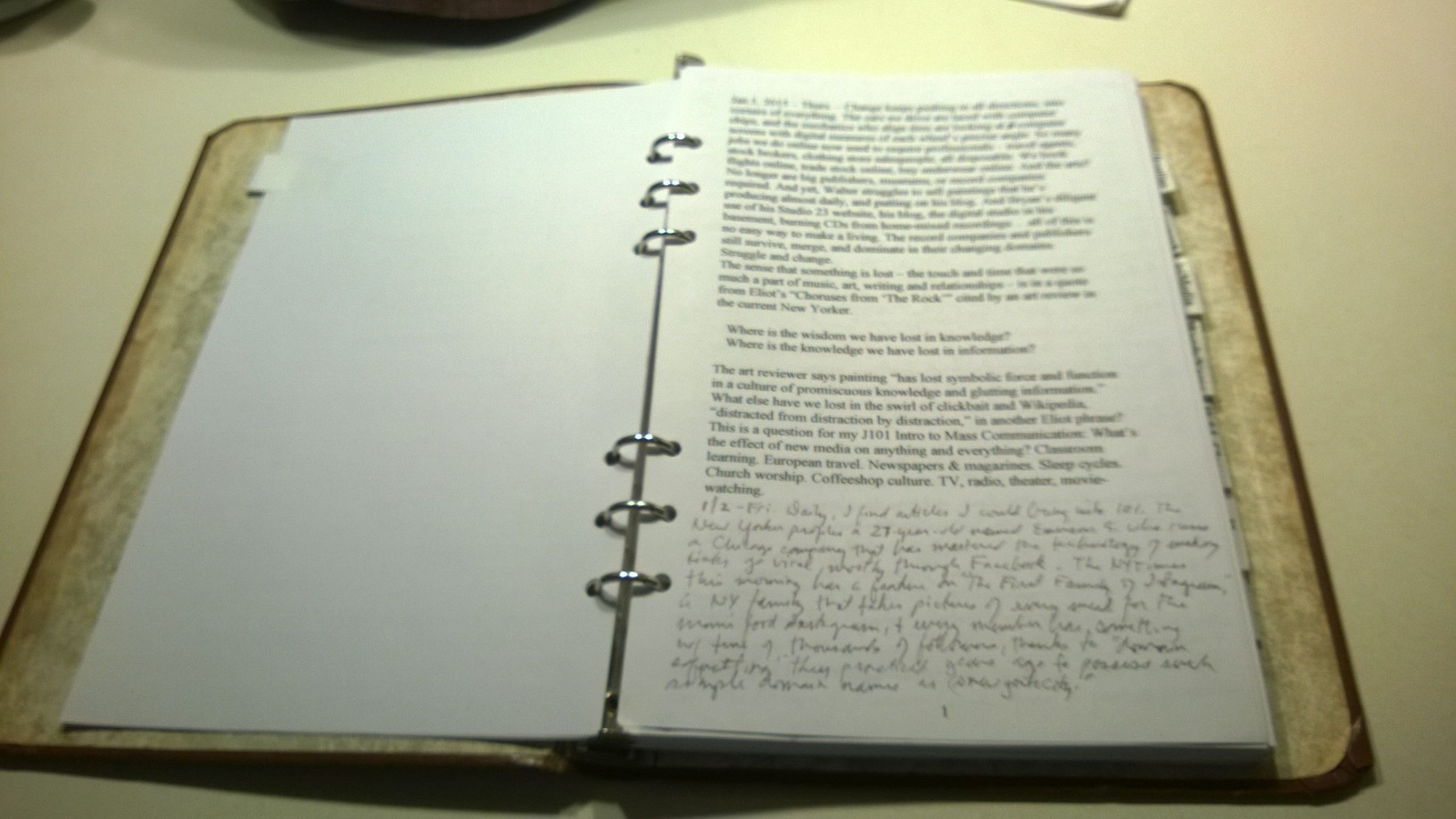
Why, in this world of infinite choices and the great search-able eBay/Craigslist flea market, can’t I find the 6-ring notebook I’ve used since college for keeping a journal?Notebook1

It’s not as if iPhones and social media have abolished journal-keeping. Even twenty-somethings use pens and have private notebooks. Our 24-year-old daughter, for instance, says writing that way is life itself to her. When she’s writing in her a journal, she’s not worried about anything material – jobs, money, the future – at least not for the moment, she says.

Once upon a time, this was a popular tradition. As an American Studies graduate student, I was impressed with how 19th century writers like Thoreau and Emerson and an otherwise unmemorable Wall Street lawyer named George Templeton Strong kept life-long journals . When published in the 20th century, they ran to an incredible number of volumes. Everybody who was a reader, it seemed, was also a journal-keeper. And a writer.

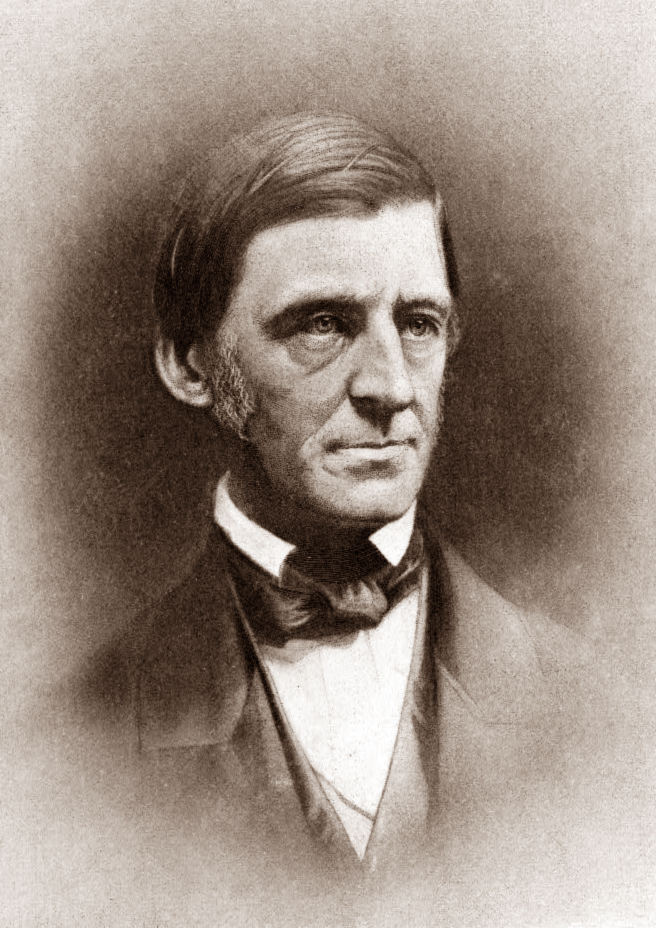
Ralph-Waldo-EmersonIn fact, there’s a book about Emerson’s writing process called First We Read, Then We Write, by Robert Richardson. Emerson was the most popular public speaker in America, and many of his speeches became published classics of American literature. His journals were the warehouse of his publishable ideas and phrases. His strategy as a writer was to plagiarize his journals.

According to a review of First We Read, Then We Write in the Wilson Quarterly, Emerson went to the trouble of indexing his journals. Ten years after he began this self-referencing, he had compiled an index of 400 pages.That’s not the journals, but just the index! It had 839 names in the biographical cites. A word like “soul” might list 100 references.

If you are a writer, a journal is not only your savings bank, as Emerson called it. It’s also good exercise, a way to record what it felt like in a particular time (see Joan Didion’s “On Keeping a Notebook”), a clarification of what you are reading and thinking (see William Zinsser’s Writing to Learn), and a record of details – the protein of all good writing.Notebook size

Online recently, I thought I had finally found more of the 6-ring notebooks I’ve been using for my journals. But when UPS delivered the box, I found they were half the size I needed. (Size was not among the information given online.) So I sent them back with this letter:

All-Pro Software
2936 S Fish Hatchery Rd #130
Fitchburg, WI 53711

Dear Friends,

I am returning these four Mead Loose-Leaf Memo Books with sadness in my heart. They aren’t the size I’d hoped for. I have been searching for twenty years for the perfect 6-ring binder that, for at least 20 years prior to that, my father and I used for our personal journals. Ours had exactly this type of metal ring binders (half-inch rings in two sets of 3), but for paper that was 5 ½ by 8 ½ inch, not your 3 ¾ x 6 ¾ inch size. The larger paper size was also previously available, but since I had to rely on my last supply of notebooks, or re-use them, I have easily created re-fill pages by cutting regular 8 ½ x 11-inch paper in half and hand-punching that 6-ring pattern of holes.
These lovely, larger 6-ring binders, going back 40 or so years, brown in color, were manufactured by Vernon-Royal, Vernon-McMillan, McMillan-Mead, and then MeadWestVaCo., as I recall the series of companies that gave the impression of multiple buyouts and corporate swallowings. Then, alas, our previous journal disappeared from the global marketplace. My father and I are both writers, journalists, poets and, like most men of letters up through the 19th century, journal-keepers. We both have a bookshelf full of these old notebooks – 30 or 40 in number. But our supply has run out, forcing me to recycle until the notebooks are worn past the capacity of duct tape to hold them together. The rings wear out.
I do believe that this product is ready for a revival. I could get a hard-cover journal by Moleskine for $32.95 (about four times what these 6-ring notebooks used to cost), but they lack the advantage of having pages that can be removed or added or computer-printed on. In this age of mobile digital devices, the sort of product I’m looking for – not a little datebook nor a 1-inch 3-ring binder, but a journal-size, leather-colored book with 6 smaller rings – would be a hot seller.
Please consider reviving this product. I’d buy 50 of them.

Sincerely, Doug Cumming


Posted in Uncategorized | Tagged , , , , , | Leave a comment

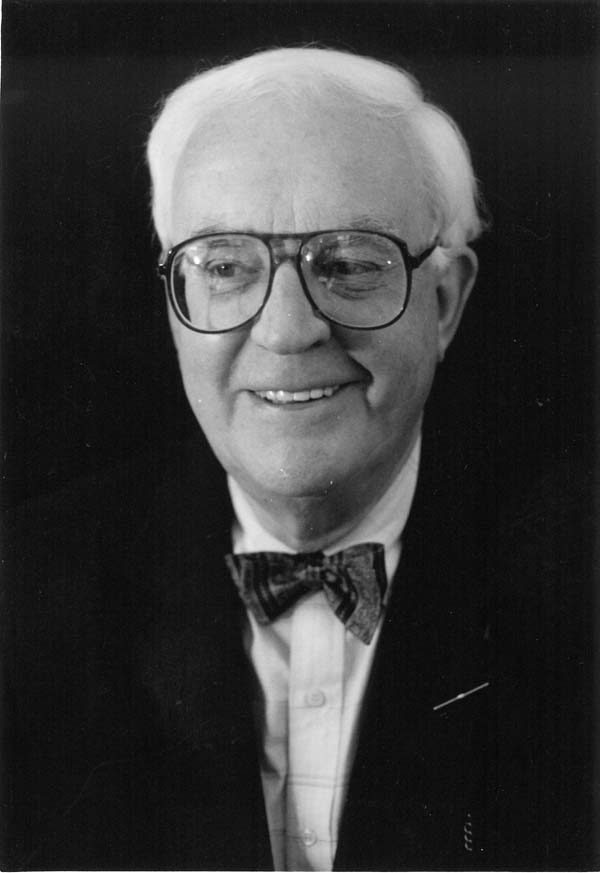
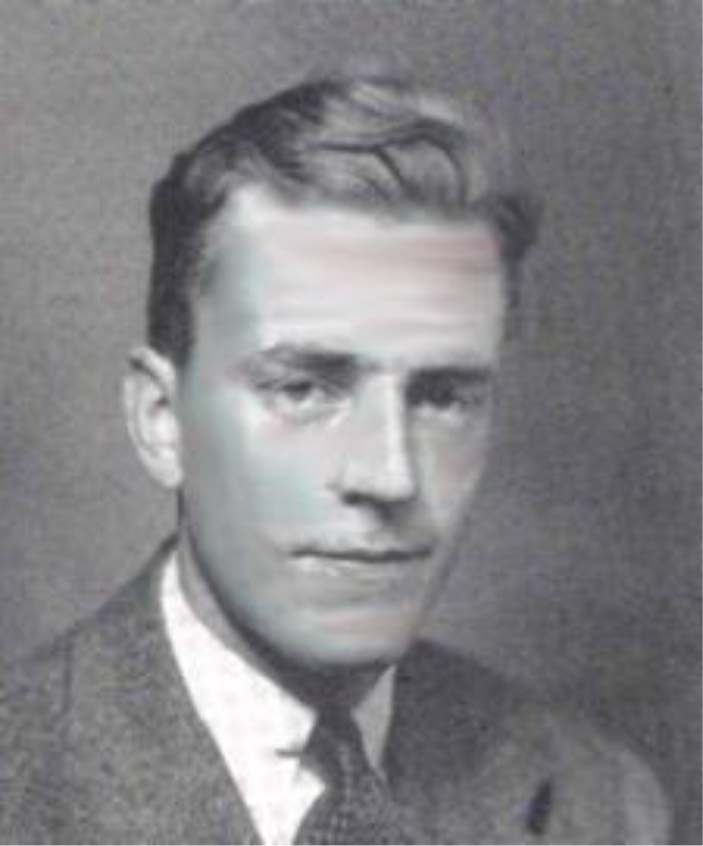
An Appreciation: Fred Farrar, 1918-2014

Eleven years ago, our Development office told me that an alumnus who owned some historical newspapers wanted to donate them to Washington & Lee. Frederic B. Farrar was 85, a journalism major from W&L’s Class of ’41 who had served in the “casualty assistance” branch at Camp Pinedale in Fresno during World War II, then for the next 35 years worked as a national advertising rep for big daily newspapers from the West Coast to Canada and England.bizhub-O2134-20140904090359

His initial donation turned out to be a remarkable collection of some 1,500 American newspapers from the 18th and 19th centuries. He added some European newspapers as old as 1559, and tossed in, as a bonus, bound copies of 118 years of Gentleman’s Magazine. Fred Farrar’s love of these historical rag-paper publications from handset print shops had developed in him an intuitive knack for finding them. He would buy unrecognized treasures at below-market prices in old bookstores and flea markets from Philadelphia to London, or bargain and trade for what he wanted, filling gaps in his collection. He drove up to W&L in Virginia from Florida in a series of visits, each time surprising us with more donations. By the summer of 2005, he had handed over to Special Collections an archive that was organized into 10 portfolios, 10 bound volumes, five binders and three drawers, which is now online and partly indexed as “Farrar Newspaper Collection.”

In his late 80s and 90s, he drove the 820 miles from his Clearwater retirement home to W&L many times, bearing fresh loads from his collection. I got to know this remarkable man, who would hold my students mesmerized for an hour in a course I designed around his collection. His passion for history was rooted in something other than the historiographical methodologies and theories of the professoriate. It seemed to grow out of his robust life experiences and his discovery of primary sources as the intimate physical body of history. This distinction reminds me of Nietzsche’s critique of “objective” Rankean history in “The Use and Abuse of History,” in which Nietzsche calls for historians who confront history out of real-life experience and character.

Fred was a strong-voiced, leonine man who would test your interest before fully opening up on any subject. Once he sensed with a cagey sidelong glance that he had you hooked, he would share story after story from American history – romantic or astonishing tales plucked from the Grand Narrative – or from his own charmed life.

Young FredHe was a master storyteller, with timing and details honed by years in different sorts of classrooms. It began when he visited an 8th grade class with reprints that the New York Times had made of its front pages covering Civil War battles, around the war’s Centennial. Later, he took so many evening classes at Adelphi University in Garden City, N.Y., that he earned a master’s degree in history in 1975, at age 57. His thesis became a high school classroom workbook, This Common Channel to Independence: Revolution and Newspapers, 1759-1789. This teacher workbook became a curriculum just in time for the U.S. Bicentennial, outlining the development of American liberty and Revolution through reprints of historical newspapers. By then, Fred had been elected to the American Antiquarian Society. He also wrote a history of Editor & Publisher on its 100th anniversary in 1984, filled with reprints of E&P articles from each decade.

In a second career that began in 1980, he taught journalism history at Temple University’s School of Communications, using his newspapers and broadsides as primary sources for slide lectures. Students were impressed with his toughness, as if he were some manifestation of the past that had barged out of the same character-forming history he loved. A columnist at the Bucks County (Pa.) Courier Times wrote 20 years after taking his class that Professor Farrar was merciless, and instilled lessons you never forgot. “You want to be a journalist?” the columnist quoted Farrar. “Then you think like a journalist and notice detail because detail is the essence of all great journalism and all great writing. That’s what I’m teaching you.” Fred never stopped teaching. In retirement in the Tampa Bay area, he taught history courses at various colleges to adults over 50 and in the end, to residents of his retirement community.

Fred Farrar died on July 29 with pneumonia, five days after his 96th birthday. In the years since I had met him, he had continued giving W&L gifts he had only hinted at earlier: a collection of U.S. newspapers reporting the winners of every presidential election (almost) since George Washington, and a rich collection of Civil War newspapers covering battles from both the Union and Confederate perspectives. His last donation came when our director of Special Collections, Tom Camden, visited him for several days in July, just weeks before he died.Nuremberg chronicle

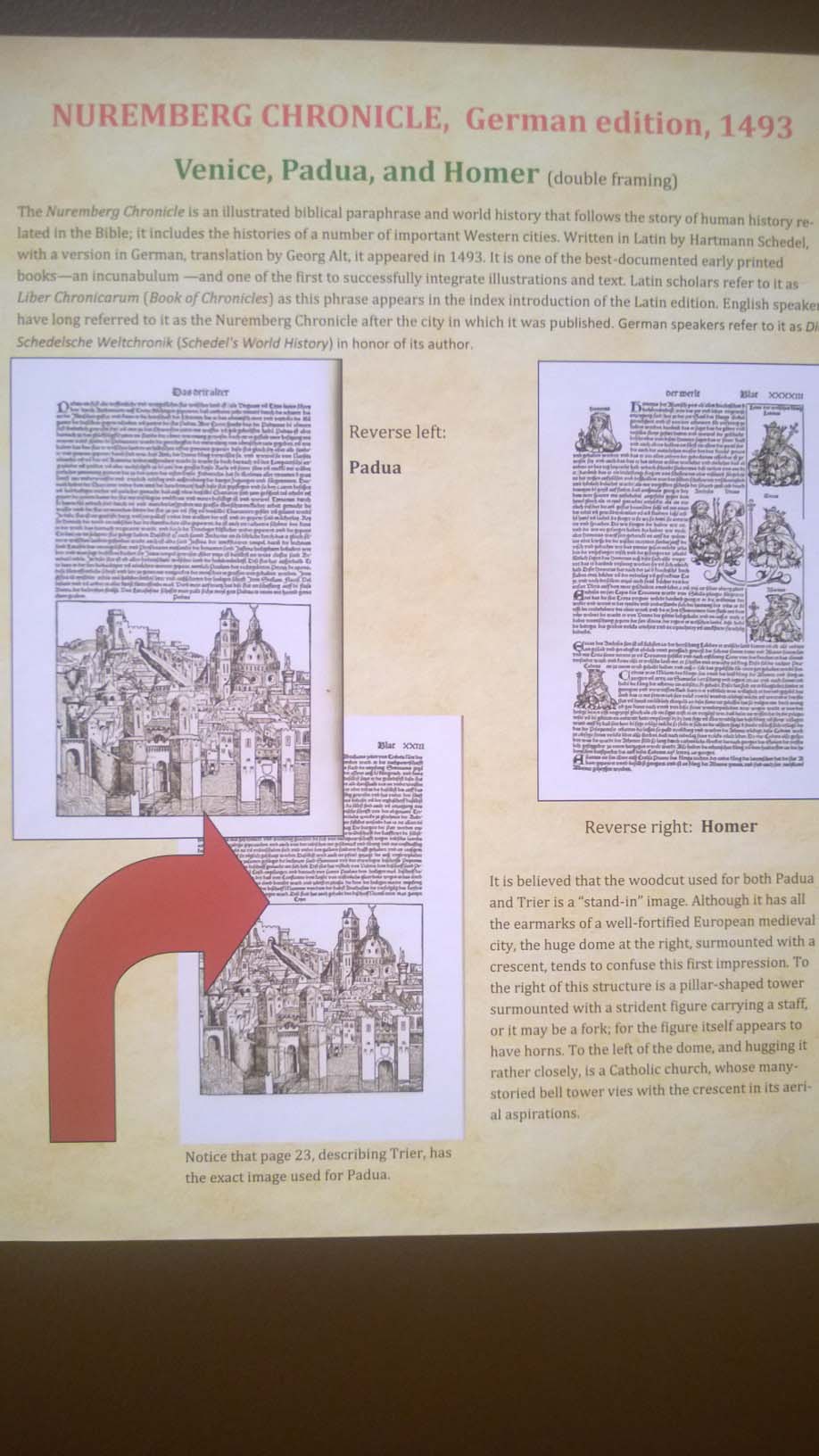
Camden, the former director of special collections for the Library of Virginia, radiates a boyish delight in the ragged oddments and dusty discoveries that fill his quarter of the library. He had that look as he recounted his final visit with Fred in his home. Fred brought out historical and rare books: General Henry Lee’s memoirs of the American Revolution, the 1869 edition with a biography written by his son, Robert E. Lee; an antique two-volume Life of Walter Scott; an “arts and crafts” edition of Malory’s Morte d’Arthur illustrated by Beardsley, and more like that. He also turned over rare documents that are now on display in our library: sheets of incunabula from Dante’s Commedia (1477) and the Nuremberg Chronicle (1493), and the original Indenture conveying land in Philadelphia in 1801 to printer John Dunlap for printing the Declaration of Independence and other works for the revolutionary cause. Camden’s irrepressible amazement may have been a factor in Fred’s decision to give this last trove. But I am sure it was something else. It was Fred’s final recognition that his alma mater was the right home for this stuff.

Every time Fred came to visit, he would explain that he was looking to leave his historical publications in a place that would share his appreciation for how they contain the reality of history. He gave these piecemeal, partly to test whether our interest was as passionate as his, and partly, I suspect, because he was still using the material to teach history.

It was hard for this gruff gentleman to let go of it all, right up until the end.

Posted in Uncategorized | Tagged , , , , | 5 Comments

Why Not Ask?

Here’s a good question to ask any seasoned, serious journalist: What’s the best question to ask in an interview? It would be interesting to collect 10 or 20 of the best journalistic questions to keep handy in your toolbox.

My colleague Bob DeMaria, now retired, once helped me with a video project interviewing veteran journalists in Roanoke a number of years ago about the art of the interview. They had a variety of tips, but one suggestion they all agreed on was that your last question should be this: “Do you have anything else to add?” or “Anything I didn’t ask?” . . . followed by a long pause, if necessary.

Another good question is “How do you know that?” I heard this one from Alicia C. Shepard, then-ombudsman for National Public Radio and author of a terrific book, Woodward and Bernstein: Life in the Shadow of Watergate. She said the other good question to ask is this: “What does that mean?”

Another visitor to our department at W&L a few years ago, Carol Costello, now a CNN news anchor, told my students that a good question is not only “Why?” – that old chestnut from the “five Ws,” but “Why now?”

Such questions – “How do you know?” “What does that mean?” etc. – make journalists indispensable, especially in these days of surface information and spin. It gets at what I heard another veteran journalist say was her driving question when she was executive editor of the New York Times: “The story behind the story.” That was from Jill Abramson, talking to the journalism-professors’ annual conference in August.

Posted in Uncategorized | Tagged , , , , | Leave a comment

Election Night Live!

Election Night 2The third floor of Reid Hall glowed in the dark on Election Night, Nov. 4.

I had an inconspicuous job of copy-editing for Rockbridge Report’s election coverage, the only live TV broadcast and web report on the voting in Rockbridge County. I felt  like a mere sub-contractor with no real relationship to the students who were sailing the ship. But I had taught some of them in past years, and felt the thrill of seeing them all in action around the energy of an election night as deadlines and vote returns fluttered by. The whole floor became the kind of buzzing, pizza-messy, nighttime newsroom that we elders — the recovering journalists — could feel in our muscle memory.

Maybe that’s why we were all there – not only Brian and Kevin, the instructors of the Rockbridge Report classes, and Jenny and Michael the support staff, and Claudette, whose 202 class had some involvement, but also Toni, Dayo, Pam and me and even Aly, our new Knight Chair of Journalism Ethics, weighing in with ethical umpiring. We tallied up our collective experience of covering elections, and it came to somewhere over 200 years.

Maybe those 200 years of doing it the old way supplied some subliminal guidance. But it was the students’ show, and they performed like pros. They did live broadcast updates on the hour, studio interviews, live interviews out at the campaign gatherings, tweeting, calling in, feeding the graphics. You should’ve been there.

Posted in Uncategorized | Leave a comment

Halloween to the Max

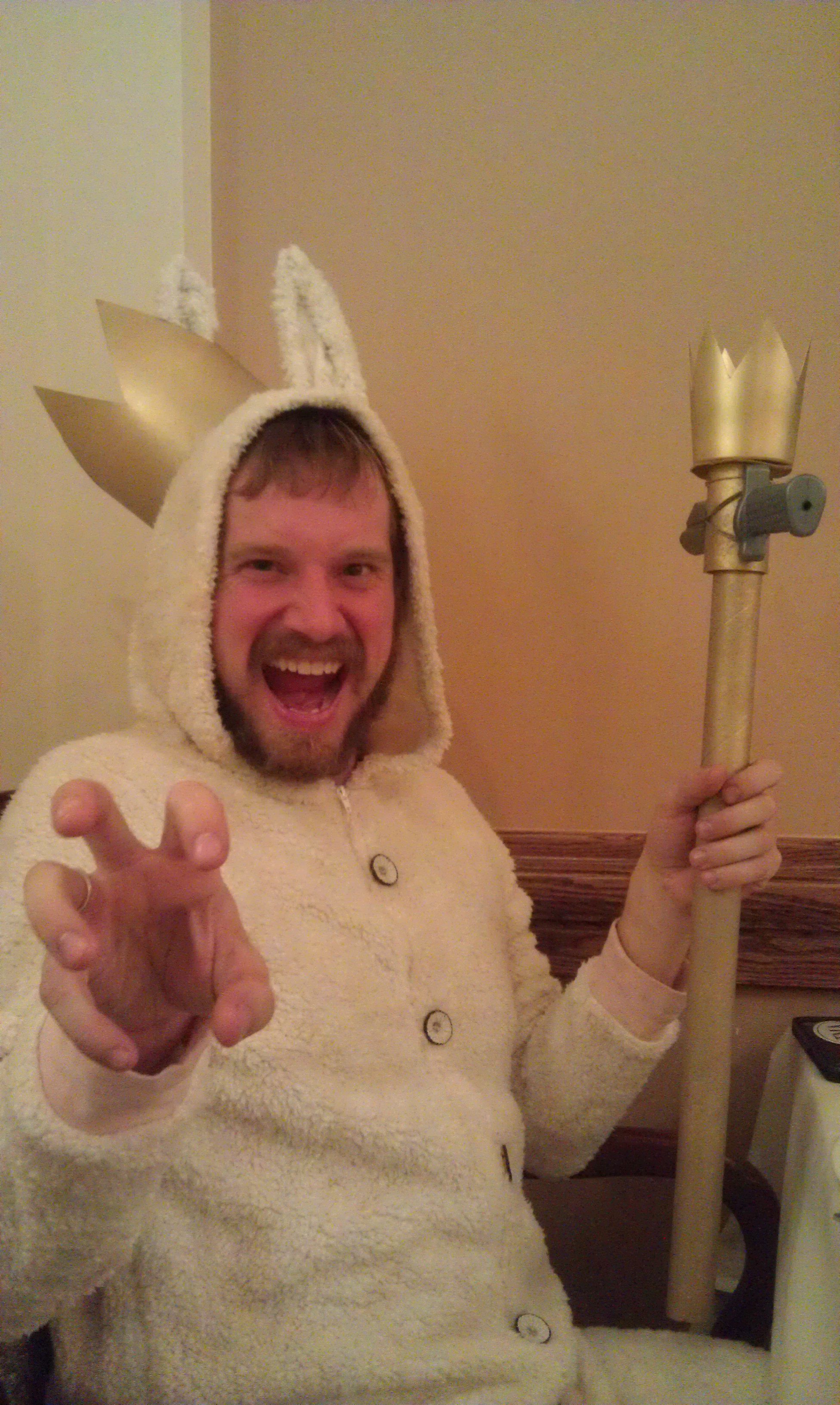
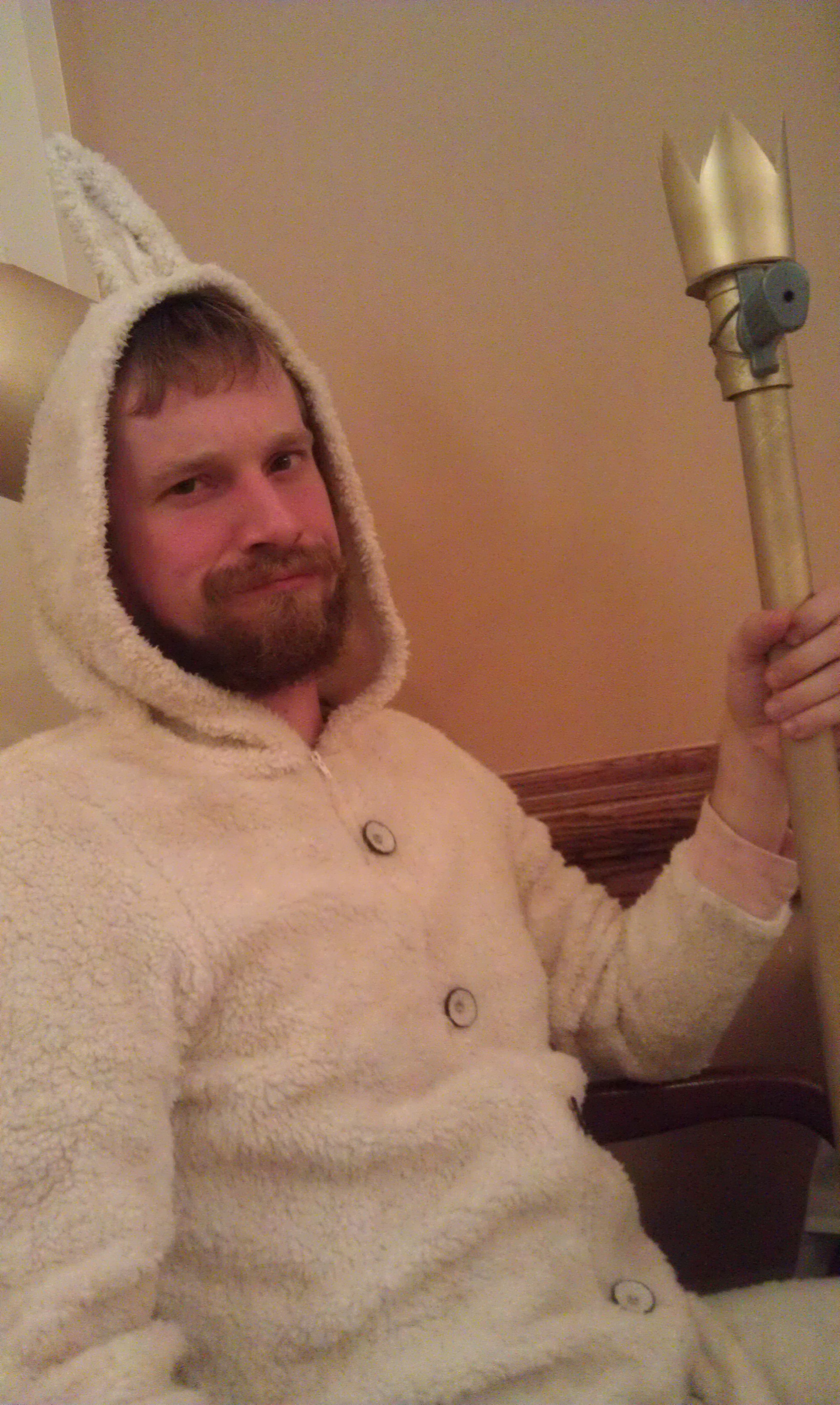
Max-Dan 2

Daniel “Wild Thing” Cumming

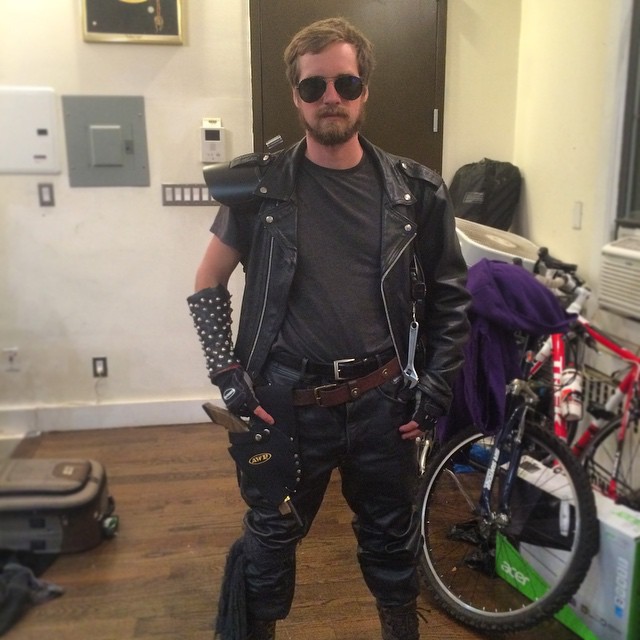
Happy Halloween, pagans and Christians all! It’s interesting to read our mashup culture in the costumes. (How do you dress up like a Republican-majority Senate?) Our son Daniel visited us last week, and spent his most creative hours working on a Halloween costume that combined Max of Where the Wild Things Are (see picture) with an overlay of the ripped black leather and weaponry of Mad Max, the Mel Gibson movie series he spend much of the rest of his time watching.

Daniel as Mad Max

Mad Max Jr.

He’s in New England now (not sure where he’ll trick or treat tonight), and I hear he stayed with our friends the Silks in West Hartford for the last two nights. Interestingly, Mark was quoted at length in a Hartford Courant article on Halloween and the move by Newington, Conn., elementary schools to ban a Halloween costume parade after some parents objected on religious grounds. Halloween was originally a Celtic festival, Samhain, set on one of the two days in the calendar year when the veil between the spirit world and our world was said to be the thinnest. An excerpt from the article:

Professor Mark Silk, director of the Greenberg Center for Study of Religion and Public Life at Trinity College, said it’s likely that pagans’ ownership of Samhain has justified some Christians’ belief that Halloween is to be avoided.

But, “it’s worth noting that in the history of Protestantism in New England, the Puritans wanted no part in Christmas,” or any other dates on the Catholic liturgical calendar, Silk said.

There’s been a recent push to, “put the Christ back in Christmas,” but, “it’s based on imagining that Christ was ever in Christmas in American culture,” Silk said. “The original position of settlers in New England was, ‘We don’t want any Christmas. It’s Christ’s Mass, we don’t do Mass,'” Silk said.

The 19th century marked a huge increase in commercialization of holidays like Christmas and Easter, and Halloween is catching up to those in a big way, causing push-back from those who do not want to see such celebrations secularized, he added.

“Halloween became part of that, you could call it the liturgical calendar of American religion,” Silk said.

While conservatives “just sort of stepped away” from the holiday chaos for a time, “what you have now are people who feel like they can enter their objections in the public sphere in a larger way, and if people have religious objections, even if they’re ones they’ve only discovered in the past 10 years or something, it counts.”

While many are inclined to dismiss Halloween objectors’ views as overreaction, Silk said he can understand the feeling of discomfort. While living in Atlanta, Silk, who is Jewish, said his wife objected to the Christmas trees in the lobby of their children’s public school.

“The initial reaction of the principal was sort of, ‘Oh come on, everybody does Christmas,'” Silk said. But upon explaining that they did not, in fact, celebrate Christmas, “then they were great, they said come in and explain about Hanukkah.”

Such discussions are, “part of the negotiation of religious acceptance and comfort in the public square,” Silk said. “Pluralism involves these kinds of struggles all the time as society evolves, and for most people it’s something they haven’t ever thought about.”Max - Daniel 1

Posted in Uncategorized | Leave a comment

Church pledge as investment

Here is the layman sermon on stewardship I was asked to give at R.E. Lee Memorial Church. Given Oct. 19.

This is not an interruption in your regular programming.
Brubaker dawnThis is not like the two weeks of fund-raising that intrudes on your National Public Radio listening, your Morning Edition and All Things Considered, Prairie Home Companion and This American Life. I’m not Rick Mattioni with WVTF down in Roanoke or Martha Woodroof with WMRA up in Harrisonburg coming on to talk about these great shows, and how they cost money and if you raise your pledge by so much you’ll get a tot bag or umbrella with R. E. Lee Memorial Episcopal Church emblazoned on them. It’s not that at all.

But this idea made me think of the comparison between Episcopal Churches in America and the Anglican Church in the United Kingdom. There is a parallel to the way the British raise money for their public radio and public TV, the BBC. In the UK, the BBC is funded by a tax – technically, an annual television license fee. Every household, business or institution with a telly pays this every year. Currently it’s £145.50 for color and £49.00 for black and white. Here, we have fund-raising weeks to get listeners like you to make your pledge, because Lord knows, Congress isn’t much help with this. This is like the difference between the way an established church of the Crown is supported by a tax on all citizens, but a disestablished church like ours relies on free-will offerings. This is the history of Europe versus our history. Our American churches rely either on free-market appeal, on star power, or a sense of duty and civic obligation . . . or something else. Today, the established Anglican churches in England, or where we were in Ireland in July, don’t get tax money any more. But they are certainly living off of their centuries of establishment. And it’s conventional wisdom here in America that this has something to do with why they are so little attended. Their churches and cathedrals seem more often visited for their beauty than for fellowship with the faithful. Or people drop by for that sad British musing on the past, like in Philip Larkin’s poem Church-Going, not for renewal.

But this isn’t like an NPR fund-raiser. It’s about something else that we call “stewardship.”

Sheep in ConnemaraI’ve been wondering what this is – this stewardship. Peyton Craighill gave me the academic answer recently. This was in one our weekly morning breakfasts we were holding at Sweet Treats up the street from here. He took the word apart and gave the root meanings. Ship is the essence or abstraction of a thing – the “thing-ness” of a thing – like penman-ship, relation-ship. Ward is a keeper, like the warden of a jail, or our senior warden. And stew – S-T-E? Peyton says it is the same Old English word as “sty.” Great. So we are the keepers of our sty.

Last week, I asked our friend Bert about stewardship, since he’s a Lutheran pastor in Maryland and has been preaching a lot about stewardship lately. He gave me that old familiar mantra about gratitude. Stewardship is our response in gratitude for the abundance of what God has done for us, for His Creation and everything we have, which is all from God, as we know. Ok, I thought. But that was my last stewardship sermon. a few years ago, and I talked about my gratitude for things that don’t get talked about much (especially in stewardship sermons) because they’re so close to us and don’t cost anything: Language. Kinfolk. And memories. My theme was that we should take care of these things as precious gifts. Take care of the English tongue, and the memories that we can summon up in amazing sensorial richness, and take care of our relationships with cousins, parents, children . . .especially when these are no longer in residence with us so we have to make the effort to invite or visit. Take care.

Bert could see my eyes glaze over a bit. So he changed his advice. Just tell your story, he said. “Tell your story” is good advice. One of my journalism students in Ireland last summer had that exact phrase tattooed across the back of her neck.

My story. . It’s a story of growing up in an old Georgia family that told stories, played jazz and sang Beatles songs, wrote poetry and musical comedies, and ate meals together. I set out on the world in complete innocence and confidence and ignorance, and picked up a very liberal education with that kind of openness. Looking back on it, I don’t think I was a good steward. I was like the Prodigal Son without the part about the pig sty. Things worked out well for me, mostly.Barna Woods

When I got this assignment on stewardship, a metaphor came to me. Good stewardship is practicing your scales and arpeggios and sustained tones. Growing up, I put aside the clarinet I had been trained on since fifth grade – private lessons, an elementary-school concert band, terrible headaches from stress, a weekly practice record. I put all that down and picked up the tenor saxophone. I was pretty good for an amateur, never having taken a lesson. Twelve years ago, I lived in New Orleans for a year, teaching journalism at Loyola University. In the same building with the communications department was the music department, and on the music faculty was a jazz saxophone player named Tony Degradi. I decided it was finally time, in my middle age, to start taking saxophone lessons. So once a week, for $45 an hour, I would go down to Tony’s office for my lesson. I thought we’d do some jamming. I wanted to learn what goes on in his head and his soul when he’s sailing on a solo. I had the rhythm and I knew the chords, but how do I put those things together better when jazz is just moving along, and everybody’s making it up as it goes?

But we didn’t jam or improvise much. Mostly, he taught me how to practice. You practice scales, all 12, up, then down, 2 ½ octaves. Then intervals. Then arpeggios. Then just one note, sustained, no vibrato, soft, then loud, then soft. This was radical. I began to realize that I had always thought I was practicing when I just played what felt right and sounded good. In fact, practicing for jazz is the opposite. It’s playing what doesn’t feel right or sound good. And you do that until it does sound good – or at least tolerably decent. You get your house in order. And then, it’s amazing how much better your ad libbing gets. Here in Lexington, I’ve taken a few lessons from another fine jazz saxophone player, Tom Artwick. He teaches me the same thing – how to practice right.
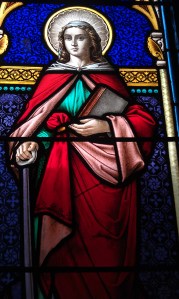
A saint

A saint

There’s something about good stewardship in that. We learn the good habits of practice, the habits that don’t feel good or natural at first. But in time, with practice, we find our Christian lives becoming beautiful improvisations. We’re more in the syncopation and uncharted music of grace, because we get dressed up in a dull sort of formality on Sunday mornings and go to a musty old church, and because we’ve made our pledge, and increased it by more than the Cost of Living Index, as we have every year for the past 30 years. It’s practicing scales. That’s my story.

But I’m not sticking to it.

Just taking care of what we have, no matter how grateful we may feel about it, tends to close us off to some things that might be stirring in the church. The inspiration some of us drew from reading and discussing the book People of the Way: Renewing Episcopal Identity. The talks we were having at Sweet Treats about mission in our weekdays’ work and in our community. Or an idea of coordinating outreach with other Lexington churches and in transformational relationships through a model called Love In the Name of Christ, Love INC. These are all new things, still barely visible, transformations that wait for us out there in our future, outside our church. What is God up to? We won’t find out by simply taking care of our sty, merely being good stewards, or shrewd stewards.

Rather than the old concept of stewardship, Libby and I now think of our pledge as an investment. We’re not burying our talents, but putting them to work. At doing what? We don’t know. . .yet. This is the thing. We are investing in a vision that is only just coming into view. I don’t even know what the vision is. I am investing in a vision I can’t even see. But I know it’s there.

Have you ever noticed how the word parish sounds like the word perish? Or how it’s related to the word parochial, which is defined as “narrowly restricted in scope or outlook”? There’s a much-quoted verse out of Proverbs: “Where there is no vision, the people perish.” But this doesn’t refer to our own vision within. The Hebrew word is better translated as revelation, a word from outside ourselves. This is what takes us beyond stewardship, to that place that the book People of the Way talks about, where we enter other people’s homes and lives depending on their hospitality, and listen to their story. A vision as revelation moves us out of the parochial.

I recently had a vision that wasn’t a revelation, but came from my own imagination. It was a brilliant idea, I thought. With an election coming on Nov. 4, I decide to bring applications for absentee ballots to the five or six shut-ins I had just started visiting on Tuesday, bringing them lunches in the “Meals for Shut-Ins” program. I imagined if I could get half my shut-ins to vote, this could be the start of a revolution – tens of thousands of volunteers with Meals on Wheels bringing absentee ballots to a million elderly shut-ins around the country.

The day I set off with five application forms along with the lunches from the hospital, I was feeling strangely vulnerable, open to what God might be up to. That morning I had been with the men’s prayer breakfast group. Our reading from that Scottish Calvinist Oswald Chambers was ferocious, as usual. He said, “If we are ever to be made into wine, we will have to be crushed. . .to be broken bread in his hands.” As I took those absentee forms to each door, I was struck by how ignorant I was of the tragedies and life and death stories brooding within each little bungalow. In one, a chain-smoking old lady struggled to turn off the game show on her little TV. In another, I wait on the porch with a one-eyed cat and rusty junk while the lady inside comes to the door with her yappy dog. On Moore Street, the nephew with the cancer in his neck, which hurts like a toothache, he tells me, hobbles to the door, bent over. In another, the wasted son with lung cancer is helping a nurse aide with his mother, who is suspended midair in a harness for some kind of treatment. And in another, the lady who answers the door looks like a visiting angel; beautiful blue eyes look at me with compassionate serenity, and she tells me they don’t have time for me to fill out the absentee ballot application. “We must get her to the hospital at UVA,” the angel tells me.

In between these visits, I’m back in my little Miata listening to the Diane Rehm show on public radio. The show is on “Single Parenthood and Child Well-Being.” The tragedies that I peek into in each house are multiplied by the millions in what the panelists are talking about on this show. It’s about single moms with jobless boyfriends who desert them, moms struggling with 2 to 3 minimum wage jobs and little hope or vision, perishing. Marriage to this generation just seems like some stupid idea out of the past, out of touch, like the Democratic Party or church bazaars. This rush of experience I barely take in, unable to connect it with the prayer breakfast or church or, certainly, the beautiful bubble of luxury I return to at Washington & Lee.

But I know why Libby and I have upped our pledge to this church. It’s an investment in the mission that comes as vision, like a revelation, when it comes.

Posted in Uncategorized | Tagged , , | Leave a comment

Connecting intro and outre class experiences

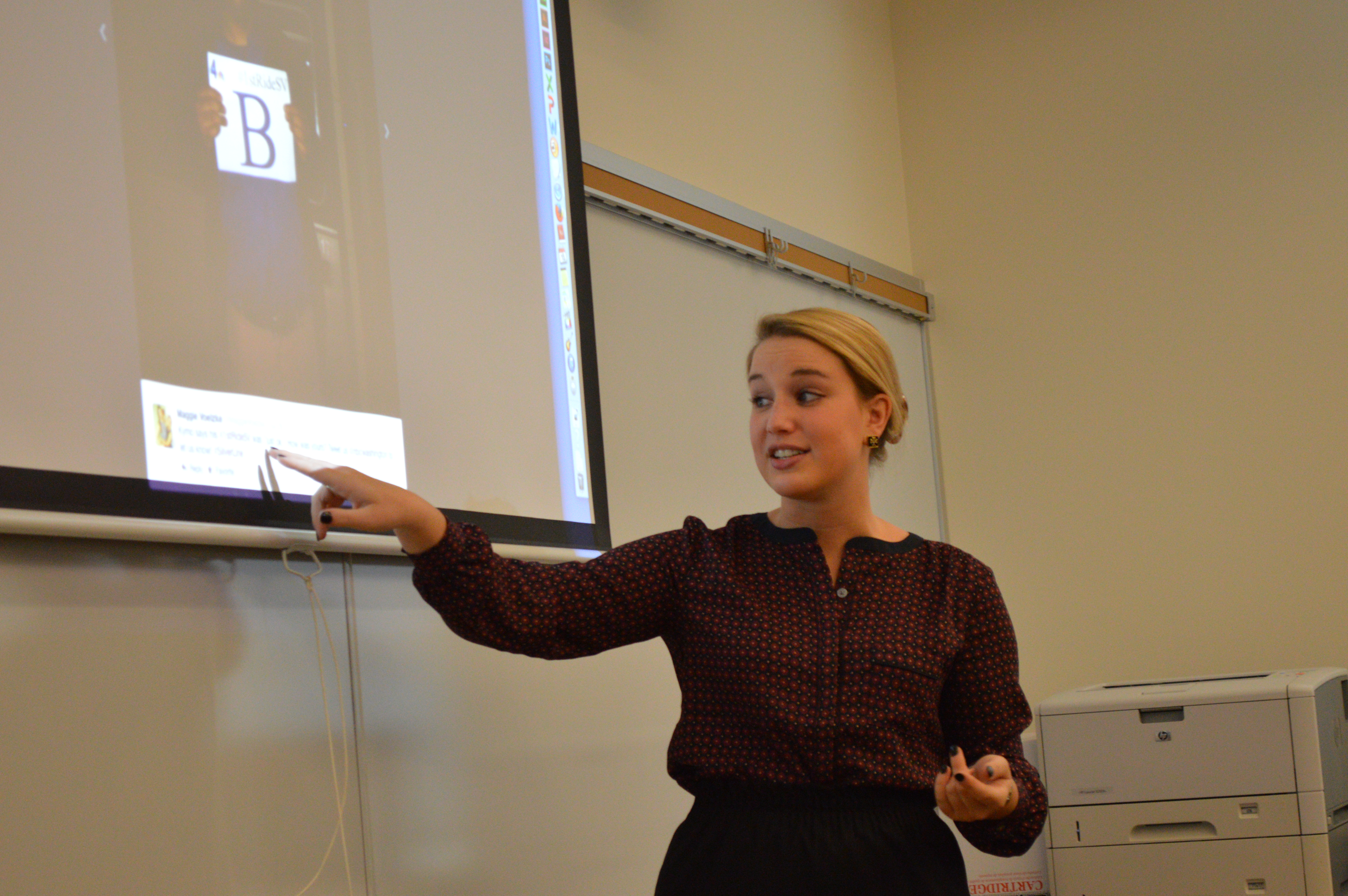
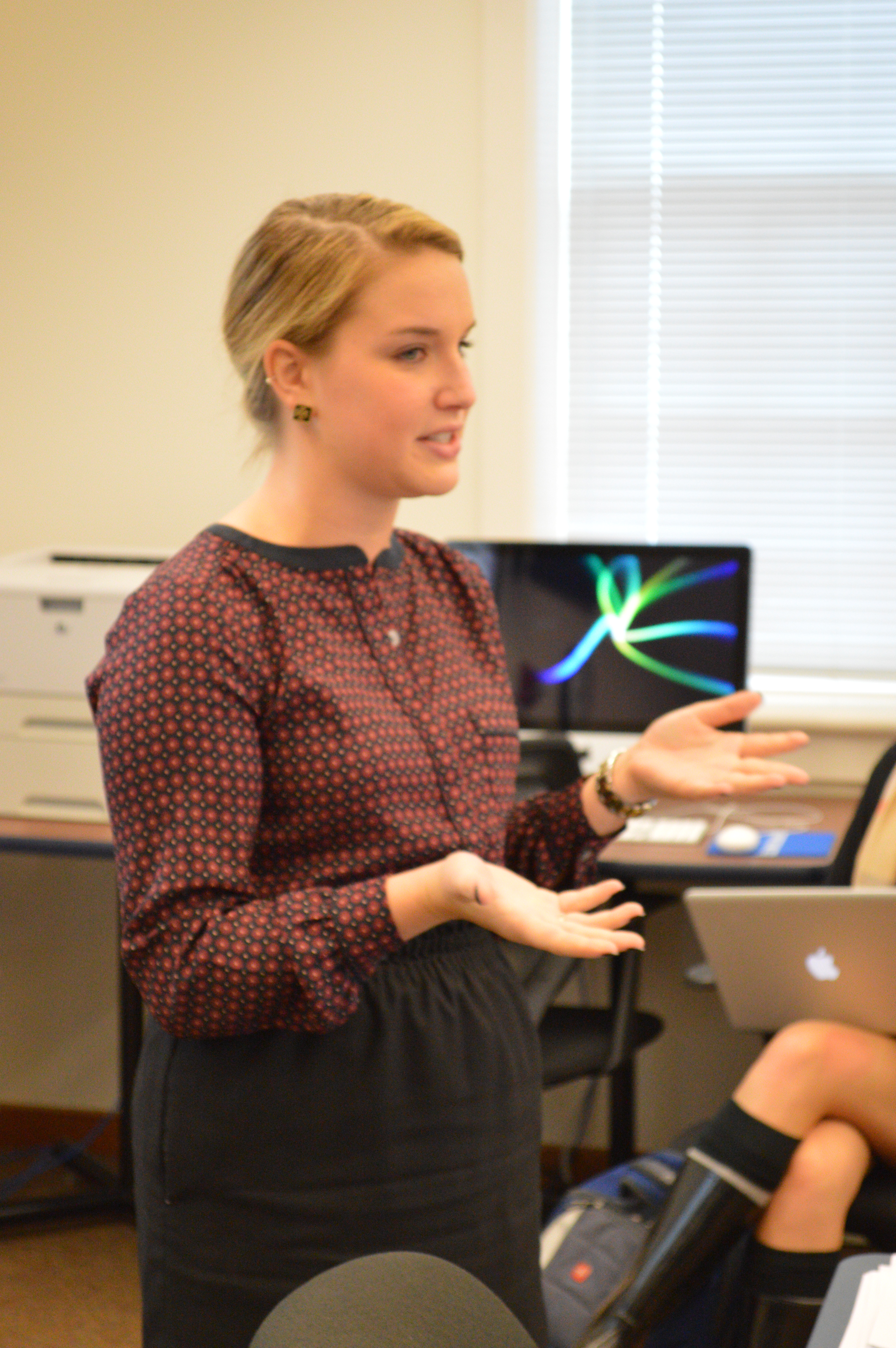
Maggie Voelzke

Maggie Voelzke, senior, guest teaching my J201 lab on social media.

The course of study for majors in our department runs in a sequence designed to build on a foundation, layer by layer. In teaching the foundational JOUR201 Intro to News Writing, I’m now giving students exposure to what they will be doing in the next year or two in the sequence.

I’m trying to bend the sequence into a circle.

The course has two lab sections  this term. As I did last fall, I had students in this class cover one of the presentations by fellow majors on their summer internships. (I also tried something new for the assignment this time around: I called their first effort a draft, wrote comments on how it should be re-worked, gave no grade and very few copy-edits, and sent it back for a re-write, which would be graded).

The 35 internships were remarkable. Those students, most of whom took 201 a year or two ago, were writing page-one stories for big dailies, or for hometown slick magazines. One was staking out celebs for a New York tabloid, and another working for an all-digital award-winning New York ad agency that some Boston University students started a few years ago in their dorm as “Mr. Youth.”

Maggie Voelzke, a senior I had taught three years ago in a first-year comp class on “The Press and the Civil Rights Movement,” then in JOUR201, was working for the NBC affiliate in Washington D.C. One of my 201 students, for her assignment covering the presentations, said Maggie “spent her summer hashtagging, interning on the web team . . . More than just tweeting, Voelzke wrote articles, conducted research, and posted on a variety websites.”

This gave me another idea for circling the course sequence back around. I asked Maggie if she would help me teach the lab on social media. She did so, enthusiastically. This gave my 201 students a feeling for how social media—their daily bread—is actually being used today in the business. Maggie brought her summer experience with NBC4 to both labs, starting with a marketing assignment.

Maggie 2 “The first event was a big one for the advertising and PR side of the office,” she said in an e-mail to me before lab. “Several hundred people gathered right in the center of Dupont Circle to watch the USA v. Germany soccer match.

“The German embassy put up a jumbotron and it was a huge social event for DC residents. The web team saw this as an opportunity to not only cover the action (as I did), but also to promote NBC4 as a brand. Three interns went down to Dupont Circle to give out NBC4 water bottles, hats, sunglasses and grocery bags to fans watching the game while simultaneously covering what was happening in Dupont Circle via Twitter. Using Twitter allowed the web and promotions teams to easily access our tweets (via use of the hashtag #whereareyouwatching) and gave us an edge on social media. We were encouraged to be funny, creative and, above all, interesting in our tweets.”

Posted in Uncategorized | Leave a comment

“Mr.” R. E. Lee, Without the Flags

Lee pix

Robert E. Lee, in a Michael Miley photograph blown up and hanging in the foyer of the reopened Robert E. Lee Hotel (note reflection of chandelier), Lexington.

The Confederate flags are now gone from around the recumbent marble Robert E. Lee, at eternal rest with his riding boots on in the innermost sanctuary of Lee Chapel.

That is as it should be, for many reasons. One is historical. Our campus was a sanctuary of recovery from the Civil War, where “the sun falls through the ruined boughs of locusts/ Up to the president’s office.” That president was Lee, “in a dark civilian suit who walks,/ An outlaw fumbling for the latch, a voice/ Commanding in a dream where no flag flies.”

These are lines from “Lee in the Mountains,” a poem by Donald Davidson from the 1920s. He was one of a group of highly literary, romantic and vaguely unreconstructed writers based at Vanderbilt. On April 12, 1948, Washington & Lee, marking the 150th anniversary of George Washington’s foundational gift to then-Liberty Hall, conferred an honorary degree on Davidson and seven others.

“Lee in the Mountains” is a haunting meditation – as obtuse as Allen Tate’s “Ode to the Confederate Dead” – on Lee’s decision not to urge a guerrilla war of resistance in the mountains, but to set to work on re-building the South as a defeated section of the Union. But the poem seems a bit too wistful about that decision.

“I am alone,” the narrator says, “Trapped, consenting, taken at last in the mountains.”

It is not the bugle now, or the long roll beating.
The simple stroke of a chapel bell forbids
The hurtling dream, recalls the lonely mind.

I suspect that it is Donald Davidson, not Lee, who imposes the wistfulness. You can sense it in the other poems collected in the same book, also titled Lee in the Mountains. (The 1938 volume I checked out from the Washington & Lee library has Davidson’s signature in fountain pen.) The poet can’t seem to leave alone his obsession with finding redemption in being a loser. “For us, the long remembering/Of all our hearts have better known.”

This is worship of the dead, the rutted past, the washed-out soil. Davidson didn’t give up his fight after the Brown v. Board of Education decision of 1954. He organized a Tennessee Federation for Constitutional Government to defend segregation, and wrote a paranoid pamphlet about how the integration of schools in Oak Ridge, Tenn., was a pilot for the integration of the rest of the state. He was named as a character witness for John Kasper, the man later convicted of inciting violence in Nashville, including the bombing of an elementary school. Davidson sat in the courtroom in support of other racist bomb-throwers.

This was a sorry pose for a Vanderbilt professor of English, even in the 1950s. But it reminds us of a past we are apt to gloss over. One reason those Confederate flags needed to be removed is that the old battle flag was used in the 1950s by the Klan, the white Citizens Councils and Deep South governors in a last-ditch fight for white supremacy. Blacks seem to remember this history better than white Southerners. In 1956, when Davidson, a gentle poet at heart, was hanging out with a bad crowd thinking he was defending “state’s rights,” the Georgia legislature was changing its state flag to include the Confederate battle flag. Everybody knew what that meant then.

At W&L, the relatively new Roger Mudd Center for Ethics is spending a year reflecting on Race and Justice with a lecture series. Meanwhile, on Oct. 13 (Oct. 12 is the anniversary of Lee’s death in 1870), Christian B. Keller, a historian at the U.S. Army War College, will deliver a Lee memorial lecture at 12:15 p.m. in Lee Chapel, “Robert E. Lee, Great Captain: The Military Education of a Future Civilian Leader.”

And if you’re visiting Lexington for that, you might be able to book a room in the Robert E. Lee Hotel, a 1926 landmark that just reopened on Main Street with some of the splendor of the original.

[This originally appeared in Like the Dew: A Progressive Journal of Southern Culture and Politics.]

Posted in Uncategorized | Tagged , , , , | Leave a comment

Outstanding in our fields

Two photos from across the sea. One is by Life photographer Howard Sochurek (1924-94), of Frost in England in 1957. The other of me, in Le Marche region of Italy, in 2012, don’t know who took it.

Frost in EnglandIn Le Marche

Posted in Uncategorized | Leave a comment

Making a Case for Higher Ed

My next column in Clio Among the Media, the quarterly newsletter of the History Division of AEJMC (the organization of journalism professors).

What history do we [media historians] teach in a communication school or journalism department?

Mag covers1In the past we had various answers to this existential question. We taught a history of American journalism that provided stories of origin – Ben Franklin’s printing press, Zenger’s trial and so on – and exemplars of virtue (Steffens, Murrow, et al.). This history was meant to explain and inspire what was then, around mid-20th century, the solid, surefooted profession of mainstream news production. Maybe it also exposed future reporters and mass comm graduate students to useful tools of historical research, but not enough to win the respect of the History Department across campus. Then came the heck-no Sixties, and history in our corner of the university began to welcome cultural history or a more inclusive American history. In the new century? We’re a mix of the trends since the Sixties, but tending away from theory, and toward social and biographical history.

These permutations were traced in an essay in American Journalism by John Nerone, “Does Journalism History Matter?” (Fall 2011, Vol. 28, No. 4). The problem these days, Nerone suggests, is that our tools of historical research seem stuck in the 19th century and the subjects of our refereed articles are too narrow to explain the big picture – how the whole news system shapes public opinion. Nerone argues that communication scholars, being more theory-minded, are interested in this larger news system because it undergirds our democracy and self-governing. And historians of journalism should be more interested, he adds, because it would make what we do matter.

Schools and departments that house journalism history are going through their own existential crises, responding to and sometimes crusading for the digital re-molecularizing of everything. It’s not surprising that journalism history might be losing a little prestige in these changes. Given the proliferation of AEJMC divisions and interest groups, it’s not surprising that membership in the History Division has fallen about 34 percent in the last 20 years, to 312, and paper submissions fallen about 24 percent to around 65 per conference. Actually, it’s surprising that the decline hasn’t been steeper, which is why outgoing chair Kathy Roberts Forde presented these numbers in Montreal as something to contemplate, but not to panic over.

Let us take comfort in our long experience with an inferiority complex, because what I see from the popular front of newsstand magazine covers is that the whole exercise of higher education is being challenged and questioned. Does college matter – or more to the point, What’s the matter with college?

A cover story in the Economist (June 28) noted that the deep-rooted traditions of the best universities are being shaken by unrestrained costs, changing market demands and the rattling disruptions of digital media. The magazine welcomed the coming earthquake.

The New Republic, now being revived by Facebook co-founder Chris Hughes, ran its most-read article in the magazine’s 100-year history (Aug. 4) with a cover picture of a Harvard banner in flames and the advice: “Don’t Send Your Kid to the Ivy League.” This was an excerpt from former Yale professor William Deresiewicz’s Excellent Sheep: The Miseducation of the American Elite and the Way to a Meaningful Life. His critique is aimed at the current generation of those who won the terrifying Ivy League admissions game, “trapped in a bubble of privilege, heading meekly in the same direction, great at what they’re doing but with no idea why they’re doing it.” Some elements of this aimless competence applies to many students in colleges below the Ivy line. You’ve met students with “little intellectual curiosity and a stunted sense of purpose,” right?

Then the Atlantic’s September issue led with a photo-illustration of a wrecking ball scattering the textbooks and other icons of campus life, headlined “Is College Doomed?” That cover story was a long report on a high-tech higher-ed startup in San Francisco called Minerva. This accredited university, without sports or fraternities or shade trees, uses an online platform to haul every student through an interactive learning experience designed by a former Harvard psychologist. This isn’t about MOOCs, one of those “massive online open courses” available from America’s coolest lecturers. Rather, it’s the distilled essence of learning, the pure transformational whammy to the brain, self and soul in an age when mere information (formerly maintained in the old lecture hall and library stacks) can be had quickly and in customized form through databases, MOOCs and such.

Minerva’s brash bid for glistening pedagogical efficiency may offer a better path for some, and it may teach college a lesson or two. The Atlantic’s writer is mostly wowed, but worries whether college professors under a futuristic Minerva regime might produce less research knowledge or lose their unique aloofness from society’s rat race. To me, what’s missing is community, college as a community of learners.

My university’s president, Ken Ruscio, replaced the planned convocation speaker on Sept. 10 with himself, to address what he felt were some brewing controversies, including the questions raised by these magazine cover stories. He used the word “community” 11 times. He said: “We exist as a university so that we learn together what we cannot learn alone.” This may resonate more at a selective, private liberal arts college like Washington & Lee than at a large research university. But it does hark back to the origins and long life of universities in general.

The question remains, though, whether these origins and long traditions matter anymore. What’s our purpose? And to this question, I agree with Ruscio, that our highest purpose (or purposes, plural) can’t be measured well with technocratic metrics. If post-college employment, salaries or life-satisfaction are your measurements, that will shape your idea of college’s purpose and efficiency – or inefficient waste. But if the purpose is not entirely for the individual student, but for the greater society, how do you measure that? I don’t know. But it seems important to consider that one of the higher purposes of college is to nourish democracy, as Ruscio argued.

I think it’s a winning argument for journalism departments, and as Nerone argues, for journalism historians, for we have long asserted our ultimate purpose is to attend to journalism’s vital role in citizens’ self-governance and keeping a humane check on power.

When Deresiewicz gets around to offering advice to victims of Ivy League toxicity, he has little faith that they can escape the trap by thinking their way out or doing more extracurricular “service” for people with different backgrounds. Instead, he writes, “You need to interact with them directly, and it has to be on an equal footing: not in the context of ‘service,’ and not in the spirit of ‘making an effort’. . .” I would add, “So try journalism.”

Posted in Uncategorized | Tagged , , , , | Leave a comment