The Second Greatest Invention Ever

I’ve let too many emails pile up in my Outlook — thousands upon thousands. So I’ve been deleting them by the score these last few days. I’m up to the year 2009. But I won’t do a wholesale delete (even if the system allowed that) because there are too many letter-like emails I want to archive. For example, here’s an exchange between me and my father, from March 20, 2009):

Printing Press1-1

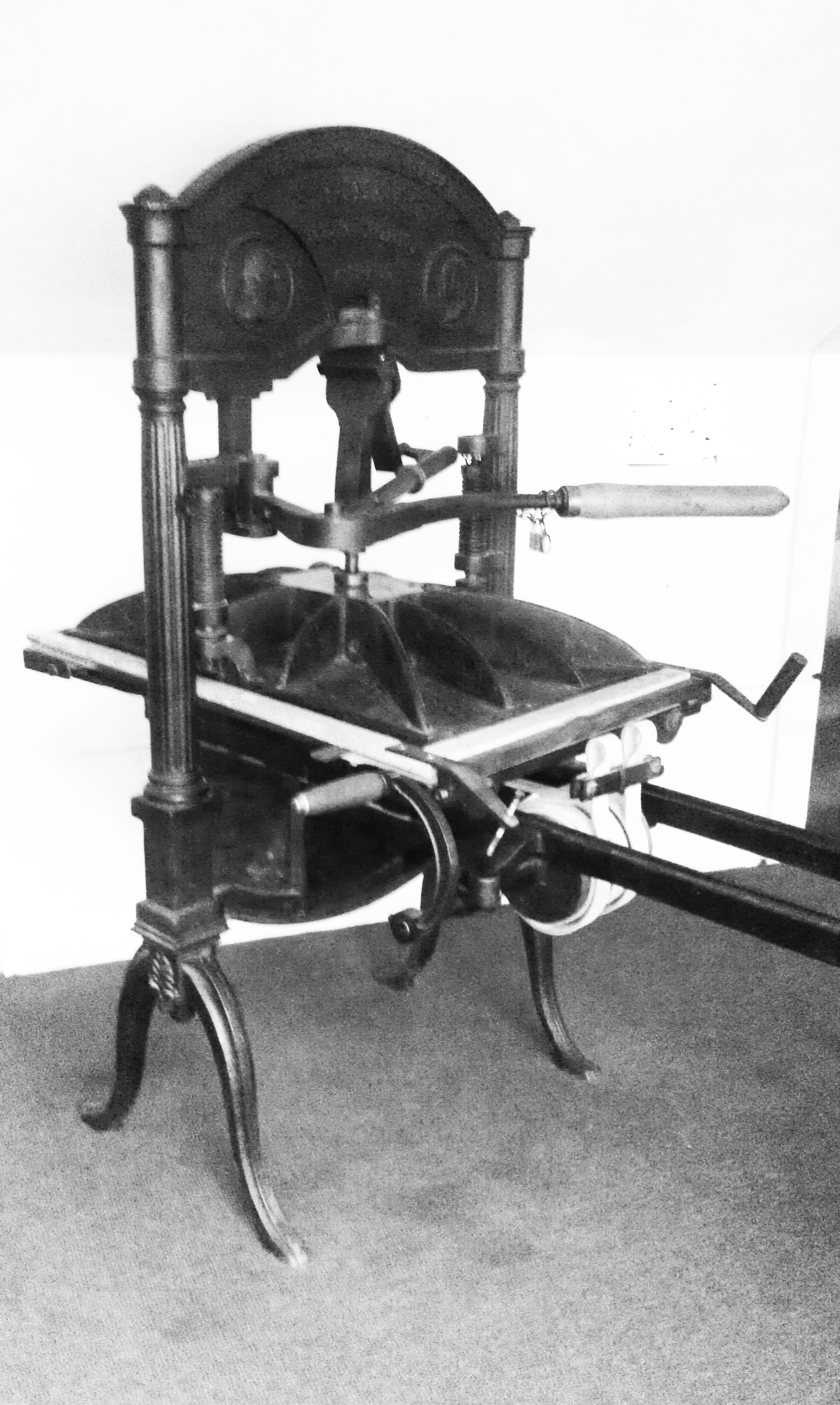
The Washington printing press at W&L

You would’ve enjoyed my presentation of a demo of our 1848 printing press, which two women (a Dutch-American librarian here, and the wife of our dean, who ran a letter-press business when she and her husband were at Princeton) inked up and operated for a group of about 12 that I pulled together for yesterday afternoon.

I kicked it off with a brief (10 minute) pep talk on why this wrought iron and worn wooden-handled machine (virtually the same technology as Gutenberg’s press 400 years earlier) was the second greatest invention ever. (Thank you, the student who took the prompt and asked: Well, what was the greatest?) The greatest invention – cheap, universal, flexible, sustainable, reaching across the world and across the generations – was: the alphabet. Especially, by our good fortune, the 24-letter Phoenician, Greek and Arabic alphabet, which became the Latin letters that made movable type possible (why the great civilization of Ancient China never got this far – too many ideograms).

The printing press was an amazing thing, the Rube Goldberg boundary between the old and the new worlds of human consciousness. Not that it created civilization – the Greeks, Egyptians and 15th century Florence did fine without it. But it created something new and dangerous – democracy and education (both words created by a man inspired by the printing press, Sir Thomas Elyot, T.S.’s ancestor), as the early 15th century was a period when national languages came into their own. Sir Kenneth Clark calls this chapter in his Civilization book “Communication and Protest.” We’ve been protesting ever since, inventing crazy ideas like “rights” and “the priesthood of all believers.”

Another amazing thing about the printing press: It was the first mass production ever. The beginning of our modern economy was to duplicate words on a page! All other mass production followed.

And another thing: Gutenberg didn’t invent anything, but put together about seven ideas from existing crafts, some quite old. For example, the giant screw that brought pressure from the platen to the bed was from wine and olive presses, or maybe bookmaking presses. Mixing a new ink that didn’t bead up like a net on metal required a linseed varnish the painters were starting to use. The mold for type couldn’t be sand, as the monks had used, because typeface had to be much more precise and even, so he borrowed the casting techniques from the Mainz Mint (he had an inherited association with that guild). And so on.

And what’s most amazing of all: Today, we have no use whatsoever for the printing press. We’re all digital and ink-jet photo printing. My handout at the demo had a poem on the back that was a paean to the printing press, saying it is the “laughter and tears of the world” and “shall never die until all things return to the immutable dust.” That was written in 1916. Here we are, not even a century later, and it’s the printing press that is consigned to the immutable dust of history.

Doug – That was a mind-blower and a delight. I knew much more than the average know-it-all, having taught and been caught up in the printing press, made short movie of a linotype, in operation; would read and weep at Paul Gallico’s great short story about one left-over guy in the newsroom who gets call from stringer of gang murder in the capitol (Like Valentine’s Day massacre ) and how he gets the production crews from bar getting drunk and  a dozen creative improvisations to get ‘em rolling. (Forget name of story).  But your presentation was full of new, dazzling  connections of what makes us be us.  Eliot’s ancestor inventing words democracy and  education? (Come on now.)  

But it is brilliant , and smothers the scene I’ve just invented  I wanted to tell you of for the Tate Play wherein Bo, playing the hustler Ace who wants  $100,000  to make rock band famous is cussed out by Grumps who suspects him as con artist (which he is) but accuses him of knowing nothing of real big band music and Grumps gets turned-on nostalgic and tells of how his first big band (mine) was Charlie Spivak and reveals his proudest possession (he gets it out) a trumpet that was originally Spivak’s. Ace picks it up and delivers the famous Spivak theme song, an unaccompanied F octave (Star Dust?). And then he shows his virtuosity on an  acoustic  guitar (playing and singing “Lazy River” ). This converts Grumps, to his regret.

 But  that’s trash to your molten gold of an inspired  and stunning connected  wisdom.  

Posted in Uncategorized | Leave a comment

The Knot of Self

We are leaking all over the place
To relieve the knot inside
Of the pressure of needing more space
Lest in captive heat it gets fried.

Call it soul. It goes out of its mind
(I think it must be) through the ears.
If I cover them both, I find
The self is all it hears.

There’s a sound like an endless flood
Of two hands not clapping,
Holding in that roar of blood,
Skull noise when the tongue’s not flapping.

My earmuffs cut off what’s next door
Of a neighbor cutting his lawn
While I cut mine, secure
In a rampage all my own.

This self of myself took me years
To build on what was around,
And it hates to plug its ears
For a swim with only my sound.

Posted in Uncategorized | Leave a comment

Stilled Fiddles

Cyrus playing

Cyrus Grey Carawan (1985-2014)

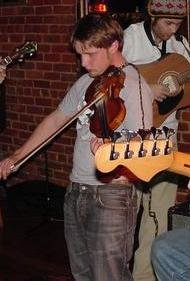
Last Thanksgiving, our house was filled with fiddle music. Old-time fiddling spilled out of the road-worn fiddles of two of William’s friends, Hunter Riccio and Cyrus Carawan. It was a beautiful sound, as if the fog had come rolling down from our Allegheny mountains and condensed around the great platters and wine vapors of our all-day Thanksgiving feast. My parents and mother-in-law were there, and brother Bryan from Nashville and sister Anne from Atlanta and their mates, a niece, our children, including William, and a bunch of his tattoo-and-road-grime buddies, Eric, Hunter, Ruby, their pit bulls, and I’m not sure when he showed up, but sometime after dinner, Cyrus.

Cyrus, I came to learn from him and his fiddle-magic, had been a child prodigy. At age 11, he had won first place in the youth division of a Florida all-state competition for fiddle playing. The following year, at age 12, he entered the same contest in the adult category, and won first place. The legendary Vassar Clements, pioneer of “hillbilly jazz” fiddling, was a judge in that contest, and gave Cyrus private lessons as his prize.

?????????????????????????????????????????????????????????????????????????

Eric and William

The food, the wine, and the music lifted us all into a long evening of great fellowship. Cyrus seemed most at home in that spirit. It’s true, the spirit of the wine was particularly involved in his case, but Cyrus floated on that spirit with a sweet nature that was hard to resist. He became like a member of the family, sharing his life story with a fetching note of pride, offering to be a contractor for the work we needed doing on the falling plaster in our stairway, and playing his fiddle. Man, could he play that fiddle, like the Mountain Whippoorwill: Fire in the mountains, snakes in the grass, Satan here a-bilin’, oh Lordy let him pass. He could play off of anything we would improvise, from my tenor saxophone to Bryan’s fancy jazz-country guitar chords. The ad-libbing got tighter and wilder and didn’t want to stop. I think it was midnight when it finally gave out.

On Monday, Aug. 4, Cyrus Caraway was killed when the car he was riding in, along the winding Maury River Road toward Goshen Pass, left the highway, hit a tree and caught fire. The driver, two years younger than Cyrus, was also killed. The funeral I attended on Sunday with Libby, William and Elizabeth Shields, was a difficult mix of Cyrus’s true life of friendship and music (beautiful words from friends Spencer McElroy and Jeff Bane) and the conventions of that particular church (obviously not Cyrus’s church or his type of music). The coffin was wheeled out covered in flowers and the many rosette ribbons he had won in fiddle contests; a young woman following the coffin carried his fiddle and bow.

Cyrus’s fiddle has lost its master, and so has the other fiddle that en-souled our Thanksgiving. Hunter Riccio, Elizabeth Shield’s son and William’s best friend, died in March in New Orleans. He was 24. Cyrus was 28. Whippoorwill, fly home to your nest.

Who can explain it? All I know is that I am so grateful that we opened our doors to so many people – family and sojourners – for that Thanksgiving, and that we have a house big enough to let Elizabeth stay here until she can find a new home.

Posted in Uncategorized | Leave a comment

A Memory

Me reading at Hewitt

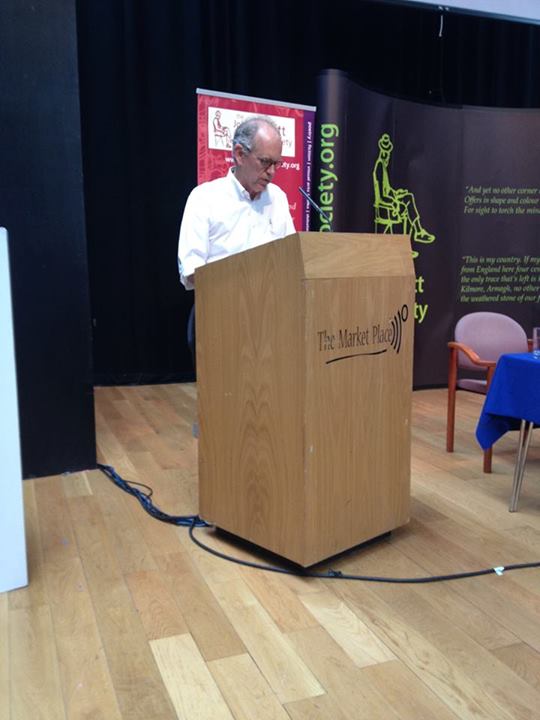
With some 16 participants in the memoir workshop of Maureen Boyle, they were all so extraordinary, I suggested a lottery to choose the three who would read at the showcase on Friday. Oops. Mine was one of the three. Here I am then, at the reading.

The spring air filled the car as I drove through the dark neighborhoods around Emory University, gracious curving roads of stately homes and lawns like fairways. It was as if the car needed to gulp that flowery night air to stay alive, all the windows opened and me just driving anywhere to keep moving, without a destination. What car was it? It must’ve been the Prius that Sarah had inspired us to get.

Where was I going? I know now, in memory, but didn’t know then. I needed to be somewhere, but for what? To think, or cry? Or pray?

Then the way came clear, the same route I had taken home every afternoon from Emory that summer I was in the Barkley Forum, the camp for high school debaters named for a former U.S. vice president who had gone to Emory. I was going home again, 40 years after high school and leaving Atlanta for work in other cities. There, by the pine-needle-covered lakeside, I would think, or just be silent with the bivouacked ducks in the dark.

I had left Sarah back at the Children’s Hospital of Atlanta. This was her third year of fighting bone cancer, and it was the lowest point yet, it seemed. Dr. K had just confirmed that the worrisome blood count was indeed a kind of leukemia that the chemo had triggered. . . one that would kill for sure, even if the bone cancer didn’t return as it had once before. The only hope was a bone marrow transplant – and that carried other risks as well.

I stood in the dark under those towering loblolly pines and waited to feel something, to feel less than numb and dumbstruck, there across the street from my childhood home, where strangers lived.

Epilogue: Sarah is a year out of college now, cancer-free for six years. She just emailed me from New York, where she’s living with her boyfriend and working in the photo archives at the New York Times.

  • From “Memoir Writing” workshop at John Hewitt International Summer School, July 28-Aug. 1, 2014, Armagh, N. Ireland
Posted in Uncategorized | Leave a comment

A story too good to check out

I remember reading the appalling story last month in the Roanoke (Va.) Times before leaving for Ireland: Nuns at an Irish orphanage during some three decades of the mid-20th century had discarded about 800 dead babies and children in unmarked graves on the convent grounds, some in a septic tank. Yuck.

The news story was originally based on the Facebook reports of a researcher who had been searching through records of this Catholic home in Galway where unwed pregnant girls could have their babies in isolated shame and give them up for the nuns to raise.

But the story was wrong, or at least suffered from several steps of exaggeration and lack of context. Shawn Pogatchnik, the Associated Press reporter who was my original contact in Dublin, wrote a diligent analysis of how the story fell off the rails of verifiable facts.

The deaths of so many children, in the context of Ireland’s poverty and diseases at the time, was not unusual. In fact, the death rate at this “mother and baby” home was lower than that of most of the other nine such places in Ireland, all long-since shut down. Contrary to some of the news stories, these children were baptized, and buried on the orphanage grounds mainly because family plots in churchyards had no room. Death stalked the land from the 1920s through the 1950s, and infants in these homes were dying not so much from starvation but from measles, pneumonia, tuberculosis and the flu.

As for the septic tank, it was a “disused” tank when the burials took place, even if any were on that spot – which was merely the speculation of the researcher, not a fact. But “Nuns bury babies in septic tank” was too good a headline to resist, Pogatchnik says. A harder story to tell is the real one, of Ireland’s widespread poverty and disease during much of the 20th century.

– Doug Cumming

Posted in Uncategorized | Leave a comment

Into Ireland

Doug in Merrion Sq

In Merrion Square, Dublin, during City Spectacular. The Georgian row houses surrounding the square included homes of Oscar Wilde and W.B. Yeats.

Teaching for the month of July in Northern Ireland city of Amagh. I highly recommend this course for journalism majors. I’ll be teaching it again next year, I’m sure. It’s with ieiMedia. http://ieimedia.com/

Here are the posts I’ve contributed so far to the blog we’re all contributing to, students and faculty. Check out the other posts as well.

Saint Patrick’s Town

North-South in a Swirl

Of Parades and Tweets

‘Mind Your Manners’

The Isle of Poets

For Iggy McGovern: A Sonnet

A story too good to check out

The Crows Can Hear the Falconer

The Plantation history question

Saint Seamus the Poet


And here are some more pictures from Dublin.Long Hall longviewNessa OMahony Dan & Cori at CraveReading Dubliners aloud at Sweny

Posted in Uncategorized | Leave a comment

Jonah Withdraws to Nineveh Suburb; Exclusive Q&A

Masthead croptDAY FIVE – The prophet Jonah, after his remarkable success at converting Nineveh, spent two days outside the city thinking things over under a tree.

With his shade tree under attack, Jonah loses his cool.

Shade tree under attack, Jonah loses his cool.

On the first day he stayed cool in his hut and under the shade of the tree, which apparently popped up in a jiffy. He seemed happy. But the next day, a worm ate the leaves, the day was hot, and Jonah turned bitter.

“I’m better off dead!” he was heard to yell skyward.

Apparently, the story ends abruptly with Nineveh filled with people “and many animals.”

One of Nineveh's many animals, by the King's throne.

One of Nineveh’s many animals, by the King’s throne.

But the Journal got an exclusive interview with Jonah after his meditation under the tree. He seems to have learned a lot from his experience. So we asked him some Questions about the Meaning of Life. Here is a transcript of the interview.

Question: Is life good or is life bad?

Jonah: Sometimes life is good, sometimes life is bad. Sometimes we forget the goodness of God and we think it’s bad, but I’d say basically life is good. I ought to get a t-shirt.

Q: Is it better to live in a big city or to wander in the desert by yourself?

Jonah: Oh my goodness. As difficult as it is sometimes getting along with people, it’s better to be among God’s children.

Q: Even a big city like Nineveh?

Jonah: Or Roanoke. . .or Lexington.

Q: What is a prophet?

Regan & friends

Regan and friends.

Jonah: Oh. A prophet is a person that appears wise and has a message to deliver. But I’ll tell you the secret. A prophet is merely a spokesperson for God, Who sends the message. And the prophet wanders around and says good things and appears to be a wonderful person, but it’s really You Know Who [pointing upward] talking.

A saint

A saint

——————

A New Day Dawns in Nineveh

DAY FOUR – It was as if somebody had pulled the plug on Nineveh’s nasty party.

Everything went quiet. No meanness. No cussing. No bullies coming down the street.

And there on Babel Avenue, a ragged figure sat in the dirt wearing burlap.

Reporter on the scene in Nineveh. King in lower right, in sackcloth, ashes and humility.

Reporter on the scene in Nineveh. King in lower right, in sackcloth, ashes and humility.

“I was scared,” the figure said. “I didn’t want my kingdom to be smashed.”

My kingdom? Yes, this was the King of Nineveh, bearing a striking resemblance to the young lady Taylor Fitzgerald. The King and all the people of Nineveh had listened to the words of the prophet Jonah when he told them of God’s displeasure with their bad manners and bad morals.

They all – “a lot of them,” was the King’s estimate of Nineveh’s population – adopted a brand new attitude. They humbled themselves, begged for forgiveness, and resolved to honor God and each other.

“God’s changed his mind,” Jonah said.

Jonah look a little tired. “I don’t know what’s next,” he said.

The narrator of this story, bearing a striking resemblance to the Rev. Tom Crittenden,

Father Tom narrates the story on Day Four.

Father Tom narrates the story on Day Four.

said Nineveh was so big it took three days to walk across it – which would seem about right at the pace Jonah was walking. Getting there by horse would have taken at least three days as well.

At the story’s conclusion on Friday June 27, at 5 p.m., the youth of the Vacation Bible School will perform a musical rendition of these amazing events. The public is invited to come to “Oh, Jonah” in the sanctuary of R.E. Lee Memorial Episcopal Church. It’s free.

King on the street being interviewed.

King on the street being interviewed.

—————–

Disgorged by Whale, Jonah Sets Sights on Nineveh

DAY THREE – A seaweed-draped Jonah was seen staggering ashore yesterday, lifting his arms toward the sky. He appeared to be in good health.

Jonah looks heavenward after three days inside a whale.

Jonah looks heavenward after three days inside a whale.

In a recorded interview, he told the Journal that the whale spit him out and he swam to shore. A host of young onlookers suggested he might consider taking a camel or horse to Nineveh, since Nineveh is apparently where he means to go now.

Avery 6-25-14

Avery Hess: “I think he was pretty brave to actually not panic too much in the whale. . . I bet he was really relieved to get out of the whale.”

One of the witnesses, Avery Hess, offered her own observations about this dramatic turn in this news story.


Trey Lewis and his granddaddy Buster.

Trey Lewis and his granddaddy Buster.

——————————-

‘Bad Luck’ Prophet Thrown Overboard, Believed Still Alive inside Whale

DAY TWO – Scared to death by a sudden storm at sea, the crew of a ship bound for Tarshish heaved  minor prophet Jonah overboard yesterday, according to crew members who asked not to be identified.Jonah in whale

This was followed by two extraordinary events:

  • A large whale swallowed Jonah whole.
  • And the storm ceased.

Our fearless reporter and photographer tracked down the whale for an interview with the enclosed prophet.

Jonah being interviewed

Jonah being interview underwater by Jehovah Journal

“When I told them I caused all this trouble,” Jonah said from deep inside his captivity, “they threw me into the water.” Jonah had been napping below deck during most of the storm.

He described his new circumstances as “dark and scary and lonely.”

Before heaving Jonah into the sea, the crew tried to lighten the ship by tossing non-human materials. That didn’t work. Then they drew straws to see who would get the short one, expecting that would tell them who was causing the storm.

Jonah drew the short end. He was hoping to escape God’s demand that he go to Nineveh to cry out against the meanness there. But his attempt to flee “didn’t work,” he said.

Group A with pictures

Group A with their drawings of Jonah in the whale.

Reflecting on these latest developments, youth at our Vacation Bible School have experienced being inside a whale – by walking through the dark passage and hearing the underwater sound-effects on the bridge between the church and Parish House. They have been given strips of paper to see who got the short one, like Jonah. And they have told about their own exciting journeys.

Helen and Grace

Helen and Grace

Summer H and Ava C

Summer H and Ava C

Avery, for example, went to China last year, when she was six, and walked on the Great Wall. Noah went to a Magic Mountain water park in Canada.

Meanwhile, back to our running news story, Jonah was scared but he seemed resigned to doing his job as a prophet. He said he thinks God sent the whale to swallow him. “God’s very powerful,” he said.

Clara boy & Gabi

Clara, Graham and Gabi, in Group C

—————–

FRIGHTENED PROPHET JOINS JOPPA SHIP

DAY ONE – Local minor prophet Jonah ben Amittai got a command from God yesterday, according to numerous witnesses.Jonah mug

Jonah, in an exclusive interview with the Journal, acknowledged that an angel spoke to him. He said the angel told him to go east to the city of Nineveh and cry out against the residents there for not being very nice. He apparently didn’t like the sound of that.

Nineveh is some 800 miles outside our circulation area here in Judah. It is not known whether the citizens there have heard of the God who created the heavens and earth and seas and gave us the Law. It is believed that they entertain many smaller godlets and demi-gods there.

Jonah, who declined to give his age, said he didn’t understand why he should be attracted to Nineveh. Instead, he was boarding a ship in Joppa that was bound for Tarshish, far to the western edge of the Great Sea.

“I hope it’ll be a sunny, pleasant trip, like a cruise in the Caribbean,” he said. “I’ll preach to them.”

He said he expected to preach good news where he was going.

Everybody 3Students and staff of the R.E. Lee Memorial Church Vacation Bible School, 58 individuals in all, witnessed the conversation between the angel and Jonah.

Regan2

Regan

“He didn’t want to get involved,” said Regan B., age 10.

Ginny mug

Ginny

“He might think he’d be famous, or he might be embarrassed – like I am sometimes,” added Ginny P.

Gabi mug

Gabi

Or maybe he just didn’t want to travel that far, suggested Gabi E., adding that it’s sometimes awkward to talk to people about religious beliefs that are different from yours.

The weather forecast calls for sunny pleasant sailing, so Jonah may have made the right choice. Check this space tomorrow. We’ll be following his journey.

Foster and Lidia selfie

Foster P. and photographer Lyndia Orr, in a selfie

Editor Cumming

Editor Cumming

Posted in Uncategorized | Leave a comment

Captured in Art

Time spent with my childhood family draws me back into that cartoon simplicity, the way my younger brother Walter’s caricatures draw people into their absurd (but all too true) versions. Mama takes the measure of my face, standing in the kitchen of our Tate house, and laughs. “I’m so mad at Walter for a drawing he did of you,” she says, jiving. Now, she says, she My mug home 2013can’t look at me without seeing that face.WWC caricature007

I know the one – I have the original: I posed as a model for the illustration he did for a Journal-Constitution feature story on older executives who get laid off in favor of younger, lower-paid professionals. The illustration had this old man, balding, bow-tied, and butt-folded into a trashcan. Walter is a genius at capturing the surface reality.

Why doesn’t a poem do the same at capturing the inner reality of a person? Like this one I wrote about Walter years ago, “Suspended,” when he was staying in the Tate house over the winter, enjoying the solitude and the bare trees in a kind of seasonal inversion of the leafy, family-full summers of his childhood.

SUSPENDED

   Your Mad River canoe floats
in mid-air athwart
the carport

Of our parents’ weekend mountain
house, cleated high
by bowlines,

Carabiners, and screwhooks to hold
against the flow of things
to ruin.

The whorls of elevation lines in topo
maps of ridges mark, like
fingerprints,

The runs you take when you have time.
Not much time left, city work
a long commute

And only six weeks before foliage closes
the vision, the fine-tuned knowing
of these ragged hills

Lived in at last for yourself — suspended
in magnificent shape like that
unhousebroken hull

Eyeing through windows over bookshelves
how it will run the currents
within.

Me and Walter cropt


Posted in Uncategorized | Leave a comment

The Bipolar Synthesis: Journalism in the Academy

My latest column in Clio Among the Media, the newsletter of the history division of AEJMC.

We have a relatively small journalism program here at Washington & Lee University, without grad students or professors of public relations, advertising or anything that is primarily theoretical. Yet we feel confident in our academic status. The history books say journalism education started here, although it’s a stretch to equate the scholarships that Washington College President Robert E. Lee started offering to printer’s apprentices in 1870 with the sort of journalism-school education that began in 1908 at the University of Missouri. We hold to the idea that a good liberal arts education is fundamental for journalists – or for anyone called to contribute to a democratic society through communication. We also believe in the value of Ph.D.s and ACEJMC accreditation and all that. So our website says with pride, we are “the nation’s only accredited journalism and mass communications program in a highly competitive liberal arts university.”

Gene Foreman, former Philly Inquirer m.e., Skype-ing with former NYTimes reporter Roy Reed (on monitor in the background)

Gene Foreman, former Philadelphia Inquirer m.e., Skype-ing with former NYTimes reporter Roy Reed (on monitor in the background)

But it can be an uneasy mix – the best journalism as it is actually practiced and the culture of the ivory tower.

Not that these can’t reinforce each other. I see the two worlds blend well where faculty members had highly successful newsroom careers twinkling with Pulitzers, Murrows, SPJ awards or Nieman fellowships before coming to their advanced degrees and classroom teaching. When colleagues have had more than 25 good years in the news business, they have connections that remain.

The best moments are when these connections reach students. I recently dropped in on the final presentations of our journalism majors’ in-depth, multi-media capstone reporting projects. The professor, Brian Richardson, was himself a Phi Beta Kappa W&L journalism major, ’73, who reported and edited for the Tallahassee Democrat and Miami Herald for a decade before getting a Ph.D. at the University of Florida. He had taught this in-depth reporting course for more than a decade. He also worked many summers on the Philadelphia Inquirer copy desk between academic years of teaching.

As it happened, Gene Foreman, the long-time managing editor of Philadelphia Inquirer during those halcyon years of Pulitzers, was a visiting

Critique session: l-r, student Cory Smith, Gene Foreman, Brian Richardson and Jim Steele

Critique session: l-r, student Cory Smith, Gene Foreman, Brian Richardson and Jim Steele


professor here who was just finishing up teaching a spring term course he called “Journalism that Changes the World.” (During one class, he brought in by Skype former New York Times reporter Roy Reed, who had been with Foreman at the Arkansas Gazette when that paper was doing its legendary coverage of the Little Rock Crisis of 1957. Enjoying Reed’s great Southern gift for storytelling there on the big screen, I was reminded of the way Shelby Foote stole the show in Ken Burns’ “Civil War” series.) Foreman came to the In-Depth student presentations. And on that particular day, he had brought in one of his former star reporters, Jim Steele, of the famed Bartlett & Steele team of investigative reporters, now at Vanity Fair. So the students got a critique from Richardson, Foreman and Steele. They were tough critics, but honestly, were wowed by the students’ work.

The best of the newsroom culture, that rakish tribe of well-seasoned news gatherers, has an uneasy relationship with the good university culture in which journalism programs and schools are embedded.

This is not that old chestnut, Those who can’t do, teach. I am grateful for the good theoretical models, historiography and sociology that created the groundwork for this generation of journalism professors. The work continues. As our chair Kathy Forde pointed out in her previous Clio column, sociology has played a key role in our understanding of media history, and provides useful tools for us to continue the work.

But journalism is not just a craft or trade that we are preparing some of our undergraduates to enter. It is also a mode of knowing, worthy of a respected place in a liberal arts education. I was struck by a recent David Brooks column (“Stairway To Wisdom,” New York Times, May 16) in which he hinted at this. In order to understand a social problem in depth, he said, you start with the data, then move on to the academic literature – the theory and sociology of it. But life experience tells us that individuals, you and I, for example, aren’t entirely generalizable in the way of groups and categories. To get at the deeper meaning of a social problem, you need individual cases, and for that, nothing can match the journalistic practice of skillful listening, writing with style and a gut sense for the story.

“My academic colleagues sometimes disparage journalism,” Brooks wrote, “but, when done right, if offers a higher form of knowing than social science research.”

The Freedom Forum, formerly the Gannett Foundation, wanted to help bring more award-winning seasoned journalists into the academic fold to teach the next generation of reporters. So it created a fast-track, two-and-a-half year Ph.D. program at UNC-Chapel Hill, offering $50,000 a year, free tuition and research money. The program accepted three fellows a year for nearly a decade, then shut down. I was in the last group; we turned off the lights.

I had always been drawn to universities, their deeper draughts of thought and longer time-horizons. But leaping into the world of the Mass Comm terminal degree, especially my first AEJMC convention, was painfully disorienting. After writing for multitudes on daily deadlines and editing magazines, I was getting hazed into this other world of blind review fixations and formulaic research papers. I felt, at first, that I had left a reality of consequence for one of weightlessness and non-importance. My colleague Brian Richardson recalled his experience of that transition as well. His reporter instincts kicked in, and he sensed the whole university system lacked outside accountability. So he grilled administrators with basic reporter questions, and that was apparently a startling experience for them.

But having endured the hazing, we now enjoy the benefits, not only in lifestyle but in intellectual payback. The best of it is achieving some kind of synthesis of journalism, as a way of questioning the world and relating to readers, and the art of teaching it.

Roy Reed, Skype-ing from Arkansas into W&L journalism classroom

Roy Reed, Skype-ing from Arkansas into W&L journalism classroom

Posted in Uncategorized | Tagged , , , , | Leave a comment

Music at Alone Mill

Pass me the can, lad; there’s an end of May. – A.E. Housman

William knows traveling, so I let him be my teacher on how to spend the 300 miles of interstate from Knoxville on the last day of May. There’s nothing wrong with silence, my son tells me, and that turned out to be a fine way to go. But when I took my turn driving, I exercised my privilege to play a CD of James Taylor called “Covers.” Songs like “Why, Baby, Why,” and “The Wichita Lineman” turned into earworms in the silence. Between silences, we held good talk.

In his log cabin in Dobson, N.C., William is an experiment in self-sufficiency.

Will in Knoxville, just passing through

Will in Knoxville, just passing through

He welcomes the snakes into his new home to keep the mice in check. He shelters buddies from his Travelers Tribe who drop in. He’s foraging plantain and sorrel, and planting in small squares of sunlight on raised beds of rotting logs. He cut his own hair close to the skull, leaving a few uneven patches. His brother  says it makes him look like an escapee from an insane asylum. He does look a bit like Van Gogh in the Charity Hospital in Arles. “I was thinking about that,” he says with that droll smile, “and I like the idea that I’m escaped from an insane asylum.” The whole world has turned into an asylum, a godawful people-choked, carbon-fueled, job-enslaved asylum, and he’s breaking out.

His view turns the world upside down, like a soft version of a Jeremiah or a Jesus. “Get a job,” he gets told, and wonders why the rebuke comes from a man who hates his own job. “Don’t litter,” they say, when he tosses the fragment of one of his hand-rolled cigarettes on a city sidewalk. But to him, the cigarette butt will biodegrade a lot sooner than the litter of the sidewalk itself, and the road, which turns into this eight-lane interstate leaving Knoxville, a strait-jacket over earth, the thick long-lasting oily garbage of the Dump. The City Dump for him is the city itself, although they try to remove the more obvious garbage out to the country. William says he wouldn’t toss a cigarette butt in the country; he’d put it in his pocket.

We got home to Virginia in time for the gathering to remember Hunter, aka “Tugboat,” William’s best friend. Hunter was of the Travelers Tribe, train-hopping and Dumpster-diving, learning old-time fiddle to William’s old-time banjo. Hunter was the previous occupant of that Dobson log cabin,

Will and Libby at his cabin in Dobson.

Will and Libby at his cabin in Dobson.

which his father bought him. But he died of a drug overdose in New Orleans after Mardi Gras. William owns the place now.

We found the party following a narrow winding road up and down hills, over the Maury, under I-64, to a hidden, sparse settlement called Alone Mill. It was a tender slow-moving occasion to share solace, mostly with Hunter’s mom, Elizabeth, who seemed so profoundly touched by everyone and everything that I think her gratitude will get her through these days. (She also lost a brother in England recently, and is having to leave her apartment by Monday; we’re on tap to help her move and store things that won’t fit in the smaller place Freddie Goodhart was fixing up for her in the middle of town.)

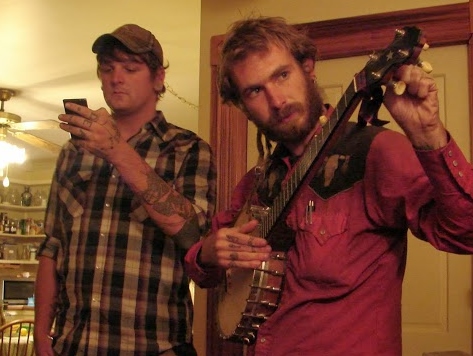
I met Hunter’s father, Elizabeth’s ex, a big man with a rugged whiskered face, sizeable girth and yellowish white hair spilling over his shoulders. Later, he played old-time banjo here with his fiddle player from down in Surry County, N.C., Joe, and Andy  from Natural Bridge on guitar, and many others, playing or just listening in the dark. Also drifting into this glade around the 1840s farmhouse were the young

Little cabin in the woods

William’s little cabin in the woods

Travelers, Ruby and Ace and others with their fiddles and banjos and beer, holding back out of respect for their elders. The eating and the music came after nearly three hours of drifting around the lovely old estate with its giant trees, garden and lawns bordered by Alone Mill Creek. That was nearly three hours of consoling talk and drinking beer and wine. Shoulder the sky, my lad, and drink your ale.

One of the elders was James Leva, who fascinated me a few weeks ago when I stopped to hear the student group he was leading in old-time traditional sacred singing. It turned out, he’s a W&L English major from ’80, a Ph.D. from UVa., and was a French professor at VMI until he was laid off and had to go teach at places like the community college. Seems his life has been an honorable slow landing ever since those four Moveable Feast years Escapeewhen a Fulbright brought him to a life in the center of Paris, where he met Samuel Becket and taught a French distiller the secrets of Virginia moonshine-making.

James recognized William. He had taught him French at Dabney Lancaster Community College (William had dropped out of high school, and needed the college credits to get into the Marines).

“Really?” I said, turning to William. “I never heard you speak French.”

“I didn’t either,” James said.

The flesh will grieve on other bones than ours
Soon, and the soul will mourn in other breasts.
The troubles of our proud and angry dust
Are from eternity, and shall not fail.

Will o' the Woods

Will o’ the Woods

Posted in Uncategorized | Tagged , , , | Leave a comment