
On this morning of Election Day, 2024, I am waving the flag of a poem by Richard Wilbur called “On Freedom’s Ground: A Cantata.” Read it aloud, slowly with a touch of drama. Record yourself doing so, as I did a sleepless night ago. Play it back to yourself.
I write this without having listened to readings of the poem, or musical versions (it seems to be the libretto of a chorale). I have not read any of the commentaries you can read online. I stumbled on the poem this week in Wilbur’s New and Collected Poems. It gives me the stirring poetry that – I have to admit – I have wished to hear from Kamala Harris’s closing arguments for American unity, to “turn the page” on Trump (as much as I am confident and grateful that her disciplined message will win the day).
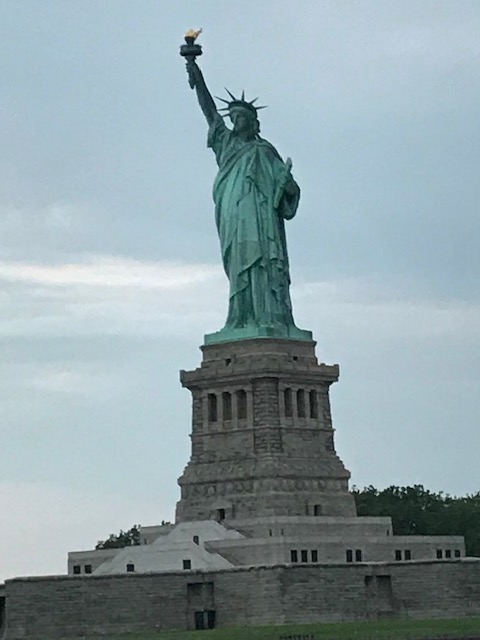
The poem has five sections. The first, “Back Then,” is a loose-metered sonnet with a beautiful description of the Statue of Liberty’s island, previously Bedloe’s Island, during primordial Time. The words he uses suggest a provocative idea, that Nature, without Man, operated in a state of utter slavery – “subject of the tide,” “vassals of the harnessed wind,” “slaves to hunger.” Before the mind of man “came ashore,” Where was the thought of freedom then?
What follows can be debated, that it was an English thought/ That there is no just government/ Unless by free consent,/ And in that English cause we fought. This was written for the Centennial of the Statue of Liberty, circa 1986. Today, I hear the criticism of saying “freedom” and “democracy” (popular sovereignty) are English ideas. How Euro-concentric! How chauvinistic!
After that lovely description of Nature in the first part, Part Two, “Our Risen States,” runs smack into the related problem of any poetry written for a nationalistic cause. True poetry can’t be patriotic, as Yeats knew. Wilbur knew this too. But after all, Wilbur was the Poet Laureate of the United States, and had certain duties to fulfill. It’s true that “free consent” in government was an English idea, if not exclusively, being in the work of John Locke that I once browsed worshipfully in a large early 1700s edition in the airless stacks of a university library.
He also salutes France’s help in the Revolution – Lady Liberty was, after all, a gift from France – and merges “liberty” in both languages as it led the French to rise/And beat with angry cries/ On prison doors and palace gates.
(I’m remembering now that Wilbur translated French plays by Moliere, and also wrote one of the most theologically powerful hymns in the Episcopal hymnal, “And Every Stone Shall Cry.”)
Part Three, “Like a Great Statue,” mourns for the dead who died for this country, but frames this in a fresh and complex way. The poet knows they did not think “liberty!” in the blink of time before they forgot us. No. Maybe they thought of Saturday night whiskey, or a beloved trout-stream, family voices at home, or the scent of sawdust. Whatever it was, we betrayed them, robbed their graves of a reason to die by the sins of our American history.
Here, the list is familiar to the sackcloth of our Biden years: pushing out the native tribes, breaking treaties, slavery (tersely put as “The image of God on the auction block”) . . .
The immigrant scorned, and the striker beaten,
The vote denied to liberty’s daughters.
Then this section changes to pride and praise, something I hope a President Harris era restores in our voices. Be proud at least that we know we were wrong,/That we need not lie, that our books are open. And: Praise to this land for our power to change it. To “learn what we mean and make it the law.” The last image of this section is King in the shadow of the Washington monument, free at last for Black Americans “to cast their shackles down” and wear the common crown of liberty.
Then it’s “IV. Come Dance.” A jig and jangle of “whatever spins around” and “Whatever takes the cake.”
Finally, then “V. Immigrants Still.”
Here, the seabirds and waves that were enslaved Nature in the first section can scud and wheel about “Our lady” Liberty with “A bright, cavorting air,/ And have the look of ransomed things.” As if humanity, free, can impart even on Nature herself a measure of creative freedom, at least “To our free eyes.”
Not that the graves of our dead are quiet,
Nor justice done, nor our journey over.
We are immigrants still, who travel in time,
Bound where the thought of America beckons;
But we hold our course, and the wind is with us.
May our good old Democratic Party – no longer uttering “white fragility” or muttering of “micro-aggressions” – win not only the Presidency but a House and Senate eager to solve some wicked problems. And may it do so with the sound of this poetry.
On April 3, 2008, a mother I did not know held her newborn daughter for 27 minutes of life in a Virginia hospital.
The newborn, in utero, had developed with a chromosomal disorder called Trisomy 18, or Edwards Syndrome. The mother knew this from amniocentesis. She knew that this tiny girl would have so many defects of essential organs, including the heart, that life expectancy at birth was virtually zero. A late-term abortion would have been understandable. But Cathleen Warner, a Roman Catholic mother of two boys, chose an option she had learned about in her desperate online research. She would go through with a C-section and be with her daughter for whatever time God gave her. It lasted 27 minutes. For Warner, it was the worst, and best, 27 minutes she will ever experience in life, she said.
I don’t weep easily over the radio, but I wept when I heard this story on NPR’s “On Point” today.
The program was about parinatal palliative care, an approach to the birth of babies so physically compromised that they can live for only a day, or hours or minutes.
I first heard about this form of hospice while I was on a Christian retreat in Virginia: Hospice for a dying newborn. The host who owned the retreat farmhouse also supported a parienatal hospice program, she said.
What’s that, I asked.
When she explained it, my instincts as a journalist perked up, having been the kind of writer who loves long-form stories that touch the human heart. Would a family anticipating the deeply private poignancy of this experience ever give a writer permission to document it, even after-the-fact? I never followed up on that idea.
But it came back to me listening to Cathleen Warner tell her story on public radio.
My emotional tears may also have been salted with anger – election-stress anger. The program framed its subject, perinatal hospice, around what former President Donald Trump had been saying. In his debate with President Biden on June 28, Trump said “they” (meaning Democrats, or maybe undocumented migrants) will allow abortions up to the seventh, eighth and ninth months and even after birth. “They will take the life of a child after birth.” He cited an unnamed “former governor of Virginia” on this. Later, debating Vice President Kamala Harris and at a rally, he pumped this up to be “execution after birth,” and now he was citing an unnamed former governor of West Virginia.
It turns out, the former Virginia governor he had probably heard about, through right-wing filters, was Gov. Ralph Northam, a pediatric neurosurgeon who made the mistake of describing in medical terms what happens when a mother goes into labor with a severely deformed nonviable fetus. “The infant would be delivered,” he said in a radio interview in 2019. “The infant would be kept comfortable. The infant would be resuscitated if that’s what the mother and the family desired. And then a discussion would ensue between the physicians and the mother.”
Cathleen Warner did not need to have her baby resuscitated nor did she need to have a discussion. Her perinatal hospice experience was what it was supposed to be.
I can only imagine the intensity of that experience.
But I understand something of its spiritual nature and the blessing of having the presence of hospice when a child dies. My wife and I also lost a daughter, who also had a chromosomal defect. She lived a rich life, longer than her doctors or statistics thought possible.
Around that April in 2008 when Cathleen Warner was in a Virginia hospital with tiny Erin Warner resting in her arms, our daughter Sarah, then 17, was getting chemo in a hospital in Atlanta and awaiting a bone-marrow transplant. The transplant was successful, while I was the one to receive her high school diploma that spring in Lexington, Va., where I stayed for my teaching job.

Seven years later, when Sarah was working in New York, a massive seizure revealed a brain tumor. It turned out, the genetic mutation she carried since birth was associated with all three of the cancers she fought, with amazing stubbornness and courage, until she died last December at 33. She was in a mountain house where she wanted to be, surrounded by family and friends and music, under sensitive hospice care.
What struck me most about Cathleen Warner’s story was her understanding of life as a gift, no matter how brief or long. We were gifted with 18 years of Sarah after she was first hospitalized with bone cancer in her right arm. A mother has a special relationship to such a life, and to its mortal end. It is a relationship that a politician can never express, whether their rhetoric is “pro-life” or “pro-reproductive rights.” All I can say about Trump calling perinatal hospice care an execution is this: “Shame! Shame on you and, at this late date, on all of your pious voters!”
In a 1963 issue of the Atlantic Monthly, I read an account by Ralph McGill, who was editor and publisher of the Atlanta Constitution when I was growing up in Atlanta, of his interview with the distinguished black scholar W.E.B. DuBois in Accra, Ghana. DuBois was 94 at the time, and would die later that year, a disillusioned but dignified exile who had renounced his American citizenship and turned African Communist.
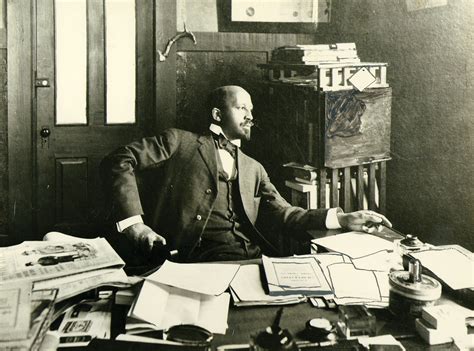
DuBois told McGill of his early days as a sociology professor at Atlanta University in the 1890s. One day in April 1899, DuBois was walking to the Constitution office with a letter of introduction to Joel Chandler Harris, an editor there at the time. But then he saw something in a store-front window that sickened him: the severed fingers of a man who had just been lynched. “I saw those fingers . . . I didn’t go to see Joel Harris and present my letter,” he told McGill. “I never went!”
It’s a famous scene in DuBois’s life, possibly a turning point as his literary and academic gifts became increasingly edged with resentment, with distrust of white society and a marathon determination to fight. This was four years after Booker T. Washington had famously held up his hands in a historic speech in Piedmont Park (as the Cotton States Exposition site would become), spreading his fingers apart as a metaphor for social segregation (which he conceded as a peace offering to the white South) on the metaphorical hand of “mutual progress.” DuBois respected Washington, but hated that “Atlanta Compromise.”
The fingers DuBois saw in the shop window were souvenirs of a lynching outside Newnan, in Coweta County. The case of Sam Hose, a black farmhand who had killed his white boss with an ax, had already received a great deal of coverage from the Constitution before Hose was lynched in broad daylight on April 23, 1899, before a crowd of perhaps as many as 2,000 jubilant citizens. The reason DuBois was going to see Joel Chandler Harris was to complain about the incendiary coverage the newspaper gave to the 10-day manhunt. The Constitution had offered a $500 reward, and published a description of the crime by the victim’s brother-in-law.
Fifteen years ago, I reviewed a research paper that a student wrote about the Constitution’s role in the Sam Hose case. “The South’s Standard Newspaper,” a century before I worked there in the 1990s, had adopted the style of sensational crime coverage so popular in the New York World and New York Journal. So the newspaper published the brother-in-law’s description of Sam Hose splitting his victim’s skull “to his eyes,” then knocking one of the children “six or eight feet,” dashing another, a baby, to the floor, and finally raping the wife “literally within arm-reach of where the brains were oozing from her husband’s head.”
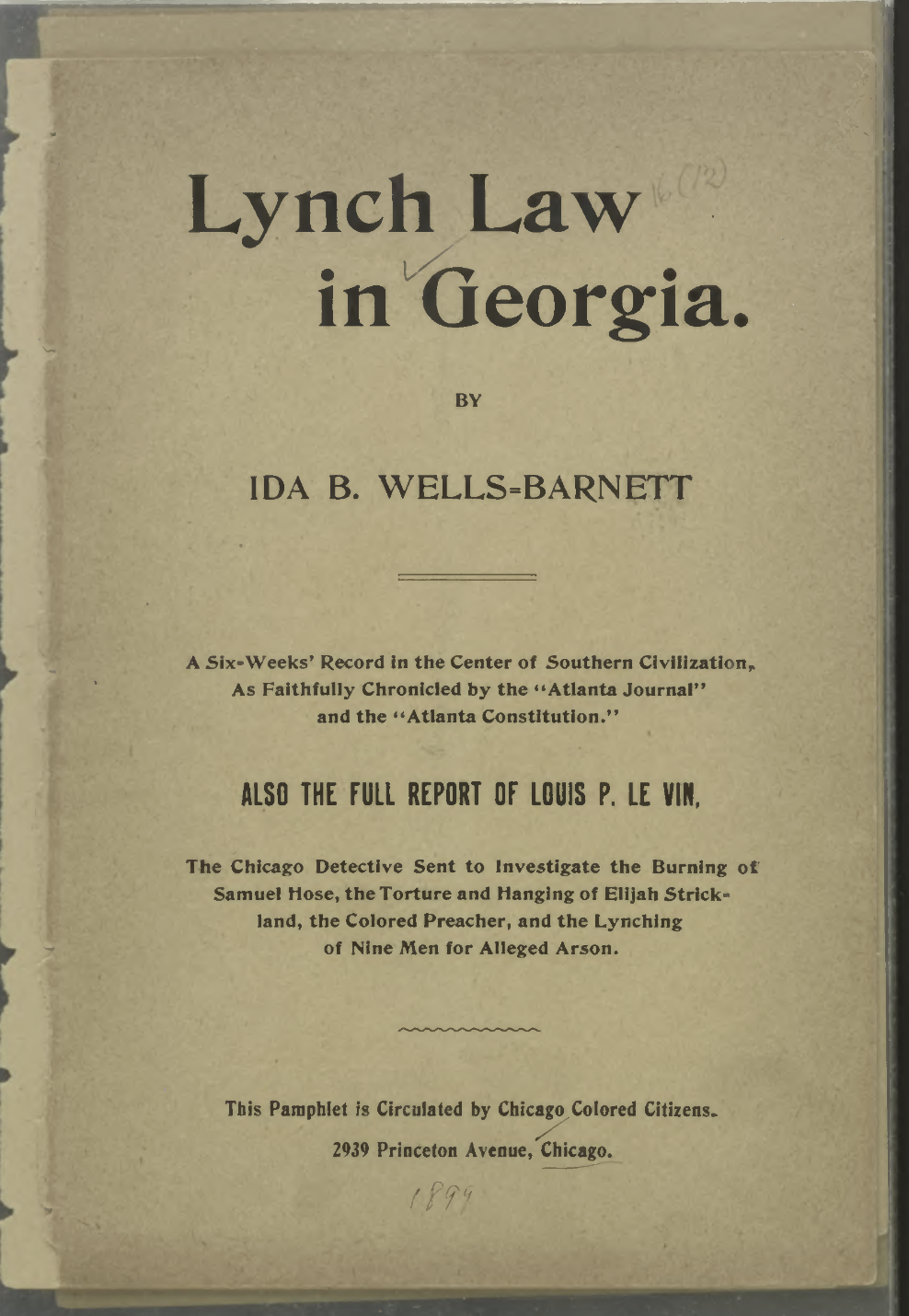
The brother-in-law was not present, and was not a trustworthy reporter. However, a muckraking black reporter named Ida B. Wells-Barnett, whose investigations of lynching around the South at this time proved to be highly credible, led a report on the case based on interviews of witnesses and other available evidence. The report, Lynch Law in Georgia, claimed that Sam Hose never entered the family’s home or touched the wife or children, but killed his boss, Alfred Cranford, in self-defense during an argument in which Cranford threatened him with a pistol. When he was finally captured and brought by train from Griffin, a terrified Sam Hose told a Constitution reporter the same version of events that Wells-Barnett would later publish. When the mob brought Hose before the wife’s mother, who asked him why he killed her son-in-law, he told her the same thing.
The excited throng offered to lynch the man right there in the older woman’s presence. She declined the offer. So they hauled him off to a clearing just north of Newnan, where he was chained to a pine sapling, stripped, and divested of several pieces of anatomy that were passed among the euphoric citizenry. A circle of firewood and this victim of Georgia’s extra-legal justice system were then doused with kerosene and lit a-fire. Hose’s only words during this final torture, according to the Constitution: “Oh my God! Oh, Jesus!”
It’s hard to imagine such community-wide, daylight savagery a mere four generations ago, looking at suburban Coweta County today. This was not some secret Klan activity, or the work of pathetic lowlifes, like the two Mississippi men who got away with Emmet Till’s murder in 1955. This was an entire community, like the town in Shirley Jackson’s gothic short story “The Lottery.”
Who stood up against it? Not the newspapers. Perhaps a case could be made that a few decent souls tried to stop the madness. Governor Allen D. Candler had dispatched the militia to Palmetto to try to prevent the lynching, though he had blamed black criminality as much as white vigilantism for Georgia’s epidemic of lynching. Former Governor William Y. Atkinson, a Newnan resident, had pleaded with the mob, ineffectively, to let the law take its course. These efforts remind me of how Governor John M. Slayton was moved by conscience to commute the execution of Leo Frank in 1915, though he could not stop Frank’s lynching in Cobb County in 1915. Weak leadership without followers. That’s what we had in Georgia in the worst of times.
In the spring of 2014, I took a class of 14 students to New York City for three days to visit magazine offices. This was the first six spring-term courses that became my most popular and successful teaching at W&L, “The Magazine: Past, Present and Future.” (One of the students in that first class went on to become an editor at Garden and Gun.)

One thing I noticed about New York City in those days when the World Trade Center had become a sunken memorial, replaced by a Freedom Tower that would house Conde-Nast magazine offices, was this: New pencil thin skyscrapers had sprung up like dead sunflower stalks. I found out that these were a new kind of residential tower, thin because they didn’t need the multiple elevator shafts that office towers needed. Who had the money to underwrite these buildings and buy the condos within? For one, corrupt oligarchs from post-Soviet Russia, I was told. They needed a safe haven to launder their money, and the best place in the world for that was New York real estate.
Later, when Libby and I were driving between Lexington and Decatur a lot for my retirement move in July 2022, we stopped for a lunch visit with Linda Watt, a North Fulton High classmate who had gone to Vanderbilt and then into the Foreign Service. (At one point, she was the U.S. Ambassador to Panama.) During the time of lawless capitalism in the post-Soviet carnivale, she was manager of the U.S. Embassy in Moscow. She described the corrupt wealth that everybody knew was making billionaires out of dark figures you could see in the restaurants loudly displaying their ephemeral wealth.
It turns out, before Robert Mueller became a byword to MAGA fanatics because of how Trump and AG Bill Barr turned his unread report into a “hoax” and nothing-to-see, he was the FBI director. In 2011, as FBI director, he issued a report on the money that was being invested in those weird residential skyscraper in New York.
He told the Citizens Crime Commission of New York City [Heather Cox Richardson dug this up] that globalization and technology had changed the nature of organized crime. International enterprises, he said, “are running multi-national, multi-billion dollar schemes from start to finish…. They may be former members of nation-state governments, security services, or the military…. These criminal enterprises are making billions of dollars from human trafficking, health care fraud, computer intrusions, and copyright infringement. They are cornering the market on natural gas, oil, and precious metals, and selling to the highest bidder…. These groups may infiltrate our businesses. They may provide logistical support to hostile foreign powers. They may try to manipulate those at the highest levels of government. Indeed, these so-called ‘iron triangles’ of organized criminals, corrupt government officials, and business leaders pose a significant national security threat.”

In retrospect, this seems a little paranoid, laying the groundwork for conspiracy theories and late-model Tom Clancy movies. But I have to wonder. Why crypto-currency – an energy-wasting digital project whose main purpose is to offer get-rich-quick schemes to nimble investors and to hide criminal profits? And why are crypto entrepreneurs now lavishing contributions on Super PACs supporting Trump and Vance? And why are Trump and Vance cozying up to the crypto capitalists (not to mention Trump’s soft spot for Putin’s Russia)?
Good thing I’m not conspiracy-minded.

Subscribe to get access to the rest of this post and other subscriber-only content.
Sometimes, it’s hard for people to connect the daily stuff of their own lives with Washington D.C. policies or even state-level politics. Military aid for Ukraine doesn’t seem to hamper our day-to-day struggles, but defending Ukraine against Putin’s Russia also seems remote from everyday issues, especially if politicians begin to demagogue against this commitment to our NATO allies. The rise of Axis powers in the 1930s seems long ago, and even the Cold War is easy to forget. The price of eggs seems more relevant, and if that can be blamed on Biden’s “terrible policies,” that’s an easy call.
Inflation has many causes, especially in the after-wash of the pandemic, which gave Americans a lot of free dollars to protect against economic collapse (Trump and Biden were together in this) and worldwide supply chains were choked. Coming out of the sheltering and having more money increased “demand”; meanwhile, supply chain problems crimped “supply.” Serious inflation followed. The Fed, over which Biden has no control, is using its leverage over interest rates to keep a lid on this over-heating economy. That’s all working as it should. But inflation, even as it comes down, is a powerful talking point for Trump and the Republican Party. So is “immigration,” an issue as complex as inflation until Congress has the guts and intelligence for comprehensive immigration reform. Meanwhile we can’t even get piecemeal immigration reform, because Trump sabotaged a bipartisan fix at the border as he cynically understood that this temporary measure would cool down the issue as a political weapon. Without this Congressional fix, Biden used a federal order to clamp down, which reduced illegal crossings dramatically and angered a lot of his supporters.
Trump supporters are ignoring the reduction of illegal crossings. Biden’s temporary and somewhat cynical political fixes didn’t help his standing in the polls. I hope Harris, with the sudden energy and enthusiasm she has unleashed, can show that running on Biden’s record isn’t a liability but an asset. He has been good for labor, and good for clean energy. Biden’s Federal Trade Commission Chair Nina Kahn has been brilliantly successful putting a check on monopolistic corporate power, the essential guardrail of a healthy free enterprise system. Things are working well now, considering the circumstances Biden inherited at the beginning of 2021.
Biden’s best policy successes have been about liberal spending that is in the form of “investment.” Investment is a great way to look at how our own household dollars might be spent. We can spend money three ways: on entertainment, on short-term necessities like groceries and transportation, and on investments that pay off in the future, for ourselves or our descendants. Investments are buying a house, paying the mortgage, improving the house. Other investments: Planning a career with future prospects and a sense of personal “calling”; getting married and keeping in touch with friends and community; service to church or society’s nonprofits; education, at all levels, including support for public education even if your family doesn’t use it yourself. That’s self-interest as an investment.
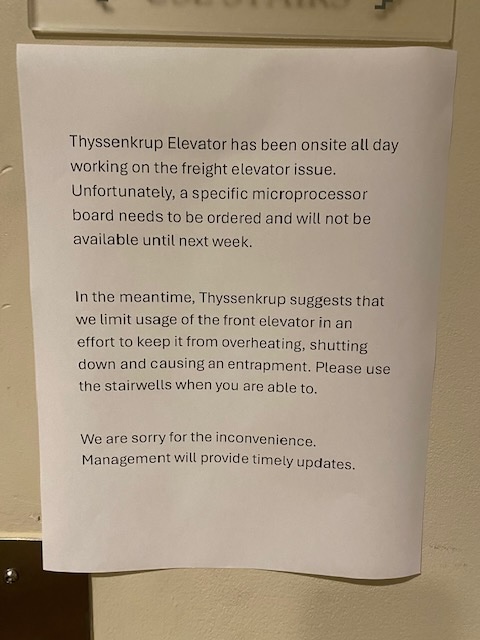
Many of the benefits of Biden’s policies are beginning to show, but they are hard to see because they are investments. For instance, the CHIPS Act is bringing manufacturing of computer circuitry (the cotton-textile dynamo of the 21st century) back to U.S., for good jobs and more control over supplies. How does this affect my life, right now? I can’t see it. But the freight elevator in our condo building is out of order and we are told to minimize use of the only other elevator, using the stairs when we can. The problem is that a specific microprocessor must be ordered and it won’t come until next week, according to the German company, Thyssenkrup, that manages the elevators. Meanwhile, the refrigerator in the half of the duplex we own is broken, and our tenant there is having to use a half-sized refrigerator we gave her while we wait for the repairman to get the parts he needs. It’s on order. The heater burned out and fried the thermostat. I don’t know, but I assume micro-chips are involved.
Subscribe to get access to the rest of this post and other subscriber-only content.
FOR IMMEDIATE RELEASE, July 13, 2023
Contact: Doug Cumming, cummingd@wlu.edu 540-570-0293
Second Concert of the “Rick Saylor Memorial Jazz Series”
Thursday, July 25, at First Christian Church of Decatur
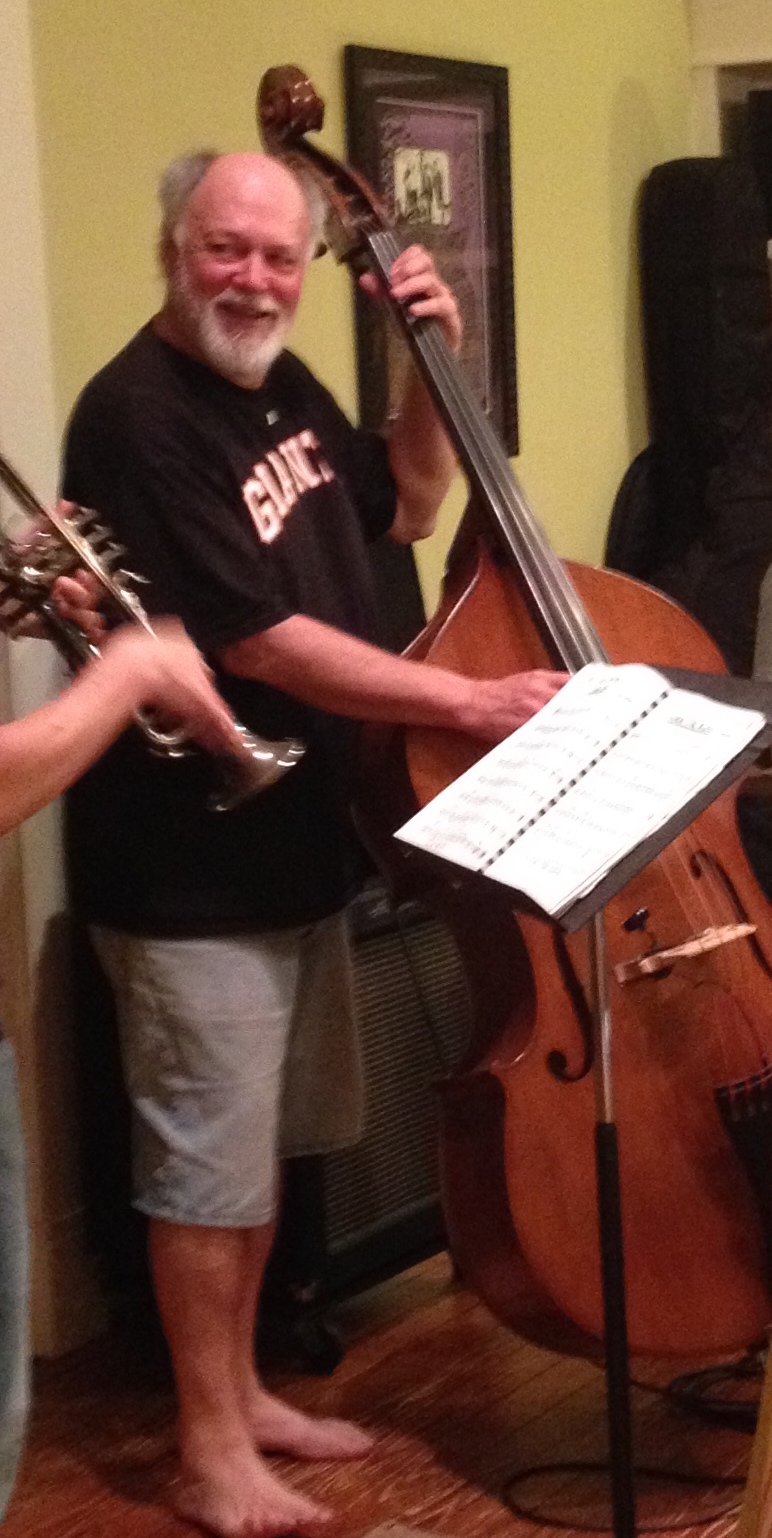
A jazz combo that grew from years of “workshopping” at the Grant Park home of bassist Rick Saylor will perform on Thursday, July 25, in the Fellowship Hall of the First Christian Church of Decatur, 601 W. Ponce de Leon Ave., Decatur.
Saylor, a former tour manager for jazz icons Wayne Shorter and Herbie Hancock, died on Aug. 6, at age 70, after suffering a heart attack. He was the host and mentor of a generation of local jazz musicians who would gather at his house every Thursday evening to play from the jazz canon, Bebop to jazz fusion.
As the steady bass player holding it together, Rick Saylor emphasized that these weekly sessions were for the joy of playing jazz and learning from one another, not to “play out.” Honoring his memory, the other musicians decided to continue the weekly sessions and break Rick’s no-performance rule with a first memorial concert last Dec. 6 at the Decatur church.
The group includes Adam Cole, keyboard; Bo Emerson and Dan McGraw, trumpets; John Willingham, guitar; Jordi Lara, bass, and Billy Bryant, drums; Walter Cumming, trombone, and Doug Cumming, tenor saxophone.
Saylor grew up in the San Francisco Bay area during the halcyon days of the late ‘60s and early ‘70s counterculture. He was immersed in the music of the time working in the famed Village Music store in Mill Valley in the Bay Area and playing bass with local bands. He also began doing sound for the Inn of the Beginning, a music venue that brought nationally and internationally recognized musicians to the area. It was there that he was recruited as a tour and sound manager, managing national and international tours for numerous groups and eventually for jazz icons, including Shorter and Hancock.
In the late ‘80s, he moved to New York to co-produce an award-winning jazz documentary series for Masters of American Music that included series on the history of jazz, Sarah Vaughan, Billie Holiday and Thelonious Monk. He also worked for a talent management agency involved promoting the “new” lions of jazz such as Benny Green, Diana Krall, Joshua Redman and Christian McBride.
The church will open at 7 p.m. for the 7:30 p.m. performance. The concert is free. All are welcome to come and bring someone.
On April 16, I voted in Georgia’s Democratic presidential primary for Joe Biden. It was the only choice at that time for beating Donald Trump. That’s what my vote meant then.
Now, Biden is no longer my choice. He is going to lose to Donald Trump if he is the only choice we Democrats have.
I can’t change my primary vote. I don’t have a choice, and didn’t have a choice then. But Biden can change his mind.
Moses worried about how the Israelites would behave after he was gone. There was so much still to do. They had not yet entered the Promised Land.
I say “he is going to lose” not as a criticism of Biden but as my fixed bewilderment about the multitude of American adults who tell pollsters they prefer Trump. Maybe they’ll change their minds by November. Maybe the polls are wrong. Biden thinks so.
Polled people gave Trump the edge long before the disastrous debate in Atlanta on June 27. Now it looks even better for Trump. He is so giddy about running against Biden, he isn’t thinking at all about how he would run against someone else. Someone wrote that Trump must be praying that Biden doesn’t step aside and let the Democratic Party be more democratic than anything we can imagine. If Trump prayed.
I pray for Biden to step aside. It’s more than I can imagine. A true revival of America. An excitement of mind, body and spirit, sweeping across the nation like sunlight in springtime. A reawakening to who we are. A recognition that Biden has actually been a damn good President, and things have finally turned around for the good, thanks to his wise and cagey successes. We are recovering from Covid-19 and its rampages. He has helped grow and strengthen NATO, an alliance that has held militarized evil in check since 1949. While we suffer in the heat and storms of this summer, we might see what another Democratic candidate could help us see clearer (since Biden, like Moses, gets tongue-tied. Ex. 6:12) – that our giant systems of agriculture, industry, transportation, and utilities are all steadily replacing carbon with clean, green energy. This is for our grandchildren and their grandchildren in the Promised Land. Thank you, Joe Biden.
But Joe Biden isn’t going anywhere. He says there is still so much (for him!) to do.
This is only the beginning of misery for us ordinary Democrats.
We will not watch TV. It’s too painful. But millions will be watching. The ads for Trump will run clips from the Atlanta debate. They will run clips of Biden wandering away from a line-up of VIPs. TV will show Biden as weak, Trump as strong. Image is everything. As Steve Bannon said in an interview (before going off to federal prison, where like Trotsky he will only become more powerful and mythic), Trump is McLuhanesque. He understands that TV is everything. Written words don’t matter. That’s old media. Language, logic, facts, news, persuasion, laws, the sacred history of the Jews and God’s Providence as handed down in Scripture – none of that matters. Soft, what light from yon window breaks? It is the East and Trump is the sun.
We Democrats voted without some important information about Biden. Millions will be voting for Trump without important information about him, thanks to the insolence of the U.S. Supreme Court, the law’s delay. Americans won’t know whether he is guilty of leading an insurrection against America. That case, aptly named Donald Trump v the United States, has been delayed until after the General Election.


