A prison ministry

“I was in prison, and you visited me.” – Matt. 25:36
 
Twice a year, in the gym of Phillips State Prison in Buford, Ga., the love of Christ pours out on more than 50 inmates selected to be in a long weekend retreat called the Kairos Prison Ministry.
 
Kairos is an international ministry in nearly 500 prisons in nine countries – but mostly in the United States, which holds the record for per capita prison populations. The lay Outsiders who have come to Phillips State Prison are from scores of churches of various denominations in the Atlanta area, including three men from Holy Trinity Parish, my home church here in Decatur.
 
Ron Stein, until the Covid pandemic, was involved in the follow-up program that brings monthly visits to maintain the Kairos community of prayer and fellowship after the inmates’ three-and-a-half day weekend. Pete Pfeiffer has been involved in Kairos for 25 years, starting at Lee State Prison when he was at First United Methodist Church in Cordele, Ga. Since coming to HTP, he has continued to be involved and he talks about it in adult Sunday school. The third HTP member, Tim Ball, who was inspired to join by hearing from Pete in Sunday School, has been involved in the long weekends at Phillips State Prison.
 
It’s an exhausting experience that Tim, at 77, is taking a break from now. He says the prayers, singing and small table discussions “about life” and its choices are a powerful release for incarcerated people. “Working in a prison where men had not been able to speak their minds and talk to anybody else, it’s just a wonderful experience,” Ball said.
 
The ministry is designed to maximize the experience of Christian forgiveness, community and release. It grew out of an older movement called Cursillo, or “short course” in the faith, which began with Catholics in Spain in 1948. In 1979, men of the “Fourth Day” (living into the commitments of their three-day Cursillo weekend) created a prison-appropriate version of a Cursillo weekend, which became the Kairos ministry. (“Kairos” means God’s moment, or “the fullness of time,” in the Greek New Testament.)
 
Kairos has various forms, for women and youth as well as men, and for one-on-one as well as the long weekends. One former inmate named Richard Jones, a friend in our previous church, Grace Episcopal in Lexington, Va., said his Kairos weekend was the best experience of his life. He remembers especially the Saturday evening when he received bags of encouraging letters and cards from people “who didn’t know me from a bucket of paint.”
 
“There’s so much love, you could cut it with a butter knife,” he said.
 
Ron Stein had always been curious about how prisoners survived. But curiosity changed to real relationships once he got involved, even though it remains “in the moment” without reference to the past or future. “I don’t just go for myself,” he said. “Some of these guys, their families have given up on them. They have no one else. . . I realized, we’re the only people who care about them.”

Posted in Uncategorized | Leave a comment

An Oregon Trek

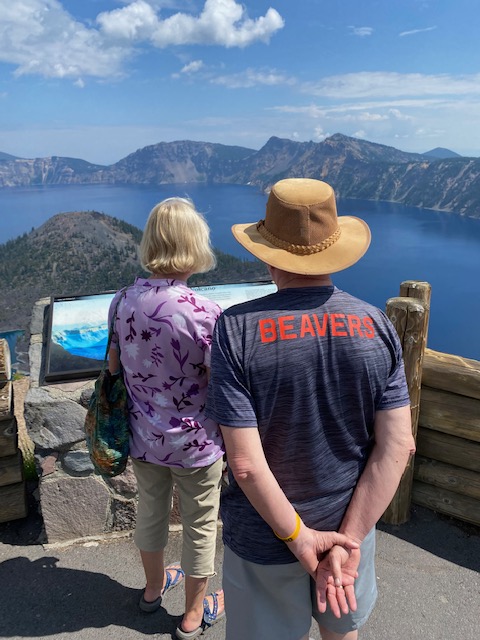
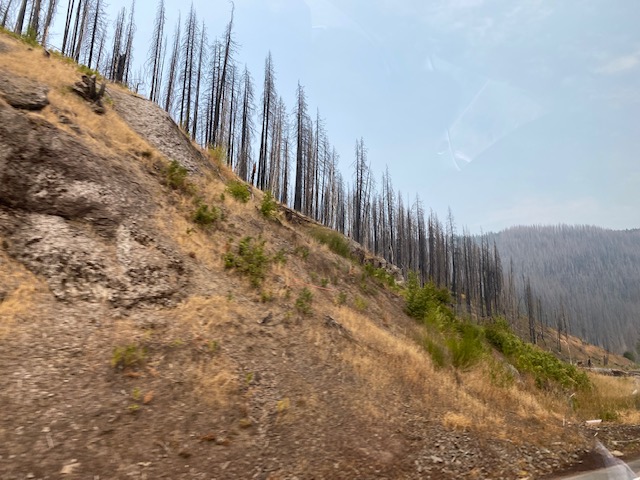
Oregon, for the last two weeks, took us to burned-over pine forests and evergreen mountains, Lavaland and the High Desert, dazzling cool days and 105-degree smog so thick the sun was like dried blood. We crossed the Columbia and we waded in the Pacific, beheld the World’s Smallest Harbor (Depoe Bay) and the nation’s deepest lake (Crater Lake).

We caught up with kinfolk on small farms in Rogue River to the south (Chris and Lisa Judson’s) and Ridgeview, Washington, to the north (Vern and Kelly Pick’s), on the Cumming side in Tigard (the Beckleys) and the Waring side in Salem (the Judsons).

Newspapers around here are dying, like one of the burned-over forests. A literary nonfiction writer selling her books at the Oregon State Fair wondered at my thinking the Oregonian had some fine writers. “Have you seen the Oregonian?” Lauren Kessler asked me. No, not lately. Up in Longview, the paper where Linda Wilson was on the Pulitzer-winning team for coverage of Mt. St. Helen’s eruption, is down to two reporters now, she told us. It’s owned by a hedge fund. So the news we get is mostly wide-screen entertainment from cable TV.

Not long ago, Oregon was a good place for newspapers. My friend Berkley came to one of his first newspapers in Bend, Oregon, arriving just after Ken Kesey’s “Bend in the River” festival in 1974. Berkley texted me information, like this: the mayor of Bend had been George P. Putnam, grandson of the Putnam publishing firm and husband of Amelia Earhart (we saw her plane in the Evergreen Aviation and Space Museum in McMinnville). No relation, I guess, to another George Putnam who bought and ran the Salem Capital Journal from 1919-1953, who criticized a grand jury for refusing to indict a railroad president for attempted murder (and so was indicted by the grand jury for libel, and convicted and jailed until the Oregon Supreme Court overturned the conviction on free-press grounds). “The newspaper without enemies has no friends,” he wrote. In the 1920s, he attacked the Klan, which we learned in a walking tour was powerful in Salem, burning out the Chinese residents who ran the opium dens and had to stay underground until chased away.

The news is old here, more than three hours behind the East Coast, written in its own history. The Kalapuya Indians were settled long and peacefully in the Willamette Valley before the beaver trappers and traders, the Hudson Bay Company and Astors, the Methodist Missionary settlers who came up on the Lausanne around the Horn in 1839-40 (including Lewis Judson, my brother-in-law’s ancestor), Jason Lee and Thomas Kay the woolen-mill owner (his mill becoming Pendleton). The Oregon Trail families who made this a state in 1859. It was all spelled out and restored in the Willamette Heritage Center at Mission Mill on Mill Creek. (We had a good shade-deck lunch on Saturday at Ram Pub over the choiring Mill Creek tailrace).

And it’s older, in the volcanic rubble and obsidian wastelands, the startling blue water of vast Crater Lake, centuries of pure rainwater and snowmelt without earth’s successions. The soft woods and wetlands were well kept in micro-environments at Oregon Garden in Silverton, but the rides and crafts and 4-H contests at the famous Oregon State Fair were a glaring overlay of what humans can make of this world without nature, or nature domesticated and Western saddled. “Evolution is a lie . . .and here’s why,” said the banner over a booth there with a big plastic dinosaur. Looking around at the human Vanity Fair, I had to admit, evolution was no explanation for all this.

Posted in Uncategorized | Tagged | Leave a comment

Across the Fractured Land

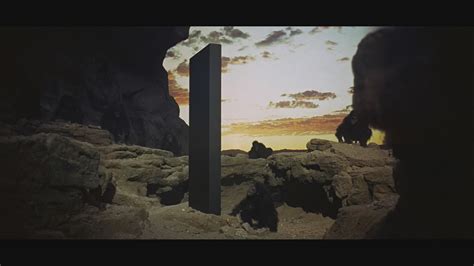
We flew for four and a half hours across the land, stuffed into a full Delta airliner four rows apart, no view of the land. No earbuds, no room to reach them in my shoulder bag under the seat, I watched “2001: A Space Odyssey” without sound. I could pay more attention to the camera angles (mostly no angle, straight-on symmetry) and “special effects” without the goofy music and dull dialogue. Check. The movie is just as pretentious, sluggish and enigmatic isolated as pure visual.

   Lately, I’ve been thinking a lot about a Theory of Man (as the science of homo sapiens would’ve been called in former times, before we cleaned up our language of gender and race). It’s remarkable to me that the most singular thing about the human creature, our web of connections through symbols of words, laws, rituals, faith, etc., is so little remarked on or understood. In “2001,” the idea that these things evolved is assumed in “The Dawn of Man” scenes, but these “things” of language are misplaced as “tools and weapons” (In a sense, symbols are our “tools and weapons,” but that is only a metaphor for a mystery.) The apes in these scenes discover using bones to kill prey for food, then to kill one another. A bone-as-tool becomes the spaceship a million years later, in 2001 Anno Domini. What caused the earlier evolutionary leap, and what will help us to the next stage? It’s a mystery, represented by the featureless black monolith. (The next stage, of course, is in Christ, the New Man, as we say unconsciously with “the Year of Our Lord” 2001.)

    Arriving in Portland, then brought to Salem in a car with windows hot to the touch (registered as a record-breaking 110 F outside on I-5), we eventually re-fueled on Chinese takeout and settled on couches to watch CNN and MSNBC for big news on a big thin-screen TV. The big news came right from my hometown, the familiar Fulton County courthouse where I went to settle Mother’s estate in 2017. The news was, in a sense, about us – as citizens of Georgia, we are the aggrieved party in The State of Georgia v. Donald Trump et al. 

    The grand jury indicted the former President and 18 others on racketeering charges. This is clever, to call what Trump tried to do openly and with the apparent agreement of his millions of supporters, a criminal conspiracy. All he did was to claim voter fraud, and use that claim to perform a kind of theater of pseudo victory. So? He’s an entertainer, a brand. But the purpose was to overturn the election of Joe Biden. To call this a “criminal conspiracy” is clever, and unique. What mobster was ever a former President, or ever acted so brazenly and publicly? (Well, maybe in a sense the populi always have a kind of amused moral laxity about knowing that famous gangsters were supplying them with bootleg gin, or like in Providence, that Raymond Patriarca was keeping Federal Hill safe using killer henchmen. Trump voters know he is “bad,” but they are amused and hope he might bring a more convenient order to their lives.) What is truly unique about this alleged criminal enterprise is that its purpose was to overthrow the outcome of a Presidential election. It’s not an exaggeration to call this an attempted coup, or the overthrow of American democracy.

    Back to that most human thing, our web of connections through language (the meaning of evidence, of logic, of facts and laws), the DA, Fani Willis, began by reminding us that all of the accused are presumed innocent. A grand jury looks only at “probable cause,” and needs only a majority of 23 (the equivalent of a unanimous jury of 12) and looks at only the prosecutor’s side of the story. A trial will be closer to “truth” as a contest, with rules and rights favoring the defendants. Proof must be “beyond a reasonable doubt.” Trump doesn’t have to take the stand. But can he stand that silently, missing his campaign rallies?

   The breakdown in language, in meaning, is a sign, like the 110-degree F on the car windows. Something is terribly amiss. Was this an attempted “coup,” an attempt against American democracy? Was this a “criminal conspiracy” and is Trump the Godfather of thugs? I don’t think we all agree on the meaning of these words. I don’t think we all agree, even, that the Fulton County Courthouse, with all its rules of evidence and procedure, is the proper place to resolve our differences on this. Within families, our solution is “Let’s not talk about politics.” Or religion. Or the news. We certainly won’t talk about politics when we visit relatives nearby, with a brother’s ex joining us. And here, with my Democratic in-laws, all the talk is in agreement that the Republican Party is sick and doomed.

Posted in Uncategorized | Leave a comment

The Frank Hamilton School of Music

[from my profile of Frank Hamilton in Salvation South]

I guess you could say I became part of the Frank Hamilton community before I met him.

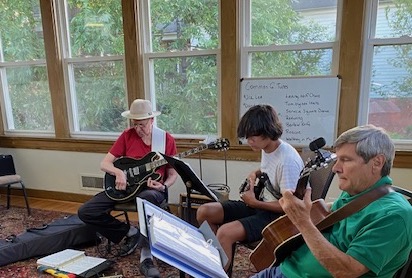
I realized this one Sunday afternoon as I sat listening to the Showcase, a recital of all the Frank Hamilton School’s classes at the end of each eight-week term. Our daughter, Sarah, would sing “Summertime” with her harmonica class. My wife, Libby, would play stand-up bass with her string-bass class and sing with my sister, Anne Preston, in their “Sing Your Heart Out” class.

And though I had taken no classes, the harmonica class was letting me play my tenor saxophone on “Watermelon Man.”

Each class performed on a tiny stage, in between school director Maura Nicholson’s cheerful groan-worthy jokes. This was in the administration building of what had been a sprawling Methodist orphanage across the street from Columbia Theological Seminary. Many in the audience were also performers, but some were not. The local physical therapist of my wife and daughter was in the audience (sitting beside Frank Hamilton, by chance) because they invited him. I recognized some old family friends near the front—local actress Carolyn Cook and her husband Matt Cook, a retired radio newsman my father had taught in college. I have no idea why they were there.

Sitting at ease in this audience, I had an epiphany. I turned to my sister, and whispered, “Do you realize that none of the women here are wearing makeup and none of the men have tucked in their shirts?” Most of them wore T-shirts. These are our kind of people, I said.

No, that sounds too exclusive. At the Frank Hamilton School, the cultural identity is loose, open, accepting, and honestly joyful. The variety of musical styles and musical skill levels signifies that openness. Music is a unifier. The humanity of the whole world is here.

As I was thinking about this, a young woman with beautiful dark Middle Eastern eyebrows above her black N95 mask played a hurdy-gurdy, one of her hands cranking it as her other hand played something fast with nimble fingers. The musical mode was one I had never heard before, and it made me smile. The teacher on the hurdy-gurdy was Melissa Kacalanos of New York. Her four adult students were all pounding out the same hypnotic rhythm on hand-held Goblet drums, the Egyptian doumbek. They were all beginners.

It transported us at no cost to another part of the world, to another age, and felt all the more that we belonged to the present in our home community.

Posted in Uncategorized | Leave a comment

Mushroom magic

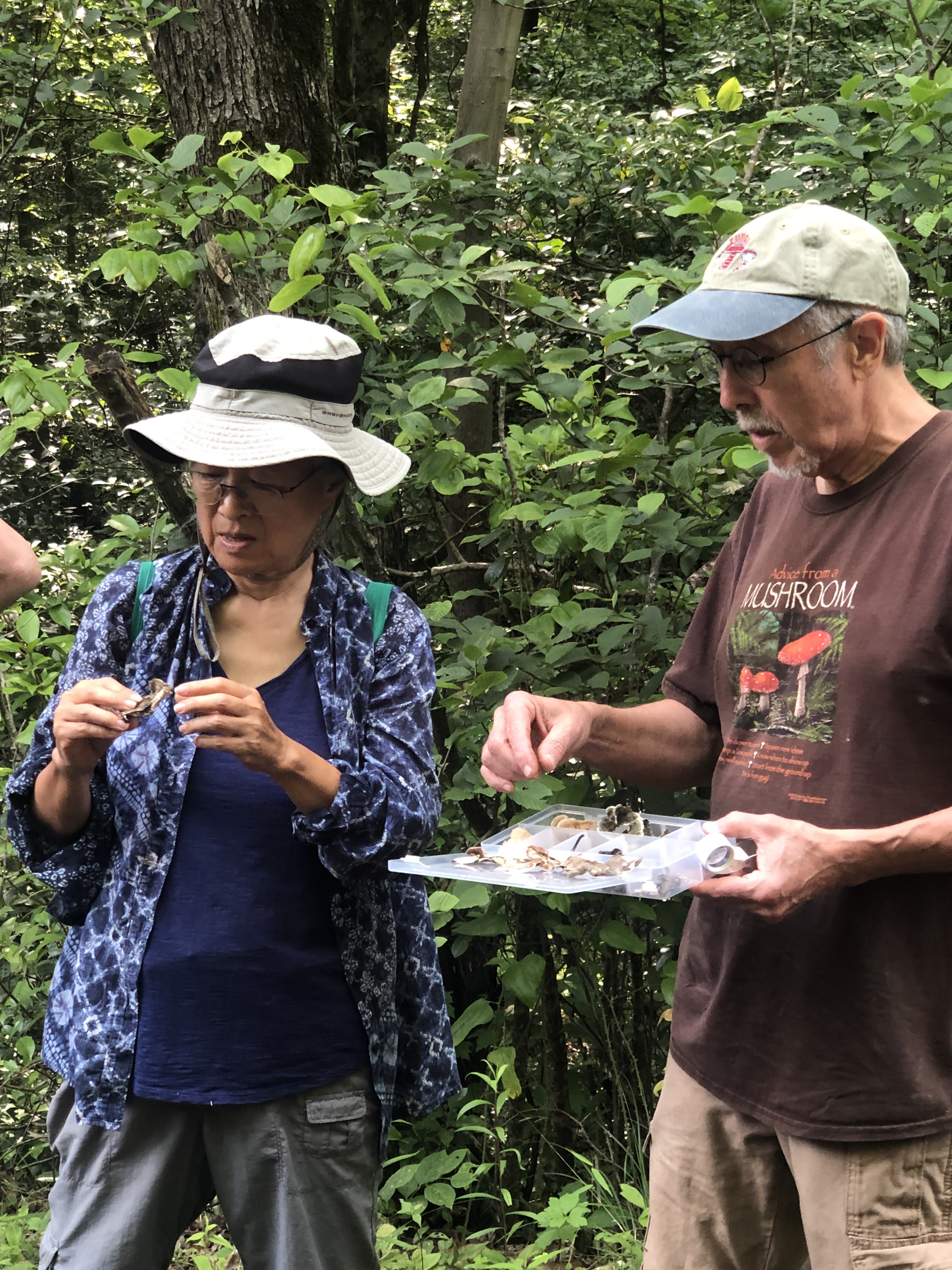
A “mushroom hike” is a slow-moving thing. The two organizers of our hike last Saturday were debating which trails to follow, thinking the 14 of us would cover a mile or two. But one of our two guides, Sam Landes, treasurer of the Mushroom Club of Georgia, stopped them. We’re only going to cover a few hundred feet every 15 minutes, he said.

The 2 ½ hour hike would cover about a half mile up the abandoned Drunken Spring Road and Corn Hill Knob trail, since that was the wetter choice, three days after the last rain. He and his wife, a pediatrician and researcher in economic botany named Cornelia Cho, were leading. They had come to this North Georgia mountain in a car with the license plate of “FUNGI” and Sam wearing a pro-mushroom t-shirt and bearing a basket with a plastic container for about two dozen specimens and two magnifying loops. 

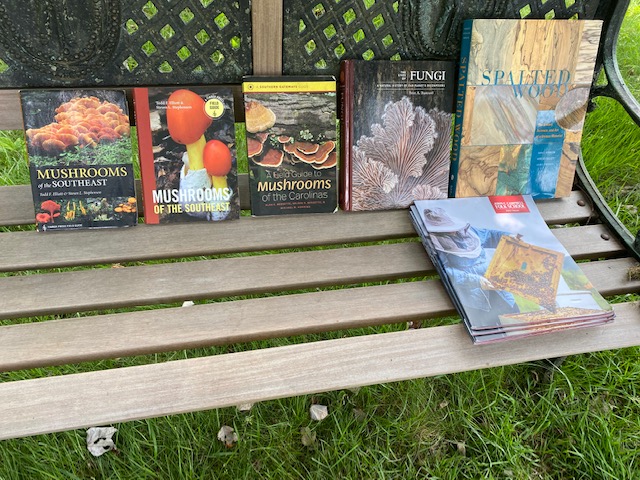
Our fungi hike also included four rambunctious dogs who got up to their dew claws in mud. After the hike, we gathered for a sweet picnic in a maple’s shade, piling goodies on bagel slices downed with bubbly. Sam didn’t give the summing up lecture I was hoping for, but he had spread five beautiful books on the old golf links bench – The Lives of Fungi: A Natural History of Our Planet’s Decomposers, Bunyard; A Field Guide to Mushrooms of the Carolinas, Bessette, et al; Mushrooms of the Southeast, Todd Elliott et al; Spalted Wood, on the lovely blue-green wood of the fruited Emerald elf cup (chlorociboria aerugiosa), and catalogues to the Campbell Folk School. And he did answer questions while I took notes.

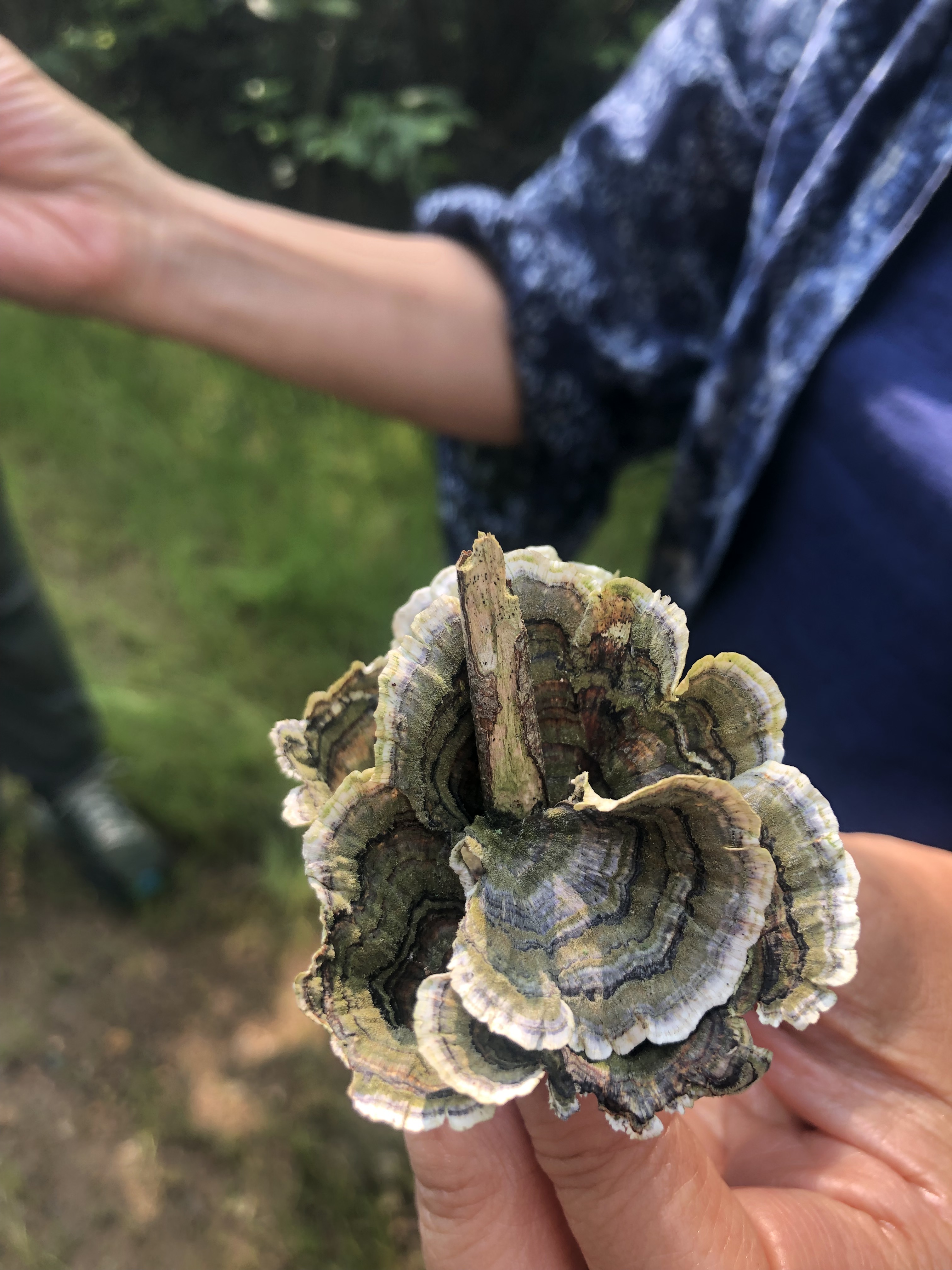
Too many kinds of fungi fill the woods for our decomposing brains. But there was something exciting about the knowledge Sam and Cornelia were wasting on us. They spoke Latin names of genus and species of Russula, morels and Amanita, naming parts too small to see without a loop: gills, spores, and the tiny pin holes on the underside of the polypores. They told hopeful stories of natural medicinal values, like the extract from the true Turkey Tail (pictured above) that can boost the immune system against certain cancers, and the spit poultice from the common plantain weed that once stanched swelling when Cornelia was stung in her hand by a few yellow-jackets, she told us. Sam would vanish into dark bracken grottoes to find the tiny red pimples called Wolf’s Milk or a slime mold (not a fungi but a mycoparasite, not to be confused with mold in your house). He would explain the morphology of what you see on the ground or on rotting logs, and what you don’t see, the vast networks of mycelia that communicate and transact energy with “mother trees” in ways that make the science of it sound mystical. Or at least Lamarkian. 

Sam and Cho brought us more than the names we couldn’t remember, let alone spell. They opened our eyes to a glittering reality deep in the dank cycles of life at our feet, a magic we previously only suspected in our savage love of these familiar trails.This is what Sam and Cornelia actually left in our brains, the experience of the naming that science does, but in this case narrowly focused on the life of our wild woods. In a dazzling documentary I watched later on Netflix, “Fantastic Fungi,” Michael Pollan describes fungi enthusiasts like Sam and Cho as being in the tradition of 19th century amateur botanists and naturalists, the scientists of their day. Whether we remember the names or the parts, we know that these have names and categories that have been discovered by “amateur” scientists like Sam and Cornelia.

We are now a part of that, the shared world of human language at the delectable tip of human curiosity (like the tip of cat briar we were invited to chew like deer). Language is the human mycelial mat, concepts mysteriously networked in our neural pathways and shared everywhere in our books, picnic conversations and iPhones. We feel sanctified by a collective curiosity, stalking fungi that emerged even before the flowers, the angiosperms of our 100-million-year period (represented by what remained of the pink lady slippers at our feet, flowers that bloomed briefly in April). They emerged even before lichen, which Sam described as “fungi that has taken up agriculture,” usually two merged fungi with a bit of algae to share its photosynthesis.The fantastic fungi were here even before the photosynthesis of plants, which let animal life flourish, We are learning how the trees cooperate in a beautiful communication and trade policy with fungi, which sequester 70% of the carbon that trees breath in from the air, thank you very much.

They were here before us, and as the documentary says, they’ll be here long after, if we don’t learn how to live in harmony with these efficient underworld decomposers and resurrectionists.

Posted in Uncategorized | Leave a comment

Three Little Words

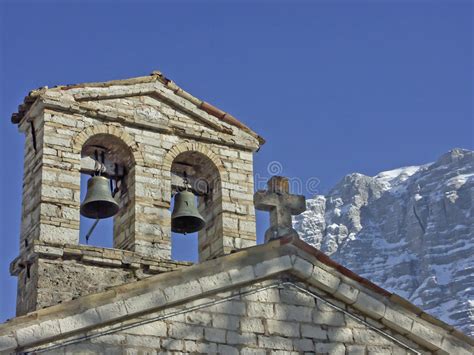
The two of us once hiked far into an enchanted forest in Italy called the Sybillini Mountains. From a deep ravine with dancing waters we climbed a path up and up through a stand of pristine trees, mostly some kind of birch I think. The path got steeper, the trees more uniform and a wind in the trees stronger, as if to send us a message through the living leaves. (I wish I could tell you what kind of tree.) At the remote-seeming peak, a vision: a classical stone chapel, open to us. Inside the small sanctuary, apparently maintained by monks but deserted when we entered, an altar had these Italian words engraved, “LA VIA, LA VERA, LA VITA.”

This is what Jesus said he was — “I am” — when Thomas asked him at the Last Supper (John 17), “How can we know the way?” How interesting that the three words have similar spellings in Italian (and Latin). The way, VIA, has the same first and last letters as the truth and the life. And the “Way” becomes the “Life,” in Italian, if you insert a “T,” which is sometimes taken as the Cross.

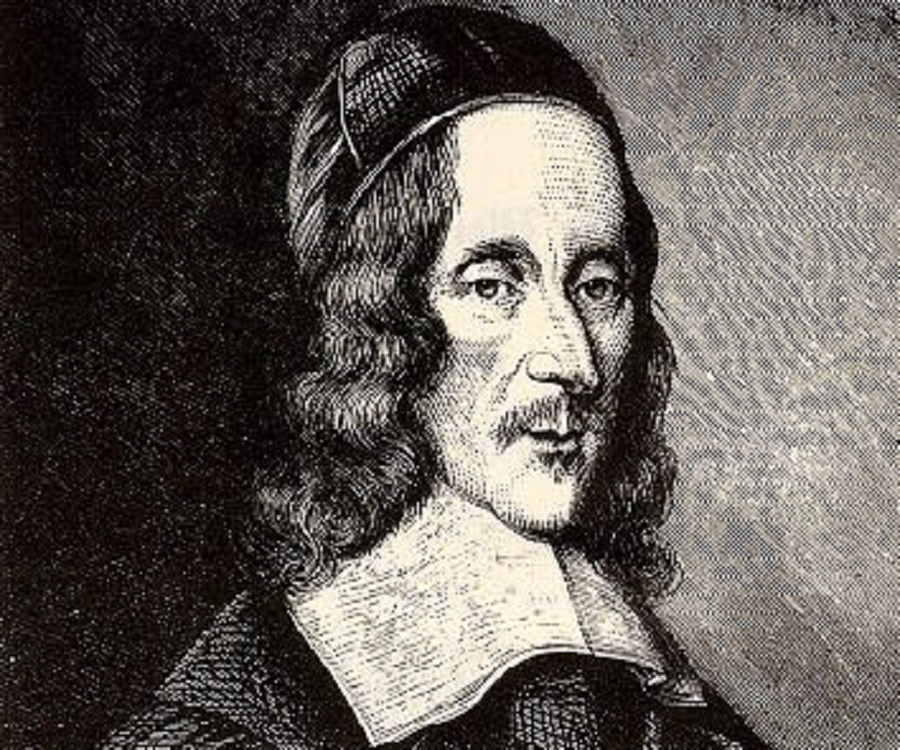
George Herbert, the 17th century poet and Anglican pastor, played with these three little English words in a poem that is set to the 20th century music of Ralph Vaughan Williams as Hymn 487 in the Episcopal Hymnal.

Come, my Way, my Truth, my Life:
Such a way as gives us breath;
Such a truth as ends all strife;
Such a life as killeth death.

Singing this, as we did last Sunday in church, you might miss the tight verbal patterns, let alone the packed meanings. The stanza is rhymed A-B-A-B. The second, third and fourth lines all start the same way, “Such a,” like three silver clasps of those jewels, Way, Truth and Life. But after the first line, the upper-case words that represent Christ Himself, become the lower-case generic words, as the divine became incarnate in the human. So, “Such a” connects the singular with the universal, the temporal with the eternal.

Look closer at the interior rhyme scheme. The last word of the second line, “breath,” is an off rhyme with the third word of the next line, “truth.” Similarly, the last word of the third line, “strife,” is rhymed with the third word of the next line, “life.” So the whole verse is woven together in an intricate almost mathematical design, exhibiting the idea that the sound and structure of language itself can reveal beauty that is nested within its meaning. When the meaning is metaphysical, the effect in language is what made George Herbert one of the Metaphysical Poets, as John Donne and some other contemporaries are called.

This tight pattern of English word-sounds is also maintained, remarkably, in the second and third stanzas of this three-verse hymn. Herbert invokes two new trinities to echo Christ’s self-naming triplet of the Way, Truth and Life, making an overall design of three. The second verse:

Come, my Light, my Feast, my Strength:
Such a light as shows a feast;
Such a feast as mends in length;
Such a strength as makes his guest.

And the third and final verse:

Come, my Joy, my Love, my Heart:
Such a joy as none can move;
Such a love as none can part;
Such a heart as joys in love.

The ingenious design weaves like a braid, but it may be too much. It strains the meaning. Although “mend” can be an intransitive verb, meaning to increase in value, a feast that “mends in length” makes little sense, unless you take “in length” to mean lifelong, or eternal. What kind of joy can none “move”? What kind of love can none “part”? It is biblical language, of course, and the idiom may be partly lost to 21st century English. Also, to hold the design, Herbert needs “move” to rhyme with, or at least look like, “love.” And he needs “length” to rhyme with “strength,” which means he needs a one-syllable intransitive verb to connect with length. Since the feast is Christ’s eucharistic Body, maybe “mends” is the perfect and porous verb. But much of this poem doesn’t make sense.

How does such a strength “[make] his guest”? I think it means the Lord (“Strength”) makes (me) his guest.

This may be explained by a feast in another poem, “Love (III).” This most well-known of Herbert’s poems is from the point of view of a wayfarer who arrives, let’s say at a tavern on the road, and is welcomed by Love, the ultimate allegorical figure.

“Love bade me welcome,” the poem begins, “yet my soul drew back.” The poem is a dialogue, a tender disagreement, between Love and a guilt-ridden traveler. Love,“sweetly questioning” the dusty traveler, finally leaves him cornered. So he offers to serve. She (for “quick-eyed” Love seems very feminine here) abruptly cuts off the dialogue. “You must sit down, says Love, and taste my meat: So I did sit, and eat.” No more argument. He is made Love’s guest.

Those last two lines give me the shivers. This is the poem that the writer Walker Percy mentions as giving him a final push into his conversion to the Roman Catholic Church. Simone Weil, the French philosopher whose conversion to the Roman Church was never completed, describes reciting the poem to herself when she was suffering from intolerable headaches, and then having Christ descend and take possession of her. For me, studying the poem in a college class called “The Metaphysical Poets” was not that intense. But it may have been the start of something important in my life, on the way.

Posted in Uncategorized | Leave a comment

The “Truth” in a Pluralistic World

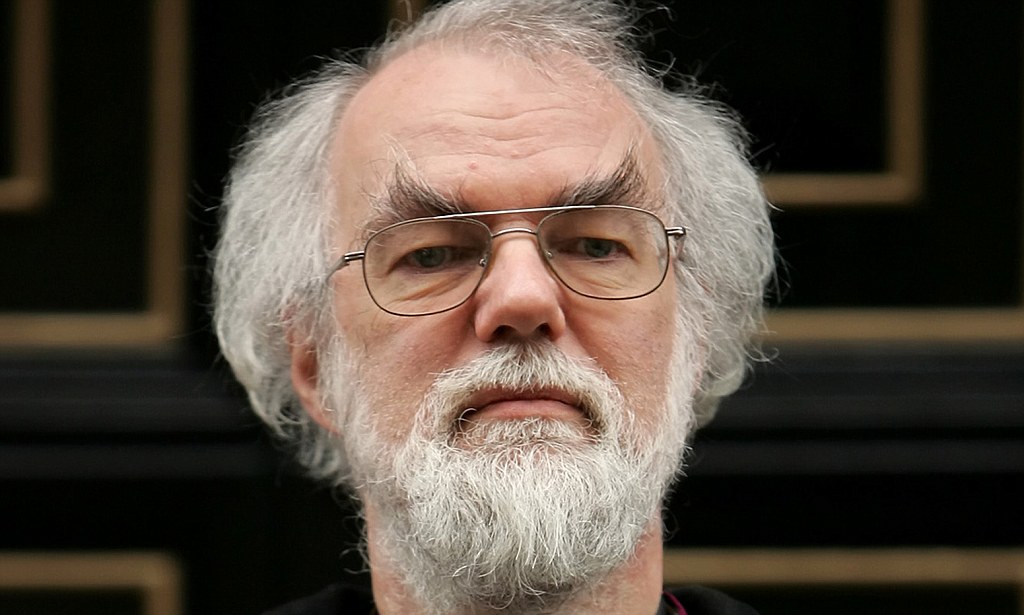
Post script to the post “Three Little Words”: Jesus’s answer to Thomas in the Gospel of John, that he is “The Way, the Truth and the Life,” makes a claim that is particularly hard to defend, much less understand, in today’s pluralistic and reasonably offended world. Rowan Williams, the intellectual Archbishop of Canterbury (2002-12) with the wonderfully upswept eyebrows and wizard’s beard, unpacked this challenge in a lecture he gave in 2010.

( LEON NEAL/AFP/Getty Images)

The problem: The claim that Jesus is THE Way, Truth and Life is aggressively exclusive, asserting what Williams calls an absolute and unique “finality.” It’s a position that can embarrass sensitive Christians in the face of Jewish continuity, other beliefs, and non-belief (even of dear friends and family).

Here is the former archbishop’s lecture. It’s carefully set out, so I can’t adequately simplify it. But to try to keep it straight in my head, or if you don’t read the whole thing, here’s my outline of what Williams calls the three “great objections” and his answers:

I. Modern Objections

  1. Moral – For God to base salvation on one chancy, historically embedded “way.”
  2. Political – That it’s a recipe for contempt of, or crusades against, outsiders.
  3. Philosophical – How can the final “truth” be born in a single place and culture, and apply to everyone always?

II. Problems with these Objections

  1. Gospel is not saying “or else!” to outsiders, but speaking only about a vital relationship with Jesus as the “final” form of everyone’s full humanity – what each person was always meant to be.
  2. To say this truth isn’t for everybody is to divide humans and humanity into various pieces, condescending to some, making Christian faith relativistic.
  3. “The Way” is not an abstract principle, but is more like a walk, a personal discovery, an individual’s transformation.

III. Modest Answers to these Objections

  1. Moral – It would be more unfair to deny that all have access to an ultimate Father-Son relationship as the stamp of full humanity, the eternal in our nature.
  2. Political – This is God’s work, not ours in any particular cultural form. Understanding that, we become humble about what we know and claim, and more critical of human systems, racism, bigotry, arrogance, etc.
  3. Philosophical – There is “something about human nature which is beyond change and negotiation; something about the way we are as humans.”

So how should Christians, believing this, relate to other faiths and nonbelievers? Williams says: With open minds and hearts, on the principle that there’s much to learn from others if you are free to live in the true fullness of your human nature and in expectation of its coming to all (including yourself).

Posted in Uncategorized | Leave a comment

No Accident: Sharing another person’s day in court

Those ubiquitous traffic accidents called fender-benders can take on an after-life all their own. They send out invisible tendrils that attach, as if by a sticky toxic resin, to body shops, insurance policies, faceless insurance agents, lawyers, police reports, traffic charges, court fees and a Kafkaesque limbo. And that’s just for a white man like me. But this one was the other driver’s fault.

On Nov. 28, at the blinding half-hour when the setting sun rifles out West Howard Avenue in Decatur, Ga., a westbound car turned into the driver’s side of my 2010 Toyota Yaris. I was driving eastward in slow traffic through a green traffic light, the sun at my back. The other car was making a left turn at the little wish-bone jag of Atlanta Avenue that crosses the railroad tracks. I was going slow enough to veer right a little to get around this out-of-its-lane other car, but it kept coming. Like in a slow-motion dream, the other car didn’t decelerate until it plowed along my driver’s side. We both pulled our cars into the conveniently located service station. A police cruiser pulled into the station too, conveniently right behind the other car.

When I saw the two ladies in the other car, I felt a strong impulse to minimize their fault, which was obvious enough and ready to be documented by the female police officer approaching us. The driver was a Black lady in her late 60s. The passenger was her mother, in her 90s. As I learned, they were heading home after early voting in the runoff election for the U.S. Senate, a historic contest between Democratic incumbent Raphael Warnock and Republican challenger Hershel Walker – two larger-than-life figures in our national political drama. I was also heading home after voting. I had voted for Warnock in the runoff, and in fact had been canvassing for him earlier that day. All three of us were wearing “I Secured My Vote” stickers. They voted for Warnock as well, I learned later.

Early voting in DeKalb County was taking up to an hour of waiting in line.

When two cars collide, or any dramatic “accident” happens, one wonders about the preceding minutes and hours that made that event possible. Our waiting in line to vote sacrificed just the amount of time needed for the other driver to be going home into a blinding sunset exactly when I was driving by.

I told her I didn’t want to cause her any trouble, since there seemed to be little damage done to either car, and my humble Yaris could live with the scars. I was thinking of how a little accident like this could be a nightmare for anyone at fault (and I could imagine being at fault in some other accident, some other day). For her, it could be worse. I knew that for a Black person in a 20-year-old car, a woman taking care of her elderly mother, those entanglements with insurance, court costs and traffic offenses could be ruinous. She must’ve sensed my dilemma, because she offered this bit of reassurance.

“Everything happens for a reason,” she told me.

The police officer, young, white and with a subdued air of self-confidence, asked if I wanted her to write up a report – which would be a charge against the woman of failure to yield while turning left. The fine and court fee for this charge, we would learn later, would be $223.25. Repairing my car would be more, if I took it to a body shop. I hesitated.

I could let the whole thing drop. But life experience told me this needed to be on the public record. Years ago, I barely saved four of us in a Camry I was driving when an 18-wheeler pushed us halfway out of our lane on an interstate in Virginia. I took pictures and got the trembling Russian driver’s name. But it was near midnight and bitter cold, so we didn’t wait in that dangerous breakdown lane for police to arrive. Months later, I learned my insurance company had settled with the trucking company over its claim that the accident was my fault. There was no police report to contradict the claim. As a former journalist, too, I want facts to be verified by a public record.

Yes, I said, write it up, I told the officer. But as I told the woman driving the other car, I will testify in your favor. She said she knew she would be charged and need to go to court, but she didn’t seem to blame me for requesting the write-up. It was her fault, she said. The sun had blinded her and she didn’t see my car.

I am not unaware of the difference between a white man like me going to court, for whatever reason, and a black woman going to court. Having covered trials and court filings as a news reporter, I view the criminal justice system as a flawed but essential foundation of God-given rights. But I’ve studied the history. When the Swedish sociologist Gunner Myrdal researched race in the South for An American Dilemma (1944), he found that “Negroes” never enjoyed the trust that whites had in the courts. They were terrified. “Whites were the judges, the jurors, the bailiffs, the court clerks, the stenographers, the arresting officers, and the jailers,” as Gene Roberts and Hank Klibanoff wrote in The Race Beat. “Only the instruments of execution. . .were desegregated.”

This split-screen reality of the courts left a generational trauma for Blacks, like a fear of big dogs or deep water. Young Black men who already had run-ins with the law would instinctively run when cops told them to stop and submit. That’s what happened in Atlanta in 1966 when a white police officer stopped Harold Louis Prather to question him about a carjacking. He ran, and the policeman shot him twice in the hip and side. Bleeding, the youth collapsed on his mother’s porch and blamed the cop. By the end of the day, the Summerhill neighborhood was in full riot, with Stokely Carmichael and Mayor Ivan Allen playing historic roles.

In January this year, what happened in Memphis to the 29-year-old Black photographer Tyre Nichols seemed similar. The cops, this time, were Black, and the FedEx worker apparently had no police record to prompt him to run for it. But after an initial “confrontation,” he did run. And, like Prather in Atlanta, he ran to his mother’s house, calling “mom” as the officers beat him mercilessly. He died three days later.

Our hearing at Decatur Municipal Court was scheduled for Jan. 19, a weekday, at 6 p.m. This may have been an inconvenient time for a judge and other city workers to hold court, but it was good to accommodate people who need to work during the day. In the bright, modern courtroom sat about a dozen adults, all of them Black, waiting respectfully. Sitting closest to the door was the driver of the car that hit me. We greeted and I sat beside her to join the wait. A middle-aged white man in a coat and tie came in to sit at a desk near the front. I would learn that this was City Solicitor Larry Steele.

There’s something unnerving about being the only white person in a courtroom full of black defendants and their kin waiting for justice, when in comes a white Solicitor. Of course he represents one side of this evolved English system we have, with our rights from the Fourth, Fifth and Sixth Amendments of the Constitution guaranteeing presumption of innocence, equality before the law and all that. In terms of the law, his race was irrelevant. I knew that.

But it was a relief to me when “All rise” was called and the judge took her place in the seat above all, Municipal Court Chief Judge Rhathelian Stroud, a Black woman. The defendants came before her when called. She was serious, but reasonable. One man who looked to be in his 60s couldn’t pay his fine and court fees, so he was given 13 hours of community service to work off the $200 debt, instead of jail time. He was sent away with instructions to get his community service orders.

Later, I learned something about Judge Stroud from reports in the Atlanta Journal-Constitution from December 2017. At that time, another judge with Decatur Municipal Court, Lindsay Jones, had sentenced a woman to spend two nights in jail – starting with the night of her 20th wedding anniversary – for contempt of court. Judge Jones attacked the woman’s account of a minor traffic infraction by playing a video of her car in an intersection under a red light, then jailed her for “perjury.”

The woman, her husband and her lawyer, all of them Black, were quoted in news accounts calling this punishment outrageous and embarrassing.

“This is what he does,” the woman’s husband told WSB-TV. “If you dispute a ticket in this court, you’re going to jail.” The attorney added: “We have to have a day of reckoning over this. This can’t continue to happen.”

Chief Judge Stroud, who was in effect Judge Jones’s boss, learned of the penalty and met with Jones, who is an adjunct law professor at Emory University with a long history of advocating for civil rights and multicultural understanding. According to an email Judge Stroud sent to the City Manager, she listened to Jones explain what he did. She shared her “concerns and subsequent expectations” with him, and Jones resigned. The woman was released from jail after only one night.

This was the same Judge Stroud who called our names to come forth. The woman driver pleaded “not guilty,” which marked the start of her bench trial. The Solicitor and the female officer were standing by a lectern on the left side. The driver who hit my car was standing at a lectern on the right. I was told to stand on the left with the other two. That would put the only three white people present together.

“Your Honor,” I said from the Solicitor’s side. “I’m a friendly witness.”

Well, the judge said, you can go over to be with the Defendant, which I did. We were sworn in.

Solicitor Steele presented his case. The officer gave her report of the accident. The Defendant acknowledged that the officer’s account was accurate, but that she was blinded by the sun, and “Mr. Cumming and I talked and he said. . .”

“Objection, your Honor,” said Steele. This would’ve been hearsay. So I was called on for my testimony. I explained that I considered not pressing charges, but did so only to have a record on what happened. There was little damage and no repair costs, I said. The judge asked if I had reported it to my insurance company. No, I hadn’t.

The solicitor did not seem happy with how things were going. He pointed out that the Defendant had broken the law. I recognized that he was just doing his job, protecting the safety of the public. From his perspective, I was getting in the way. I had no business being here unless it was on his side, since the “victim” in a crime like this is really the State, not me.

Judge Stroud was ready to pass judgment. Guilty as charged. Then the judge suspended the entire $223.25 penalty.

We left, relieved.

A few weeks later, I received a card from the Defendant, a woman who had retired after more than 30 years working in cancer wards at Emory University Hospital and the adjacent Children’s Hospital of Atlanta. The card was a Hallmark thank-you with generic printed words “for everything you have done. . . for everything you have given. . .”

She also wrote in her own hand: “Thank you for your help. . . It’s good to know there are still some good people around.” Everything happens for a reason, but my reason was not to be called good. It was, in part, to see the accident from her perspective, illuminated, in a sense, by the light of the day’s sun.

Posted in Uncategorized | Tagged | Leave a comment

What the Angels Said

“Fear not.” Someone should preach that sermon. Or write a book on it as a theme that runs throughout the Bible, from Abraham to Paul. The very announcement of Jesus’s birth to the shepherds begins with that assurance, “Fear not.” It’s not just a theme, but the very nature and sign of the salvation the Bible maps out.

There’s so much fear in the land today, and loss of self-confidence. Reporting the news, for me, took a measure of confidence and a certain fearlessness. Now, people are afraid of what they read in the news, and afraid OF the news. They go instead to websites that make them feel good by reinforcing what they want to believe.

But this leads to a different kind of fear. In dark corners of the web, where social media sites ooze disorganized propaganda, fear sells. Be afraid, these oozings say. Afraid of liberals. Of transgendered teens, and the teachers that coddle them. Of CRT. (I remember when that meant Cathode Ray Tube, i.e. desktop computer, then Criterion-Referenced Tests.) Of secular humanists, socialism, gays, crime, Democrats. “Them.” They are behind the inflation you suffer at the grocery stores. They are behind a “soaring” crime rate. They rig elections, open our borders to drug dealers and terrorists, promote abortion, want to take our guns.

An op-ed I read recently made a convincing argument that the big-tech social media companies like Facebook and Twitter have a huge gap in their filters against bad actors. They filter “hate speech,” but not “fear speech.” They censor comments that are deemed racist, homophobic or antisemitic, but not those comments that merely warn of the dangers that any particular group allegedly pose to your lifestyle, or life. Be afraid, they say.

I don’t know how that can be filtered without stifling healthy free speech and important intellectual grit. I’m not even sure I agree with how Facebook defines “hate,” let alone how it might take on “fear.” Still, the drumbeat of conspiracy theories and “them” feeds a culture of fear. The op-ed argued that this kind of fear speech is what led to the Jan. 6 insurrection and the Nazi death camps. The dark depths of mass fear can tip the scale of civil society into the torch-light mob of a lynching bee or to genocide.

Now, here’s one of those fears: They are coming for our guns. Heather Cox Richardson, the historian whose “Letters from an American” start my day, makes a good case for “the right to bear arms” applying ONLY to individuals who belong to a state-supported militia. That’s exactly what the Framers meant when they wrote the Second Amendment, she says, although she acknowledges that the wording is elusive (and has too many commas, in my opinion). She quotes an 1840 ruling of the Tennessee Supreme Court that makes it clear:  “A man in the pursuit of deer, elk, and buffaloes might carry his rifle every day for forty years, and yet it would never be said of him that he had borne arms; much less could it be said that a private citizen bears arms because he has a dirk or pistol concealed under his clothes, or a spear in a cane.”

How did the NRA (formed in 1871 to promote marksmanship and sport shooting after the Civil War) turn into the lobbying giant of Movement Conservatives from the Reagan presidency to today? It was a marriage of convenience – opposition to business regulations and social programs, Richardson says. And it worked on fear of “gun control,” something that had previously been a strong bipartisan consensus. And so we’re left with a greater fear – that when we send our children to school or attend a concert like the Mandalay Bay country music festival in Las Vegas (where 60 were killed), another mass shooting might take place, for no reason.

I didn’t feel any hint of that fear as we walked down the four closed-off Ponce de Leon city blocks between rows and rows of arts & crafts tents last night. Four days ago, seven miles west of here, an “active shooter” killed one and wounded four in a waiting room in a Midtown Atlanta medical high-rise. But this is Decatur, on the Square, with the kind of open yet rich community culture I wish every community had.

Posted in Uncategorized | Tagged , | 1 Comment

“Refuge”: Across the Great Divide

Heval Kelli, a Kurdish Syrian Muslim refugee living in Clarkston, just outside the Perimeter from here, exudes the kind of human empathy you can see in his very being. He listens quietly and attentively, and in responding to what even the most troubled or inarticulate person says, he seems to have just the right words. We saw this in the documentary “Refuge,” which five of us watched in a nearly empty Plaza theater Wednesday afternoon, the matinee (after we were turned away from the sold-out premiere on Sunday).

The man’s empathy, half saint-like, half bemused with irony, has three layers, I think. One is his experience as a refugee. His father was tortured. He spent his youth in a refugee camp. By the sheerest random luck, he got to America a few days after 9/11, and was sent to Clarkston, now called the most ethnically diverse square mile in America because of its welcoming structures for refugees from places like Syria and Somalia. A second layer is his quiet religious practice as a Muslim. He prays in the traditional way five times a day, and performs the duties of compassion and peace from the Koran. And finally, there’s the overlay of being an Emory cardiologist. He is trained well by the institution and Hippocratic oath to pay close attention to illness of body and soul in others, both meanings of the word “heart.”

We grow cynical about doctors, who seem to pursue specialties that separate them from the whole person, specialties that pay a lot more than general practice. But when I see Dr. Kelli, “call me Heval,” in the film, I think of Libby’s visit to a Hispanic cardiologist at Emory’s hospital on North Decatur Road, and my visit to a native Indian periodontist yesterday, Dr. Ash. They both exuded the same feeling of compassion as Dr. Kelli, which I now associate with a special gratitude and patriotism I sense in American immigrants who have achieved the height of success in the healing arts. Dr. Ash put his hand on my shoulder as he came from behind while I sat pitched back the dentist’s chair, and touched me the same way when he left. When I complained about my recent experience trying to get some reimbursement or explanation for the $1,042 I paid for getting a crown at this same big dentistry office, he agreed with me wholeheardedly about the shame of the U.S. not having universal healthcare. Even his native India, he said, has a more humane healthcare system. There are several doctors in his extended family, and all are for universal healthcare, he said. And he is horrified at the prevalence of guns here . .  He seemed to say without words, about guns: “Don’t get me started.”

Heval was an obvious protagonist for the two University of Virginia alumnae who decided to make this documentary, “Refuge,” after they were shocked by the Unite the Right rally in their beloved Charlottesville in 2017. There’s a scene in the movie where Heval welcomes a Republican Primary candidate for governor who arrives in Clarkston, by some miscalculation, on his “Deportation Bus” tour of Georgia. Heval offers him some good baklava, which Williams samples with the forced courtesy of the campaign trail. (Williams ended up with less than 5% of the primary vote, while Kemp, running ads of him hunting illegals with a shotgun, went on to barely beat Stacey Abrams that year.)

The heart of the documentary is about Heval’s relationship with another man, the extreme version of the type who would vote for a Williams or a Kemp. Chris Buckley is an Army veteran living in Lafayette, in the northwest corner of Georgia near the Tennessee and Alabama state lines. The relationship makes a powerful case for an answer to “hate groups” like those at the Charlottesville rally. The film shows the effectiveness of getting those who resent the Other to know one of them well. Chris, a heavily tattooed son of an abusive father, came back from traumatic experiences in Iraq and Afghanistan with an addiction to pain meds that evolved into a crystal meth habit that was tearing him away from a wife and son. He found his way clear of drugs with a 12-step program. But it goes further. A counselor with “Parents for Peace” introduces him to Heval, on the notion that a 12-step program to overcome a ritualized hatred of Muslims (Chris had joined the local Klan) required a relationship with a Muslim. It worked, creating a road show out of Heval and Chris with their message, and this powerful documentary under the Katie Couric brand. (Couric, who briefly replaced Dan Rather as anchor of CBS Evening News, also went to UVa.)

One scene that struck me powerfully was Heval first driving through Lafayette, Ga., in his late-model black Mercedes-Benz. He is shocked by the poverty, the hovels and trailers, the despair that makes such communities the ruined gardens of opioid addiction or make Trump’s gilt-edge delusions so appealing. I feel the heartbreak of this landscape. I have seen it in Rockbridge County, Va., and in Pickens County, Ga., so close to the bountiful nature and communities I have loved. From a purely compassionate vantage, without the politics or sociology, this glimpse of rural poverty, where mostly white Appalachian folks dwell in a forgotten or stereotyped America, floods me with love and sympathy. Yes, these folks are resentful. Why wouldn’t they be? I also understand a very different resentfulness – the bitter resentment of a young Black Lives Matters activist or some white allies who empathize with that Black experience. But to the forgotten or demeaned Appalachian folks, it must be appalling that the “resentment” of young BLM protestors is presented sympathetically by the “liberal media” while the culture calls their resentment “hate” and “racist.”

I shouldn’t judge like this. Heval doesn’t seem to judge. He merely utters the sounds of sorrow and shock, a compassionate refugee driving through a land like his own war-ravaged homeland, astonished that Americans could forget these children of their land and history.

Posted in Uncategorized | 1 Comment