Castle in the Clouds

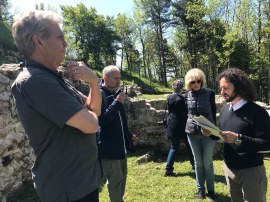
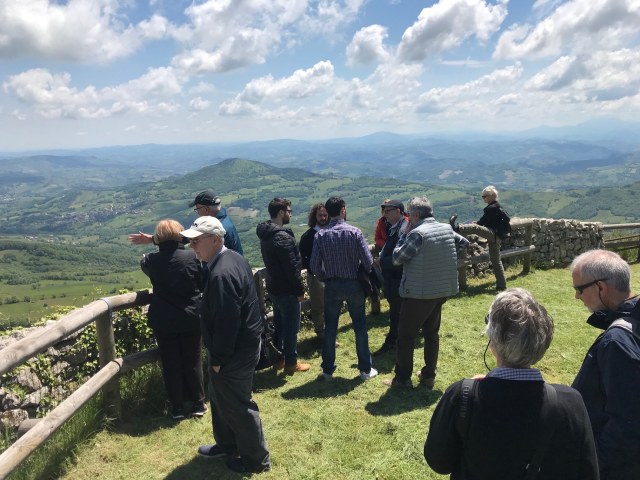
We’ve all seen ruins that look ruined – the wobbly low lines of old stone that a Park Service guide or historical sign tells us are the original foundations of a 17th century church or fort. Picture broken low walls like that on about six levels of the steep crest of a mountain about 40 km from the Italian Adriatic. Us on mountainThe higher we climbed between these stone walls, along paths freshly weed-whacked (for us? – eight American journalism instructors who bring out several solicitous local dignitaries), the more ancient the history.
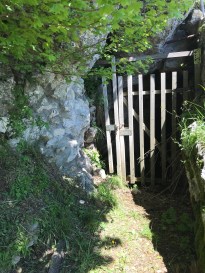
The top two levels are maybe 10th or 11th century – the Dark Ages. Darker still: a cave here behind a locked gate is said to have held evidence of Neandertal Man, bones and stone weapons. Of course. Life between the fall of Rome and about 1400 was Dangerous – like pre-historical life before Rome. And this rocky promontory, Monte Copiolo, was a rare Safety. Our guide calls it the Helm’s Deep of Lord of the Rings. Or at least it became Safe when a few strong military leaders in the Carpegna family (circa 10th-11th C.) and then the Montefeltro family (12th-14th C.) built this defensible Castello (“castle” in this Italian sense means walled city).

Cave on mountain

A cave near the top of Il Castello di Monte Copiolo nel Montefeltro where Neadertal remains were found.

It’s hard to imagine this as a “city.” But all the pieces are here. A church and hospital on the lowest level, for pilgrims sojourning to or from Spain’s Santiago or the Holy Land, or victims of the Black Plague. A huge cistern under Count Montefeltro’s control. A quarry (the whole mountaintop is a quarry turned into a castello). A Rocca (fort) with space for knights (Cavalieri) to assemble and drill before suffering the kind of sword-piercing we saw in skulls in the museum in the village of Montecopiolo.

As we stand on the breathtaking summit, Rusty Greene, the JMU professor with theatrical poise (he was originally a theater director and professor), holds forth with a theory. Is it possible, he asks, that the spark that lit the Renaissance began right here? Here on this patch of grass, Montefeltro could imagine the Piazza Ducale of Urbino? Here were Urbino’s walls against enemies and the houses of artisans, the Duomo and Palazzo, all in miniature. It seems a plausible theory, since our guide, University of Urbino archeology professor Daniele Sacco, had just told us that this mountaintop did serve as a prototype for Urbino, where the 15th century Frederico Montefeltro conjured up the Renaissance with painters Raphael and Piero di Francesco and philosophers and mathematicians extemporizing in the palace of Castiglione’s The Courtier.

Sacco and skull

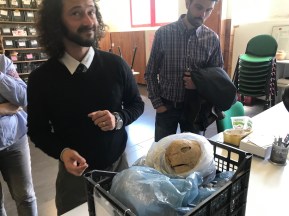
Professor Daniele Sacco and the skull of a head-bashed knight.

But Professor Sacco, who looks like a young courtier in a Zeffirelli movie, says no. There was nothing on this mountain to prefigure the Renaissance (although plenty of lovely pottery shards in the museum below). It was all about power, he says. The Montefeltros were military overlords. What they developed at Montecopiolo was confidence in their power, their military might. So when they took over Urbino, 30 km to the southeast, they built it into a showcase for their power. The philosophers and mathematicians were summoned from Northern Europe. And the art grew from there.

I gaze at the mountains and the sea from this height. San Marino. San Leo. Gorgeous clouds and the green spring land “plotted and pierced—fold, fallow, and plow” (from Hopkins’ poem). Maybe the Renaissance, the re-birth of light out of Darkness, came from so much gazing at such beauty from such a height for two or three hundred years. In relative safety.Group on mountain

Posted in Uncategorized | Leave a comment

Late night at the Urbino Jazz Club

Urbino Jazz Club, Urbino, Italy. May 28, 2019.

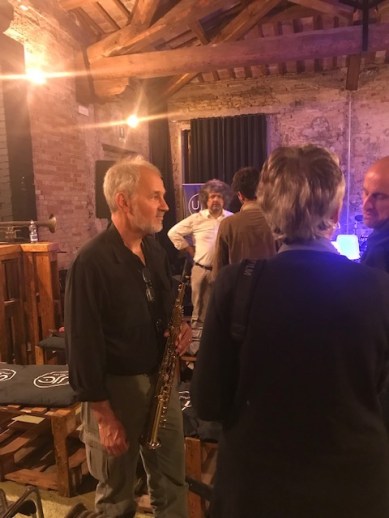
“Bravi! Bravi!” someone from the Japanese opera company added over the applause. The 11-piece improv ensemble had finished about 40 minutes of playing a mostly unstructured experiment in free jazz after quick rehearsal that afternoon. The ensemble had never played together before: Two percussionists (a trap set and a conga set), three guitars (one taking the bass line), two accordionists (of course; this is Italy), and four saxes (three altos and the soprano of my ieiMedia colleague Michael Gold, now playing jazz in San Francisco almost full time since retiring as a magazine consultant).

Michael at UJC

Michael Gold, at the Urbino Jazz Club

The conductor  was a famous jazz accordion player, ad-libber and showman, Simone Zanchini.

Zanchini is a triple maestro – a phenomenal technician of the accordion, a master of the classical repertoire with orchestras, and a wild showman who puts together a kind of performance art with jazz musicians of various skill levels. The performance I saw was of this sort. Zanchini didn’t play, but he kicked off the acoustical experiment – the opening section that was constructed of scratches and squeaks and rattles that each instrument could make outside its conventional musical design, each member intently listening to the others for cues that might be matched or countered. Before it began, the maestro spoke in Italian for about 10 minutes. The word I picked up on was ascoltare, or ascolti. . .to listen. They must listen to one another.

The Japanese opera company, scheduled to perform the next day in the courtyard below the Urbino Jazz Club, arrived in time to hear this introduction. About halfway through it, one of them, I think it was the wife of the Italian potter known to us, stood up confidently and began translating during a pause. Zanchini did not seem to appreciate or accommodate this. I think he told her to sit down, because that’s what she did, with calm Japanese aplomb.

After about 15 minutes of what I recognized as the kind of crazy nonsense we created under Bill Dixon at Bennington – what my mother would’ve laughed at and called “just noise” – Zanchini leaped up to the front and signaled a cue. Suddenly, in complete unison, the ensemble was blasting a half-familiar jazz tune. (I later learn: It’s Miles Davis’s “Jean Pierre,” which he based on a French lullaby.) That led to much more rhythmic improvisation, and to an original section of a couple of fast-paced ascending lines in 7/4 time, and I think 5/4. Zanchini would melt back into the dark, then rise again with wild directions, hand signals and arm-crossings, occasionally glancing down at one page of notation.

It ended with a splendid volcanic note that shook the 500-year-old wood beams overhead for at least a minute. Quite a show!


Posted in Uncategorized | 2 Comments

Whiffs of Local History

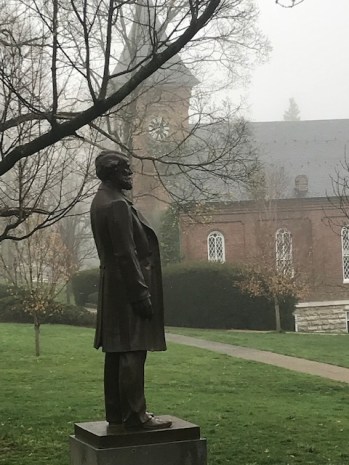
There are other names for Lexington, Virginia, and environs, names fashioned in the minds of creative folk who lived here. A French exchange student who somehow landed at Washington and Lee University in the mid-1950s, Philippe Labro, called it Genoa, ShenandMcCormick statueoah Valley, in a nostalgic novel he wrote later, L’Étudiant étranger. Another writer, a native son who fled to New York, wrote a 2009 book of eleven short stories about “a Southern town” he called Concord, Virginia. And the textbook I assign in my news-writing class at W&L calls it Valleydale, in “Blue Ridge County,” a theater of incredible news events dreamed up by the former head of this department, where “professional education for journalism” first began in 1870 thanks to Robert E. Lee (according to the plaque just inside the door of Reid Hall).
But these are gossamer veils that barely hide the real Lexington and Rockbridge County. If you’re looking for the real thing around here, you might start by looking down.

In the sidewalks of Lexington (named in 1778; chartered as a city in 1966), you’ll find among the double-bullseye patterns of Lexington paving bricks nearly 60 granite pavers that note the “Righteous and Rascals of Rockbridge.” Patsy Cline lived here, for instance. So did Admiral Byrd and General George Patton, as cadets, before they transferred out of Virginia Military Institute. But I try not to stop and read these snippets underfoot, these footnotes, as if I hadn’t heard all the stories after 16 years of living here. As if this were all reliable history.

I peer down in the ditch that construction crews are digging along East Washington Street, between the briefly controversial little cottage restaurant called The Red Hen and the Stonewall Jackson House.

I open an unlocked door, mount an unimproved stairway, and drop in on the last living 19th-century-style newspaper editor, Doug Harwood. His office is a beautiful mess, bunkered around with remaindered issues of his elegantly mischievous monthly, The Rockbridge Advocate. A scruffy, thin figure around town, he’s here at his computer, transcribing scans of handwritten Rockbridge chancery court records from the late 19th century.

Harwood is on the case again, another lode from that foggy realm of undiscovered history that he likes to publish in the back pages of his news magazine each month. “I wish I knew what I had here,” he says. It’s about a vineyard south of town in the Brushy Hills area, and to Harwood’s delight, the story involves three or four nasty lawsuits and a French winegrower, Gaspard, with a local mistress and a family back in France. Gaspard eventually acquired the vineyard from the wealthy local lawyer Elisha F. Paxton II, got tangled in the lawsuits, died and was buried in “St. Patrick’s” Catholic cemetery. That surprises Harwood because St. Pat’s, the only Catholic church in a county with about 85 Protestant churches, doesn’t have a cemetery. (There are no mosques or synagogues, and that itself is the presence of history.)

A few years ago, I researched old letters-to-the-editor in the musty back office of another local  newspaper for a book I put together with the help of student researchers, The Lexington Letters: 200 Years of Water Under the Bridge (published in Buena Vista). Another professor and I dedicated that book to Pam Simpson, then in the last weeks of her life, with cancer. Pam Simpson was a deeply knowledgeable art-history professor at W&L whose research exhumed the history of so many structures around Lexington. The W&L house of the Dean of the College, formerly called the Lee-Jackson House because both Jackson and Lee had lived there at different times, is now called the Simpson House, for Pam.

In time’s maze
over fall fields, we name names
that went west from here, names
that rest on graves.

So goes a Wendell Berry poem, “The Wild Geese.” Although he was writing about his farm in Kentucky, the poem ends with the best line for Rockbridge County: “What we need is here.”

This is from the cutting floor. It is material that Kurt Rheiheimer, editor-in-chief at Leisure Media 360, cut from a 1,500-word article I sent him. Cuts were entirely made to get the thing down to 900 words. That was the assignment.

Posted in Uncategorized | Leave a comment

Me: An Introduction

George Pryde, a retired ad man who lives in Lexington, introduced my March 10 talk on Tom Wolfe to the local branch of the English Speaking Union. I told him to leave in the flattering error of saying Wolfe and I formed a lasting “friendship,” because correcting that was my lead anecdote. Actually, Wolfe gave me several clever run-arounds when I tried to get his permission to see his W&L transcripts (unlike Trump, he had nothing to hide about his academic record; he was on the dean’s list every year, turns out), and then he declined to write the intro to my book The Southern Press. Unabashed by “pryde,” I post George’s intro here. – DC

Our program topic today is the late Tom Wolfe and the “New Journalism” with which he is so closely associated.

No one is better qualified to speak about Tom Wolfe than Doug Cumming. In many ways their lives and careers have followed parallel and often intersecting paths.

Like his Richmond-born subject, Doug too is a Southern lad, a 6th generation Georgian, born in Augusta and raised in Atlanta.

Their educational backgrounds were similar – Wolfe’s undergraduate degree was in English, at Washington and Lee. Doug’s B.A. was in Literature, at Bennington College in Vermont.

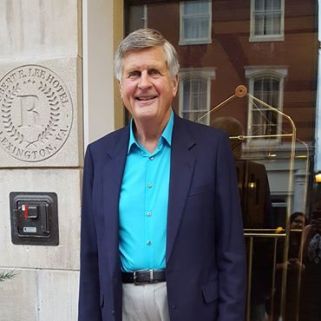
George Pryde

George Pryde, in front of the R.E. Lee Hotel. (His Facebook page)

Both went on to advanced degrees in American Studies at Ivy League schools – Tom Wolfe at Yale, Doug at Brown. Doug also earned a Ph.D. In Mass Communication, at UNC-Chapel Hill.

After college both men spent several years as newspaper and magazine journalists.

Their lives intersected at W&L when Tom Wolfe made one of his frequent returns to his alma mater, where Doug had joined the Journalism Department in 2003. There the two men found they had shared interests and formed a friendship that lasted until Wolfe’s death last May.

Of course, these two men had their differences. Doug Cumming as far as I know has never appeared in white suits and spats. And Tom Wolfe, to the best of my knowledge, was not an accomplished saxophonist, equally comfortable with jazz and bluegrass traditions. By the way, you can hear Doug play most Wednesday mornings 8 to 10 am with the jam session at the undercroft of Grace Episcopal Church.

Dr. Cumming is Associate Professor of Journalism and Mass Communications at W&L. He currently teaches reporting, literary journalism and media history.

We are indeed fortunate to have Doug speak to us today, and to have his charming wife Libby join us.

So please welcome Doug Cumming!

Posted in Uncategorized | Leave a comment

“Atlanta in search of its children”

I was working for the Providence Journal-Bulletin, stuck in a little bureau in Johnston, R.I., when I typed out a two-page proposal for why a maniacal editor named Joel Rawson should send me to Atlanta to do a story on the missing and murdered children. It was early 1981, and national newspapers, magazines and television networks were all covering what was emerging as a pattern of serial kidnappings and murders. Poor black children, mostly boys, seemed to be the victims, once police recognized a pattern. Atlanta was my hometown. It was also the hometown of a terrific staff photographer on the paper named Rachel Ritchie. I proposed that Joel send us down for a week. He did.

I finally was able to introduce myself to one of the mothers of the missing children. She had become enough of a celebrity to have a black club in Cambridge, Mass., pay for her round trip to a disco marathon to raise money for the search for the killer. But other than that pending trip, she was still mired in poverty and grief. In fact, her welfare check was reduced from $221 to $193 a month. One less mouth to feed. That’s the only note she got from her caseworker, instead of a sympathy card.

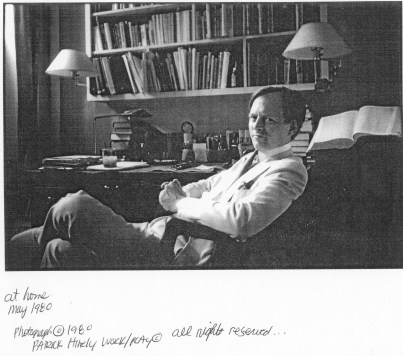
Wolfe at homeLooking back, I see Tom Wolfe’s influence all over this story. Instead of the beginning being a tight little anecdotal lead, it’s a cinemagraphic setup, much longer than usual for a newspaper story. I start with a bumpy verité lens on Mrs. Catherine Leach taking a MARTA bus from her raggedy home, Building 947, Apartment 497 in Bowen Homes to downtown for sales at Zayre’s or Sunshine department stores, or her hopeless search for menial work at the big hotels. My literary camera pans back to show Atlanta as a city for conventioneers, with a sugar-coat of Southern spring in the air.
This past week the city was alive with spring. Dogwoods and cherry trees bloom like puffs of musketry in the wooded neighborhoods. There is a softness in the air. The weather is perfect for the searches that go on every Saturday now, like the ones for Mrs. Leach’s son.

 Wolfe taught us, by the mere gossamer influence of his marvelous pieces, to set scenes and have dialog, even if it’s just remembered and we come to the over-heated foul-smelling site later.

The screen door slammed as she reached the edge of her tenement.

At that moment she heard a distant voice say, “Momma, help.” She whirled and headed back to see which one of the boys was complaining.

Opening the door, she yelled, “What do y’all want. I’m trying to find your brother.”

One of them answered, with words that froze Mrs. Leach’s insides, “Momma, we ain’t call you.”

Dear Jesus. It was a premonition she had heard. Her ears “were blazing like a ton of fire,” she recalled. It was then that she knew, even though she spent the next hour checking McDonald’s, Burger King, Kentucky Fried Chicken, Thriftown, everywhere.

 I also see now the influence of Wolfe’s eye for radical chic and Mau-Mauing, the leveraging of white guilt and liberal status-preening  — although the Atlanta version was not like New York’s. I was struck by the sad comedy of a black elite that had lost touch with the vision of Martin Luther King and with Atlanta’s underclass. And I was captivated by Wolfe’s amusement with media mayhem.

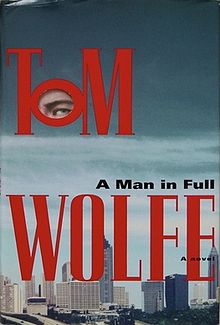
Man in FullAt a press conference where I lurked behind TV crews who had no idea why they were there, a California woman in white cowboy boots and a velvet jacket took the stage to explain why “Another Mother for Peace” had come to help. She was on the verge of tears.

“I’ve been so emotional since I’ve been here,” she said apologetically. “I don’t know. Maybe it’s menopause.”

Mrs. Avedon, and an older woman with her, mentioned several causes they support: ending all wars, withdrawing support from El Salvador, letting children build a beautiful world, shifting federal dollars from MX missiles to hot lunches.

As for the missing and murdered children: “If everybody would just keep silent and just let the police think clearly,” Mrs. Avedon offered.

Later in the press conference, the black writer James Baldwin appeared. Heads turned. Reporters murmured.

“James Baldwin,” Mrs. Avedon called gleefully from her chair. “I saw you across a crowded room in a restaurant in the south of France and I said out loud, ‘That’s James Baldwin.’”

Baldwin smiled at her.

The writer of “The Fire Next Time” said he didn’t have anything specific to offer regarding the missing and murdered children. He had come to cover the event for Playboy. Still, he stood at the podium. “It has,” he said, “something to do with the end of the dream of white supremacy.”

 It only took a little patience to hang out with Mrs. Leach enough to feel more a part of her life than with the mad carnival that had formed around the idea of sympathy for the missing and murdered children. No one had thought to arrange to get her to the airport for the disco fundraising trip, so Rachel and I took her to meet someone at the airport. I couldn’t believe how lucky I was to be with her at the airport. It was like Tom Wolfe had written the scene. This was obviously the end of my story.

When she walked into Atlanta’s Hartfield International Airport, the long space lined with ticket counters and baggage check-in scales spread before her. She shook her head. “Hoo-wee. This floor must take about two days to mop.”

Mrs. Leach was scared – she’d never been on an airplane before – so she had loaded herself up with tranquilizers. Through a mix-up, she and a volunteer traveling companion could not get on the 3:20 p.m. flight as planned and had to wait for a 5 p.m. flight.

Sitting on a chrome and leather bench, leaning against a Plexiglas wall, Mrs. Leach folder her arms and fell asleep. Her breathing was deep and steady.

Businessmen and mothers with baby carriages and security guards and stewardesses – some wearing the symbolic green ribbons – passed by. A black man with a familiar boyish face swept by in a tailored suit, his ticket in hand. It was Julian Bond, the former Georgia state senator who made his name as a draft resister and a symbolic nominee for vice president in 1968.

No one passing by glanced at the tired black woman sitting on the bench with her head nodding downward.

 The story ran on the front page of the Sunday paper, March 29, 1981, under the headline, “Atlanta in search of its children: A tragedy, feeding on itself, becomes a media event and tragicome.”

Posted in Uncategorized | Leave a comment

A Free Market Isn’t Pain Free

More than two years of Trump’s presidency have passed since I wrote this op-ed that ran in the Roanoke Times (Feb. 5, 2017). The only thing that is surprising about the last two years is that there are few surprises about Trump. The personality that Michael Cohen sketched out to Congress — an enigma, a larger-than-life mix of bad and good but underneath, a con man and a cheat — was always there for all to see.

(To update references to our three children at the end of this: Our oldest has helped build Austin Coding Academy into a profitable business; our second son is now teaching welding at the community college where he studied it; and our daughter skipped Columbia J school to deal with health issues that have put her on a more creative path of songwriting, journaling and observing the miracle of this life in our world.)

I tell people I have a great future behind me.

I learned news reporting the old-fashioned way: on-the-job training in high-energy newsrooms. I was lucky to cover a number of beats in Raleigh, Providence and Atlanta during 25 of the best years ever for American newspapers.

So why was I studying for the Graduate Record Exam, and on one cold dark morning, driving off to take this entrance exam at some obscure little strip mall? Why was I leaving Atlanta, uprooting myself, my wife and our three children, a good job and good salary, to get a Ph.D. in mass communication at UNC in Chapel Hill?

This is the way things are with free-market capitalism. The news business was changing — in many ways, for the better, but it was definitely disruptive. And I wasn’t getting any younger. So I took the leap, the cut in pay, the pain of change. A few years later, old-style newsroom refugees like me who had scaled the ivory tower were joking about newspapers as “buggy whips,” an industrial product that had been overtaken by technological and economic progress. It was interesting to study this, and welcome it, from the classroom.

All this talk now about “bringing back” good jobs in manufacturing, coal and oil production has made me wonder if some people just don’t understand the bargain we make with a healthy capitalist system. It’s a beautiful system that brings creative ideas, improved technology, competitive prices, cultural innovation, choices and economic freedom. But it can be painfully disruptive, forcing unwanted change. “Who doesn’t get this?” as Garrison Keillor put it, writing in the Washington Post about President Trump’s inaugural address.

Free-market capitalism is our winning horse. Looked at historically, there has always been something wild and dangerous about it. It has always been global, from the Industrial Revolution onward. It has always needed to be put in harness to do us good, to help the nations and to pull us in the direction we want to go. (We don’t even need the buggy whips).

Adam Smith explained the beauty of the free market’s “invisible hand,” which is the paradox of the common good being served by individuals with “moral sentiment” pursuing selfish interests. His “Wealth of Nations,” a good companion to our Declaration of Independence with both from 1776, saw the necessity of regulations — from fire codes to workers’ protections — and the need to adapt this progressive force to national interests.

Regulation has been the way we have harnessed the wild stallion of capitalism. The traces were created by 200 years of trial and error: trust-busting reforms, government inspection of meat, a check on patent medicine advertising, clean air standards, worker safety and so on. Now, the Trump administration wants to flip that around. Regulation is no longer seen as the bridle and harness on capitalism, but a stranglehold. He says we can cut 75 percent of regulations. No doubt, that will goad the powerful beast in some ways that our forebears witnessed already.

And what will be the new check on the pain that capitalism tends to cause in its creative wake? Trump wants the very thing that Adam Smith warned against, what used to be called mercantilism: isolation, tariffs and government bullying of business.

It may sound strange to call our new businessman president an enemy of free market capitalism. But that’s the way it looks, with his promise to bring back dying industries and court a trade war.

Making America great “again” is a backward longing. It’s not facing the dislocations and generative energy of the market. I know the forward look is hard and risky. But I’m proud to see that our three children, the ones I uprooted to go for my Ph.D., are facing the reality of today’s economy with courage and imagination.

One son is helping build a business in Austin teaching computer coding on a night schedule that allows older students to learn these skills without having to quit their day jobs. Another son is studying welding at a community college on the GI bill, with the goal of welding at the brave heights of cell phone towers.

And our daughter, our youngest, has been accepted at Columbia University’s School of Journalism for a master’s degree. It turns out, this is an exciting time to become a new-media journalist.


Posted in Uncategorized | Leave a comment

Cedar Hill Church: An Oral History

Louise Mikell is an 89-year-old black woman living in Lexington, Virginia. She graduated from Morgan State University in Baltimore and received her master’s in education from George Washington University. She is considered the “unofficial historian” of both the black community of the Rockbridge area as well as Cedar Hill Church, a historic black Baptist Cedar Hill Churchchurch regularly active from 1874-1927.  Her father was a member of this church and Ms. Mikell, along with her associates, revitalized it, helping the church onto the National Register of Historic Places. Once closing down in 1927, the church had no use until 1965 when leadership, including Louise Mikell, established an annual meeting held in August to celebrate the history of this black community, which went on for fifty years.

On November 28, 2018, Ms. Mikell met with Washington and Lee freshman Nick Mosher in her home in Lexington to discuss Cedar Hill Church and her involvement with its preservation.

NM: I know you were born two years after Cedar Hill Church closed down but what caused you to become the sort of, unofficial historian of the church?

LM: Well, in 1965 the persons who were the children of the members of Cedar Hill decided to get together and open Cedar Hill and clean it up so we could have a summer place to go. And so the young people could all get there and have a chance to know something about Cedar Hill and their grandparents and great grandparents. The first group of persons who opened the church were the Ezans, Edna Johnson, John Johnson, Ophelia McCutchen, Hansford McCutchen, Alice Moore, and Sarah Cheek. They got together out there and decided they were going to clean up and fix up the church and have it as a place for the third Sunday in August for the young people to come and enjoy and have a picnic and have a service and just be together as family members. Basically, at that time the families that really participated were the Morrisons and the Johnsons and McCutchens, the Beals . . . [These] basically were the people who participated in opening the church again. And that was in 1965, so we opened the church and had activities and things for fifty years. And then during that particular period of time Ophelia McCutchen was most instrumental in putting a program together. Then after Ophelia I think it was Alice Moore who took over putting a program together for the summer program. And the date established was the third Sunday in August and that was in 1965 and then through the years Alice became the main leadership in putting the program together. And then I became the leadership in putting the program together after Alice passed . . . in 1998. But during the course of those years when I was the person pushing the program we had a lot of things that took place. The church became part of the historic preservation for the state and the National preservation. BibleWe had a lot of different persons who came to speak and we had children’s programs and persons in the family who were ministers and persons who were capable of bringing a good specialty of something they wanted to say to the group. And it was a delightful situation, we had so many people all through the county who came. It was just crowded really, and that went on for fifty years. And I guess it still could be going on but I just stopped it! [Laughs] I said I was tired of this and no one decided to pick it up! My daughter tried to pick it up . . . She did the last summer that we participated and got together. She had her husband to speak at First Baptist (the historically black church in Lexington) . . . We had the food downstairs at First Baptist because when [Cedar Hill] closed, the people all came to First Baptist because it was a Baptist church out there so they brought their membership to First Baptist.

NM: So you said the church closed in 1927 correct?

LM: Yes, in 1927.

NM: So what caused this once really popular church to close down?

 LM: Well, the black people died number one. And number two, they didn’t have a school out there for their children to go to school. And then number three, they didn’t own anything . . . and they couldn’t, they weren’t given the opportunity. So those were basic reason why the people left out there. They were working on the farms and that kind of thing. And they were making a good livelihood, but they weren’t able to own a house or anything of that nature so it was well that they made an effort to move so my father came here and bought this house and it has been in my family ever since 1915, and that happened to many families and by that time there weren’t many families left out there really.

NM: Where did a lot of them go?

LM: They came to Lexington and they joined First Baptist Church down there.

NM: What were some of the reasons for moving to Lexington?

 LM: Basically, because of the fact they couldn’t own a piece of property out there and for school, for their children and those were the basic reasons, for moving – living conditions and housing. They were looking for better situations, jobs, that kind of thing. And they joined First Baptist down there.

NM: When you revitalized the Church, was it used as a church or more of a community center?

LM: Well, we just went there one day in the year. And we would go to First Baptist and have a worship service and then have dinner in the yard and meet family and friends. It was just a great day, and it would be dark before we left. [laughs]

 NM: Would you say this celebration was a gathering of friends and family or a time to worship or would you say it was celebrating, sort of, the black community of Rockbridge County?

 LM: Well, no black people lived out there by this time.

NM: Right, sort of the history then I guess.

 LM: Yes, so we were just there to celebrate our ancestors. Because our ancestors had been living there in that community since 1840. And so we were there to sort of remember them, and meet family and friends and just have a nice day being together. And it was, it was a good day to be together. And people came from everywhere, folks came from California [laughing].

you just can’t imagine how it was, it was just wonderful really. Most of them lived away, they didn’t live here. But friends here in Lexington came too because it became a very popular day that everyone looked forward to over the summer and before.

###

LM: I have books where they have written down every penny that people gave years ago, in 1830 they gave one penny! Two pennies! Whatever they had, it was just wonderful really. So that history goes on for all of those years and I don’t know what’s going to happen to Cedar Hill, it rather disturbs me really . . . I really think it ought to be a meeting house in fact it was dedicated as a meeting house and a place of worship, that’s what the idea was. And no longer black people live out there, there was once a time when a group of people wanted to rent it for a church but Edlo and I talked, oh well, it didn’t go anywhere and we didn’t get that done so now it’s just sitting there I don’t know what’s going to happen to it ‘cause I’ll be gone. [laughing]

 NM: What caused you and the rest of the leadership to choose Cedar Hill Church, I guess my question is why Cedar Hill? What was the historical significance that made it your rallying point for those who wanted to celebrate their history?

LM: Well, it was because of the fact that that’s where our people came from. That’s where they went to church. And before that church was established they had church in their homes out there, along the creek banks, along the tree line in the mountain. In fact, before they had Cedar Hill they had church on top of a high hill where the big oak tree was and they had just sat around on logs and had service. In fact, I understand there is someone buried up there, and that’s on the Harris farm and that farm belonged to John Riplogle, and he gave the land because it was right attached to his farm.

NM: Taking it back a little bit, can you tell me the origins of Cedar Hill, sort of how it came to be?

 LM: I don’t know other than John Riplogle gave that land for a church. They were having service on the mountain, under the great big oak tree. And evidence was still there some years ago. I don’t know if the evidence is still there. And the houses were all along the base of the mountain. Years ago when my father and mother used to drive out there after I got to be seven, eight, ten years old – they would point out to the mountain, the side of the mountain and their used to be old houses there where those people lived . . . They used to point out some of the names of people who lived out there. Well it was just their home! And they just tried to stay close to their homes, really.

NM: What do you hope happens to Cedar Hill?

LM: What do I think?

NM: What do you hope – or what do you think is going to happen, if those are two different answers.

LM: I don’t know what’s going to happen, I don’t know. It has been my thought that Cedar Hill Church – I tried to give Cedar Hill Church to First Baptist Church, down on Main Street. I tried to give that church to them. But of course First Baptist didn’t want it because of the fact that well, they were able to keep First Baptist. If they were able to pay the bills on First Baptist then they were lucky! So, I wasn’t able to get that done, I just always said well, First Baptist could use it as a retreat place and that kind of thing for their church and for the young people, et cetera. But now, the only thing I can see, if anyone wants to buy it, they need to sell it. Because nobody is going back out there to have service, they need to sell it to any congregation who wants it. Because of the fact that churches are churches and they are meeting places for friends in the neighborhood and the community . . . I hope it will be sold, really because the cemetery is there, and the cemetery could use the funds it got out of the church to keep it up . . . and do little things around there to make it a nicer looking place. [laughing] I don’t know what’s going to happen to it!

NM: What were the reasons behind the Church becoming a registered historic place?

AwardLM: The reasons were that it had been the religious place of worship for the group of black people who had lived in that community all of their life and it was used as a school at one time. . . . Those were the reasons that we put in the application to get a historic trust and the length of time that building has been sitting there. And that building was dedicated in 1874 but those people had been worshiping wherever they could before that building. See, that building was given to them by John Riplogle. And the first building burnt down, and they built the building that is there now because the first building was just a log cabin, in fact, it didn’t even have a floor in it I’m told, and so they built the second building and the church is in good shape!

LM: I hope this has been a help to you.

NM: It really has, thank you so much.


Posted in Uncategorized | Leave a comment

Grace Honors Jonathan Daniels

Singing at dedication

Libby, at far left, was one of the grant writers on the UTO grant.

“An actual saint was in this place, think of that,” Col. Keith Gibson told fellow church members gathered in the new Jonathan M. Daniels Community Room underneath the sanctuary of Grace Episcopal Church.

The Sunday dedication and blessing, Feb. 3, was not only the official unveiling of the room honoring an actual Christian martyr recognized by the U.S. Episcopal Church – Virginia Military Institute valedictorian Daniels, murdered in Alabama in 1965 while protecting a fellow civil rights protester. The dedication service also moved into the larger restored space – now called the Brooke Family Undercroft.

Then it moved into a refurbished third room, the Sacristy, where sunlight played through old gothic windows onto fresh-painted walls. “Blessed may you be, O Lord,” recited the Rev. James Hubbard, the interim rector.

The $325,000 renovation has brought back to life the 136-year-old undercroft of the former R.E. Lee Memorial Church. This lower level of the limestone church building at 123 W. Washington St. had been virtually unused since it was outgrown in 2007 by the early learning center Yellow Brick Road.

sacristy

L-R, Bob Glidden, Pat Mayerchak, Rev. McKinley Williams of First Baptist, Fr. James, Elizabeth Harralson, Jane Brooke, and Gail and Barton Dick.

Now it is the newest space in town for choir rehearsals, church meetings and community activities. It has even become the new home of the “Wednesday Morning Bluegrass Jam,” a local tradition that has survived some 25 years in various coffeeshops around Lexington.

The renovation, by Phoenix Construction, was supported by the second phase of the parish’s three-year capital campaign and by a United Thank Offering of $47,000 from the national church. The UTO grant was specifically to pursue the national church’s agenda of racial reconciliation under the motto of “Becoming the Beloved Community.”

An article last week by the Episcopal News Service described two years of intense debate over the church’s name. “The process of congregational soul-searching began in the wake of the 2015 massacre at a black church in Charleston, South Carolina, by a racist gunman with a fondness for Confederate symbols.’”

The vestry of the church voted in September 2017 to restore the original name of Grace, replacing the name it had borne since 1903, R.E. Lee Memorial. Robert E. Lee, when he was president of Washington College, served as the senior warden of Grace Church.

Daniels plaqueJonathan Myrick Daniels, as a cadet at VMI, attended the church and sang in its choir. In 1965, while in seminary in Cambridge, Mass., preparing to become a minister in the Episcopal Church, Daniels heeded the call of Martin Luther King Jr. to join the fight in Selma for equal voting rights. After responding clergy left the area and Congress passed the Voting Rights Act, Daniels returned to work on voter registration and breaking down racial barriers. He was killed when he stepped into the line of fire to protect a young black woman who was the target of a parttime deputy’s shotgun. The Episcopal Church honors him with a Feast Day on Aug. 14 and his name is among martyrs (including King) named in a chapel of England’s Canterbury Cathedral.

The Brooke Family Undercroft honors a Lexington family involved in the church for six generations: John Mercer and Kate Brooke, George Mercer and Isabel Brooke, George M. Jr. and Frances Brooke (who died in December at the age of 101), George M. III (who died last April at age 73) and Jane Brooke, George M. IV and Erika Brooke, and their four children, Elise, Emma, John M., and Philip Brooke.

The refurbishing of the 1875 Sacristy was underwritten by the Helen S. and Charles G. Patterson Jr. Charitable Trust Foundation.

I wrote this for the Lexington News-Gazette, which ran it on its front page, Feb. 13, 2019.

Posted in Uncategorized | Leave a comment

2018 History Division Annual Report

HISTORY DIVISION OF AEJMC

ANNUAL REPORT 2017-18

Submitted by Division Chair Douglas O. Cumming, June 9, 2018

1a. Division name: History Division of the Association for Education in Journalism and Mass Communication

1b. Current Officers

Head/Program Chair

Doug Cumming
Washington and Lee University

cummingd@wlu.edu

Vice-Head/Research Chair

Erika Pribanic-Smith

University of Texas-Arlington

epsmith@uta.edu

Second Vice Chair/Secretary (includes Newsletter Editor)

Teri Finneman

University of Kansas

Finnemte@gmail.com

Incoming Second Vice Chair (subject to vote of Division August 2018)

Will Mari

Northwest University

William.mari@northwestu.edu

Teaching Standards Chair

Kristin Gustafson

University of Washington-Bothell

gustaf13@uw.edu 

Personal Freedom & Responsibility Chair

Melita Garza

Texas Christian University

melita.garza@tcu.edu


Membership Chairs

Will Mari

Northwest University

William.mari@northwestu.edu


Amber Roessner

University of Tennessee

aroessne@utk.edu


Grad Student Liaisons

Christopher Frear

University of South Carolina

cgfrear@gmail.com


Kenneth Ward

Ohio University

kw749014@ohio.edu


Book Award Chair

John Ferré

University of Louisville

ferre@louisville.edu

Covert Award, Chair

Nancy Roberts

SUNY-Albany

nroberts@albany.edu


Joint Journalism & Communication History Conference

Nick Hirshon

William Paterson

hirshonn@wpunj.edu


AEJMC Southeast Colloquium History Division Research Chair

Cayce Myers

Virginia Tech

mcmyers@vt.edu


Webmaster:

Keith Greenwood
Missouri School of Journalism
greenwoodk@missouri.edu


  1. Annual Demographic Form. See attached file: 2018_HIST DIV demographic_form. [Please add “History Division” to top of this form.]


  1. Overall statement weighting the division or interest group’s activities for this year in the Research, Teaching and PF&R areas.


As division head, I would weight our 2017-18 activities outlined below as follows: Research 60%; Teaching 20%; Professional Freedom and Responsibility 20%. If there is an imbalance, it is only for this one year because the most challenging and preoccupying activities were related to taking on the peer-reviewed quarterly Journalism History, which has operated independently since 1974, and naming its new editor. The division’s officers also spent time working out significant proposed changes to our bylaws and discussing difficulties that have come with the popularity of a joint media history conference we co-sponsor. These activities I would characterize as largely if not entirely research oriented. At the same time, a re-formating of our newsletter Clio Among the Media from a PDF quarterly to a monthly e-newsletter carries weight for all three areas, which each produce columns for the newsletter. Also, we are sponsoring conference panels from all three areas, as can be seen in the following reports.

  1. What are your most important goals for the upcoming year?
    • We will continue to facilitate the transition of the academic journal Journalism History from an independent publication to the division’s official journal. Further details on this process so far are outlined under RESEARCH below and in last year’s annual report.
    • A solid foundation of young historians will bolster our division and ensure its future. Therefore, the incoming chair aims to increase student involvement in the History Division by encouraging a more active graduate student committee, reaching out to universities (including both mass communication and history departments) that typically are not represented on the summer and spring conference programs, and publicizing financial awards available to student presenters.
    • The division has for many years co-sponsored the Joint Journalism and Communication History Conference with the American Journalism Historians Association. The once-small conference has experienced growing pains, and its chief organizer is nearing retirement. During the coming year, the division aims to work with AJHA officers and JJCHC organizers to institutionalize the spring event, thus ensuring its future, and improve its function, especially the research paper submission and review process.
    • As history becomes an increasingly lower priority in journalism and communication curricula, it is important to emphasize that our division’s scholars have as much impact in the classroom as they do in the research community. As proposed by our teaching standards chair, the division will explore establishing a teaching competition to highlight best practices in history pedagogy.

What goals did your group set this year that you were unable to reach? Why?

  • We have accomplished all goals set for 2017-2018, although the transition of Journalism History is ongoing. The two other goals set last year by incoming head Doug Cumming related to developing a deeper “bench” among membership for serving as officers and distributing the work load (e.g. Research chair, Program chair, newsletter editor, etc.) more broadly and giving those roles more than a year’s tenure, where appropriate. The idea was to make leadership of the division more deeply experienced and more sustainable over the long run. These goals are met by a number of proposed changes in our bylaws as the three officers agreed on, and sent to membership in June for discussion and vote at our business meeting at the conference in August.

How may any or all of the Standing Committees help you to achieve your goals in the coming year?

  • The Publications Committee might be able to assist our continuing effort to find a satisfactory arrangement with an academic publisher for the division’s newly acquired scholarly journal, Journalism History.
  • The Research Committee might help with our efforts to strengthen the Joint Journalism and Communication History Conference, especially as we explore better mechanisms for receiving, reviewing, and organizing submissions of abstracts.
  • The Teaching Committee might help with our efforts to establish a history teaching competition.


RESEARCH


  1. Number of faculty research paper submissions 32; number of acceptances 20; 62.5%. (NOTE: Two of the faculty research paper submissions were co-authored with students; both were accepted.)


  1. Number of student research paper submissions 15; number of acceptances 6; 40%.


NOTE: The division received a total of 50 research paper submissions, one of which was disqualified and not counted above. Two of the papers submitted were not designated as student or faculty and also are not counted in the above questions; both were rejected. The overall acceptance rate for the division was 53% (26 of 49 qualified papers).


  1. Overview of judging process (see attached review form).

The research chair solicited judges with a variety of research interests within the field of journalism and communication history and made sure that each judge received papers within his/her area of expertise so that authors could receive the most knowledgeable feedback possible. Each paper had three reviewers. Reviewers scored papers on the attached form, and the papers to be programmed were selected based on ranking of total scores. Student and faculty papers were considered equally. Slightly more than 50% of papers were selected because the last few papers around the 50% mark were extremely close.


  1. Total # of judges 71; 2 papers per judge.


  1. Did your group conduct any other type of refereed competition? N/A


  1. In-convention activities related to research.
  • Presentation and discussion of 26 research papers.
  • Three research panels.
  • Member tour of the Library of Congress.
  • Member Q&A and tour at the National Press Club.
  • Outreach to graduate students through a jointly sponsored (with GSIG) reception at the annual convention.
  • Presentation of awards at business meeting for top papers, book, and article.
  1. Out-of-convention activities related to research.
  • Annual Joint Journalism and Communication History Conference, sponsored by the AEJMC History Division, the American Journalism Historians Association, and NYU, March 10, 2018, NYU Arthur L. Carter Journalism Institute, New York City.
  • 43rd AEJMC Southeast Colloquium, hosted by the College of Communication & Information Sciences, the University of Alabama, Tuscaloosa, AL, March 8-10, 2018.
  1. Research goals and activities of your division.


  • The big goal for the division this year was to implement the adoption of the academic journal Journalism History as the division’s official journal. Based on the investigative work of an ad hoc committee in the previous year, the division leadership recommended adoption, and the membership approved via an online vote immediately following the 2017 conference. AEJMC approved the adoption at its December meeting. Over the past several months, the ad hoc committee has continued work, ensuring the financial stability of the journal, conducting a successful search for an editor, and exploring publishing options. Our executive committee approved the recommended journal editor and began the process of setting up a journal oversight committee within the division’s leadership.
  • Another goal for the division this year was to restructure the officer positions, which relates to research because it affects the selection of Research Chair. Currently, the top three positions are Chair/Program Chair, Vice-Chair/Research Chair, and Secretary/Clio Editor. If the membership approves the officers’s proposed amendment to the bylaws, the leadership will be more in line with other divisions, as follows: Chair, First Vice-Chair/Program Chair, Second Vice-Chair/Research Chair.
  • The Clio newsletter published three times in its traditional PDF form before launching as a monthly e-newsletter. Research-related content includes journalism history book excerpts, columns related to research activity, and profiles of individual members and their research.
  • Listserv emails to promote particular events and opportunities.
  • Social media, including a Facebook page devoted to the group, allows members to discuss research in progress as well as make announcements.
  • Promotion of paper submissions through awards for top three faculty papers, top three student papers (plaques for top two places, certificates for third).
  • $500 cash prize, top academic article of the year.
  • $500 cash prize, top academic book of the year.
  • Creation of the Michael S. Sweeney Award for the best article of the year in Journalism History, with the first winner selected by Division officers from nominations by outgoing editor Sweeney.


TEACHING:


  1. In-convention activities related to teaching. For the upcoming 2018 AEJMC convention, the History Division’s three teaching panels bring together the work and ideas of 14 scholars (panelists, moderators, discussants) and five journalism practitioners. The Division co-organized three teaching panels—two that teaching chair Kristin Gustafson co-organized and one that membership co-chair Amber Roessner organized. In the space below, Gustafson describes how they each will fulfill the Teaching Standards Committee’s focus on curriculum, leadership, course content and teaching methods, and assessment collectively.


The first 2018 panel, “Contextualizing Media Credibility in 2018,” will specifically address Teaching Standards Committee’s focus on curriculum, course content and teaching methods, and assessment. Our panelists will offer ideas for how professors can provide historical perspective on the current era, when the U.S. president frequently charges that reporting on his administration’s shortcomings is “fake news” and many citizens doubt the truth and believability of journalism. We see the panel as taking into account changing notions of balance, fairness, objectivity, and credibility in journalism education and the news industry, as well as addressing histories of media relationships with government and other power-wielding entities.

The second 2018 panel, “Innovating ideas that foster a community and its history,” addresses the Teaching Standards Committee’s focus on curriculum, course content and teaching methods, and creates an opportunity for AEJMC members to interact directly with community journalists and the community stories they produce. We sought newspapers from a variety of audiences: LGBTQI, race, language-based, economic (homelessness), religious, and geographically-bound neighborhoods. Journalism educators attending the panel will learn about fresh news projects happening in the D.C. area and come away thinking about how they might replicate these strategies in their respective classrooms ranging from Race and Media to Introduction to Journalism to Mass Media History.

The third 2018 panel, “Remembering, Forgetting and Nostalgizing 1968: The Year that Rocked Our World,” addresses the Teaching Standards Committee’s focus on curriculum, course content and teaching methods, and possibly assessment. The panel brings together historians and memory scholars to explore how earlier waves of anniversary memory have addressed certain moments and movements, such as the Tet Offensive, the Martin Luther King Jr. and Robert Kennedy assassinations, the anti-war movement, and the Civil Rights, Black Power, and Women’s movements.


  1. Out-of-convention activities related to teaching.


AEJMC History Division’s out-of-convention activities related to teaching standards have taken up the Standards Committee’s focus on curriculum, leadership, course content and teaching methods, and assessment. Primarily this has been through my quarterly columns in our Division’s newsletter Clio Among the Media: Newsletter of the History Division of the Association for Education in Journalism and Mass Communication. This year’s four columns brought forward the work of 34 scholars/practitioners and featured several multi-media projects featuring student work and/or serving student research projects. As journalism educators and media historians, we have excellent classroom practices and curriculum designs. Since taking on the teaching standards chair position in 2015, Gustafson has invited Division members to share their best practices that encourage pedagogies of diversity, collaboration, community, and justice. The ideas and examples matter to our work and stretch us to explore new strategies.


  1. Teaching goals and activities of the History Division


In addition to the teaching panels and Clio columns, Gustafson proposes that we consider a special competition that highlights best practices in history pedagogy and/or scholarship of teaching and learning. As described earlier, the History Division’s teaching goals and activities focused on four pedagogies of diversity, collaboration, community, and justice. This focus supported the Teaching Standards Committee of AEJMC’s focus on curriculum, leadership, course content and teaching methods, and assessment. Our collaboration with three other AEJMC groups—Newspaper and Online News Division, Community Journalism Interest Group, and Cultural and Critical Studies Division—added breadth and depth to our division’s reach. The senior scholars who moderate panels or serve as panelists do important mentoring that supports our division’s efforts to reach out to new scholars and invite new members. As we move into the new AEJMC year, the teaching standards focus will continue to support our History Division’s goals.


PF&R:

  1. The History Division organized and was the single sponsor for the 2018 AEJMC Conference PF&R panel session “Connecting Industry and Ivory Tower: Advertising, Journalism and P.R. Executives Tell Professors How to Matter.”
    This PF&R panel offers AEJMC members insight from leaders of the industries that represent a basis for our research and for which we prepare the future workforce.

The fields of journalism, advertising, and public relations, though distinct, share a place in the academy as professional disciplines that train students for particular media careers. Increasingly, however, these are often overlapping. Beyond offering tips on how to better prepare students for the workplace, this panel explores how professors can make their research and creative activity more accessible and useful to related industries. Given the issues confronting media industries currently, we expect this panel to touch on ethical challenges of inclusion and diversity both in messaging and issues. We have recruited a highly diverse panel by race and gender to further these goals. Other ethical issues for the panel’s consideration concern the pressures on the free and independent press at a time when the media is increasingly a target of the Trump administration.

History Division Head Doug Cumming of Washington and Lee University is the scheduled moderator. Confirmed panelists from the industry include Mizell Stewart III, Gannett and USA Today Network; Elite Truong, Washington Post; Chuck Alston, MSLGroup; Wendy Melillo, American, and Jodie Warren, MDB Communication.


  1. Out-of-convention activities related to PF&R. The PF&R committee of the History Division supported the draft AEJMC statement on hate speech. At this writing, the statement is still in draft format, and though it was spurred by the incident in Charlottesville, it still provides timely, necessary, and useful recommendations for helping journalism students and working journalists in their coverage of these issues.


The History Division also endorsed the American Historical Association’s statement condemning the Polish law banning discourse about Polish complicity with the Nazis. As a member of the AHA’s Council of Affiliates, the division made this endorsement with agreement from the officers and previous head.


Additional out-of-conference activities included PF&R columns in our division newsletter, as detailed below.


  1. PF&R goals and activities. The 2017-2018 year represented a transition in the History Division PF&R chair, with Melita M. Garza replacing Tracy Lucht in the role. A primary focus of the new chair was to highlight issues related to diversity and inclusion of racial and ethnic minorities in the journalism field. Another was to extend the dialog surrounding significant PF&R events of the prior convention to help establish a continuity of ideas, rather than to simply present a one-off PF&R activity. Dr. Garza wrote two newsletter articles that elaborated on the 2017 PF&R Panel: “Where Do We Fit In? The Beginnings of the National Association of Hispanic Journalists; the National Association of Black Journalists; the Asian American Journalists Association and the Native American Journalists Association,” which was held at the August 11, 2017, AEJMC 100th Annual Conference, Marriott Magnificent Mile, Chicago, Illinois. It was a joint Minorities and Communication and History Division PF&R Panel.

The first of these columns examined the much-overlooked history of Native American journalists, and featured an interview with panelist Mark Trahant, a key figure in the founding of the Native American Journalists Association (NAJA). A second column centered on a post-convention interview with another panelist, Vinicio Sinta, who discussed the challenges of researching Latino journalism history.

One prime goal of the current PF&R chair is to try to highlight areas for more inclusive research concerning media history, and to try to expand the conception of journalism history beyond the black-white race binary. Developing a more complete understanding of American journalism history is particularly important in light of the country’s ongoing racial and ethnic conflicts.

General Information:

  1. Please see the four attached issues of the Division newsletter, Clio Among the Media. Starting in May, our newsletter converted from a quarterly PDF to a monthly e-letter as an experiment in making it more timely and flexible for digital use.


AEJMC · Association for Education in Journalism and Mass Communication · AEJMC
234 Outlet Pointe Blvd. · Columbia, SC 29210-5667 · 803-798-0271 (voice) · 803-772-3509 (fax)


Posted in Uncategorized | Leave a comment

2017 History Division Meeting Mintues

History Division 2017 Business Meeting Minutes, Chicago

(Printed in Clio Among the Media, Fall 2017, pp. 5-8)

By Erika Pribanic-Smith, University of Texas-Arlington
Vice Chair/Research Chair

Outgoing Chair Mike Sweeney (Ohio) called the meeting to order at 7 p.m. on Friday, Aug. 11.

The membership accepted the minutes from last year’s meeting as reported in the Fall 2016 Clio.

Book Award: The winner this year was Robert G. Parkinson, assistant professor of history at Binghampton University, for “The Common Cause: Creating Race and Nation in the American Revolution” (University of North Carolina Press). Book Award Chair John Ferré (Louisville) indicated that the judges selected from among 26 nominated books. Judges were Fred Blevens (Florida International), Kathy Roberts Forde (Massachusetts-Amherst), and Linda Steiner (Maryland).

Ferré described the book as “chilling and gripping,” centered on the argument that those leading the American Revolution united the colonies by turning them against a common enemy that had to be more than just England. By unifying the public against Native Americans and African-American slaves, the book argues, the nation’s founders built racism into the country’s foundation.

Parkinson said he wanted to write something about the Revolution and race, so he started by reading all the colonial newspapers. “I was really shocked about what I found,” Parkinson said, “and that’s a massive amount of material in the middle pages of the newspapers—what everyone else has overlooked.” Parkinson argued that the Revolution’s leaders needed to scare people into fighting, and they did that by preying on people’s fear and outrage.

Newspapers allowed those leaders not only to strike while the iron was hot but to keep striking, Parkinson said. They did that in part by reprinting the same items in every newspaper. Parkinson advised young researchers not to rely on databases; he said he never would have reached the argument he did if he had just “dipped in” to the available resources. “I needed to read them all, one after the other,” he said.

Covert Award: For the second time, Sheila Webb (Western Washington) received the division’s Covert Award for best mass communication history article. Her piece in Journalism Monographs, “Creating Life: ‘America’s Most Potent Editorial Force,’” was selected from among eight nominees. Webb said she became interested in Life magazine as a graduate student; she described hauling issues home from the library in garbage bags to go through them. In total, she viewed 55,000 images, of which she ultimately coded 4,500.

“I was always interested in the start-up of media forms,” Webb said. “My project was on the first decade of Life magazine, which was a new pictorial, and how does a magazine position a cultural moment in order to become the most successful magazine launch in history.”

Webb acknowledged the late James Baughman for his assistance with her research.

Conference Papers: Outgoing Research Chair Doug Cumming (Washington and Lee) reported that the division received 50 paper total paper submissions. The division accepted 28 faculty papers and 3 student submissions for a total acceptance rate of 62 percent. None of the papers had to be scrubbed for identification, which was a problem in the previous paper competition.

Each paper had three reviewers. Cumming thanked the judges for their feedback and role in the process of generating knowledge.

The following authors received awards for their work: Linda Lumsden (Arizona), first-place faculty paper; Ken Ward (Ohio), first-place student paper; Stephen Bates (Nevada, Las Vegas), second-place faculty paper; Steven Holiday (Texas Tech), second-place student paper; Kenneth Campbell (South Carolina), third-place faculty paper; Jane Weatherred (South Carolina), third-place student paper.

Elections: The membership confirmed the appointments of Teri Finneman (North Dakota State) as Secretary/Newsletter Editor and Melita Garza (Texas Christian) as PF&R Chair. These officers had been nominated by the division’s leadership. The membership made no nominations from the floor. [NOTE: The following additional appointments were made after the convention: Amber Roessner (Tennessee), Membership Co-Chair; Christopher Frear (South Carolina) and Ken Ward (Ohio), Graduate Student Co-Chairs.]

Journalism History: Frank Fee (North Carolina, emeritus) chaired an ad-hoc committee Sweeney appointed to investigate the division’s adoption of the scholarly journal Journalism History. Forde, Garza, and Will Tubbs (Western Florida) also served on the committee.

Journalism History has been operating as an independent academic journal since its inception in 1974; Sweeney has been the editor for several years. Based on its research over the past year, the ad hoc committee recommended that the division adopt the journal. Fee said that because of Sweeney’s health and the journal’s finances, Journalism History will survive perhaps 2-3 years if something is not done to secure its future.

“If we lose Journalism History, we lose a significant place for us to publish our work, which is important to the field at large for the dissemination of knowledge and to journalism history scholars for tenure and promotion opportunities,” Fee said.

Fee said the committee has identified several reasons adopting the journal can and should work. Contracting with an academic publisher would increase the journal’s profitability and provide some opportunities that the journal doesn’t have now. The committee has talked with two publishers (SAGE and Oxford) as exemplars. Interest has been lukewarm, but Fee suggested that the publishers would like to see the journal firmly in the division before moving forward.

AEJMC requires the division to show an interest and willingness to take on the journal under any circumstances (self-publishing if necessary). AEJMC would have to approve the adoption as well as any publisher contract. The AEJMC board next meets in December. Fee anticipated that the division would be ready to adopt the journal by then and possibly have a contract with a publisher prepared.

Fee said a contract with a publisher would put Journalism History on equal footing with other AEJMC divisions’ journals.

The committee proposed a two-step process: First, those in attendance at the meeting would vote on a resolution that the committee should conduct an official vote of the membership on adopting the journal. Second, the committee proposed would conduct a vote via SurveyMonkey on the question, “Should the division adopt the scholarly journal Journalism History and, if possible, contract with an academic publisher to produce it?”

Fee noted that the committee conducted a straw poll via SurveyMonkey earlier and found that 91 percent of the membership favored moving forward with adopting the journal.

Fee said Sweeney promised American Journalism Historians Association that Journalism History would not pursue a contract with Taylor & Francis, which publishes AJHA’s journal American Journalism.

In response to questions from meeting attendees, Fee noted that changes in format and flexibility would be potential trade-offs of contracting with a publisher. But, Garza added, the current model is unsustainable.

“It’s not a choice between having what we have now with the beautiful illustrations and having something else that’s not as nice visually,” Garza said. “It’s a choice between not having a journal or having a journal that’s perhaps not as pretty.”

Forde suggested creating a website where supplementary material such as illustrations could be published.

Sweeney pointed out that a publisher could attach Digital Object Identifiers (DOIs) to articles. He explained that DOIs are URLs that are guaranteed to persist forever, and an independent publisher cannot offer that. Sweeney said tenure and promotion committees increasingly are looking to see if candidates are publishing in DOI journals.

Fee added that an academic publisher can promote the journal better than an independent publisher can, raising the number of article downloads and citations.

“The benefits are considerable and the trade-offs as we’ve found them are insignificant in comparison,” Fee said.

Fee said if the division takes on the journal, it’s an all or none proposition; it’s not dependent on getting a contract with an academic publisher. The committee recommended that the division form a publications committee to scout the territory further and investigate other publication options.

Attendees at the meeting voted 45-0 in favor of conducting an official vote of the membership via SurveyMonkey.

Committee Reports

Teaching: Teaching Chair Kristin Gustafson (Washington-Bothell) mentioned the panel she co-organized with the Newspaper and Online News Division. She also asked that members send ideas for Clio teaching columns to her at gustaf13@uw.edu. She seeks ideas for teaching that involve diversity, inclusivity, collaboration, community, and justice.

Membership: Membership Co-Chairs Finneman and Will Mari (Northwest) reported that they focused on member relations over the past year. They featured members in Clio columns and social media posts, organized a tour at the Museum of Broadcast Communications, and facilitated Media History Engagement week, which resulted in 330 Twitter posts from 110 people and reached 40,288 followers. They also noted that membership has climbed slightly from 284 to 294.

Tom Mascaro (Bowling Green) expressed dismay at the condition of some of the media in the basement of the broadcast museum and asked if the division might encourage the museum to store their films better to preserve the history in the museum’s holdings. Sweeney indicated he would contact the museum to relay the concerns.

  1. Joseph Campbell (American) asked how many students were members of the division. Though that information was not available during the meeting, Sweeney reported after the convention that the division has 25 student members.

Website: Keith Greenwood (Missouri) reported that with the widespread use of social media, most updates to the website have been posting new issues of Clio. He noted that the website is the institutional history/archive for the division; he plans to fill in more of the division’s history over the next year to make it a more useful repository.

Financial Report: Sweeney reported that the division has just about broken even this year. The starting balance was $8,160.42, and income from dues as of Aug. 1 was $1,927.50. Expenses included the museum tour fee, a reception the division co-hosted at the convention with the Graduate Student Interest Group, plaques and certificates for award winners, and $500 each to the winners of the Covert and book awards.

New Business: The Council of Divisions proposed four cities for the 2021 AEJMC conference: Kansas City, MO, Austin, TX, St. Louis, MO, and New Orleans, LA. Sweeney mentioned that the NAACP recently had issued a travel advisory indicating Missouri may be unsafe for minorities, and the state of California had issued a travel ban that would prevent California institutions from reimbursing their faculty and students for travel to Texas (among other states) because of sexual orientation-based discrimination.

Among the points brought up during discussion were that AEJMC had a memorable meeting in New Orleans 20 years ago; other divisions had requested that the Council of Divisions provide further choices; it was unfair to paint everyone in the banned states with the same broad strokes; and the bans may be lifted by 2021.

Sweeney offered to report the vote to the Council of Divisions with “rich qualitative” comment expressing the division’s concerns. Thirty of the division members voted for New Orleans, seven for Austin, and one for Kansas City; St. Louis received no votes.

New Leadership: Effective Sept. 1, Cumming and Erika Pribanic-Smith (Texas-Arlington) are promoted to division chair/program chair and vice chair/research chair, respectively.

Cumming relayed his goals for the coming year, the first of which is to carry out the will of the membership regarding Journalism History.

The second goal is to deepen the bench for incoming officers in the years to come. He noted that the top officers hold multiple positions: chair/program chair, vice chair/research chair, and secretary/newsletter editor. In other divisions, those positions are separated, and spreading the roles among more people would lighten the load on the division’s leadership while providing more service opportunities for the division’s members.

Cumming thanked Sweeney for the tremendous help he had given him and others in the division over the past year. Cumming said he counted Sweeney among his heroes for taking on the task of division head as well as editing Journalism History while battling terminal cancer. Cumming presented Sweeney with a button he had found in the apartment of his father, who had been a Newsweek bureau chief during the Civil Rights movement. Cumming said he treasured the button, and “a real gift is when you give something that you treasure.” The button also was fitting to Sweeney; coming from James Meredith’s 1966 march in Mississippi to defy racism, the button said in large letters, “March Against Fear.” The membership met the gift with lingering applause.

Announcements: David Bulla (Augusta) announced that he and his colleague Debbie van Tuyll are reviving the defunct Atlanta Review of Journalism History, renaming it the Southeastern Review of Journalism History. They aim to publish an edition in Spring 2018 and are seeking submissions of research papers and book reviews. Bulla said the journal strongly encourages student submissions.

Cayce Myers (Virginia Tech), the division’s research chair for the AEJMC Southeast Colloquium, announced that the regional conference will be March 8-10, 2018, in Tuscaloosa, AL. The deadline for submissions is Dec. 11. Details are available at https://cis.ua.edu/sec18/

Nick Hirshon (William Paterson), the division’s co-coordinator for the Joint Journalism and Communication History Conference, announced that Pamela Walck (Duquesne) is the new JJCHC co-coordinator from AJHA. They are going to continue the practice begun last year of having an early-bird deadline of Nov. 1 to receive a response by Thanksgiving. Final deadline will be Jan. 4, 2018; the conference is March 10, 2018. Details are available at https://journalismhistorians.org/

American Journalism Historians Association is meeting in Little Rock, AR, Oct. 12-14. Details are available at ajhaonline.org.

Cumming announced that during the research paper competition next year, the research chair from each division will select papers most relevant to the journalism profession and submit them to a conference-wide competition with a large cash prize.

Tim Vos (Missouri) announced that the University of Missouri Press is seeking proposals for a new book series entitled “Journalism in Perspective: Continuities and Disruptions,” which he is editing. Contact Vos at vost@missouri.edu for information.

Garza reminded members about the AEJMC Trailblazers of Diversity oral history initiative. The initiative is seeking subjects; they are particularly interested in hearing from people in public relations, journalism, and the academy who have done work to promote diversity in the profession.

Posted in Uncategorized | Leave a comment